



Revolutionizing Nanoscale Chemical Structure Analysis with Advanced AFM-IR Probes
Revolutionary Advances in Nanoscale Spectroscopy
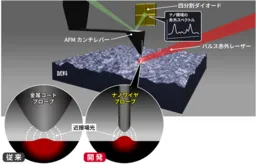
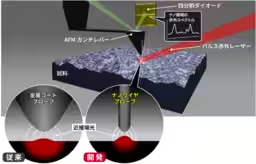
In a significant technological advancement, researchers from the National Institute of Advanced Industrial Science and Technology (AIST) and Hokkaido University's Institute of Electrical Engineering have developed an innovative nanowire probe, known as the Nanowire Probe. This device enhances both the spatial resolution and detection sensitivity of Atomic Force Microscopy-Infrared Spectroscopy (AFM-IR), setting a new global standard in nanoscale chemical structure analysis.
The Need for Advanced Nanoscale Analysis
The performance of materials and devices is increasingly determined not only by their average structural characteristics but also by localized chemical structures at the nanoscale. Effective material development relies on visualizing these minute arrangements. Although infrared spectroscopy (IR) is widely employed for structural analysis, traditional methods suffer from limited spatial resolution, typically in the range of micrometers. Consequently, a substantial gap existed in analyzing nano-scaled materials and their intricate characteristics.
To bridge this gap, AFM-IR—a novel technique combining AFM with infrared laser methodologies—has garnered increasing attention. This technique theoretically offers over 100 times the spatial resolution compared to conventional methods. However, until now, commercial AFM-IR probes have been constrained by their design, unable to achieve a probe tip diameter smaller than approximately 50 nm, which restricts their effectiveness in examining finer nanoscale components.
Design and Development of the Nanowire Probe
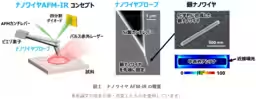
The recently unveiled Nanowire Probe transforms standard AFM-IR capabilities. By innovatively attaching chemically synthesized metallic nanowires to the tip of the proximity probe, researchers significantly enhanced both the sensitivity and spatial resolution. Testing has confirmed that the probe can analyze chemical structures at resolutions surpassing 10 nm while maintaining sensitivity levels comparable to traditional probes.
This breakthrough began with recognizing that conventional probes, coated with thin metallic layers, had insurmountable design limitations affecting their performance. The implementation of an ultra-thin nanowire offers a sturdy, flexible approach while fostering significant near-field interaction capabilities. Additionally, the elimination of traditional coatings resolves issues regarding probe stability and performance degradation, ensuring uninterrupted operation at nanoscale dimensions.
Performance Validation Through Real-World Application
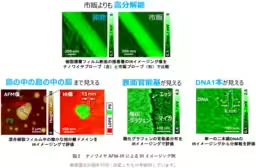
To validate the capabilities of the Nanowire Probe, a variety of materials were tested, showcasing its robust analytical performance. For example, researchers successfully obtained detailed measurements of layered adhesive films, observing a distinct delineation along boundaries achievable only through the enhanced spatial resolution of the nanowire probe, as contrasted with standard commercial probes that displayed blurred outlining of structures.
The probe was similarly utilized to study phase-separated films, achieving stable measurements in polymer blends like polystyrene (PS) and low-density polyethylene (LDPE). The breakdown of structural elements within each polymer provided vital insights, revealing PS domains of about 100 nm, accompanied by smaller 15 nm LDPE domains. Such precision demonstrates the nanowire probe's ability to effectively capture intricate structures within softer materials.
Additional applications have included the examination of nanosized graphenes and DNA molecules, whereby the unique functions of sub-nanometer-level resolution have emerged. High-resolution imaging confirmed significant chemical signals coming from functionalized edges of graphene, denoting effective chemical characterization that previously eluded existing methodologies.
Future Prospects and Implementation
The implications of the Nanowire Probe for sectors such as functional materials, semiconductors, and life sciences are profound. Not only does it provide the groundwork for the detailed chemical structure analysis necessary for ongoing advancements in these fields, but it also sets new standards for industrial application. In recognition of its potential, researchers plan to amplify its accessibility by advancing mass production techniques and facilitating its integration into various industrial challenges.
As this technology matures, AIST aims to contribute to Japan's industrial competitiveness while progressing research to further enhance the usability of the Nanowire Probe across diverse materials and scientific investigations. This revelatory study was documented and presented in the Proceedings of the National Academy of Sciences (PNAS), marking a pivotal moment in nanoscale analytical capabilities.
Conclusion
With the introduction of the Nanowire Probe, AIST and Hokkaido University are heralding a new era in nanoscale chemical analysis. By pushing the limits of spatial resolution and sensitivity within the AFM-IR realm, they are not only enhancing our understanding of material science at the nanoscale but are also setting the stage for future discoveries that could transform industries reliant on precise material characterization.
Topics Consumer Technology)

【About Using Articles】
You can freely use the title and article content by linking to the page where the article is posted.
※ Images cannot be used.
【About Links】
Links are free to use.