




株式会社HONU Aims for Zero Discomfort in Crowded Trains
Introduction
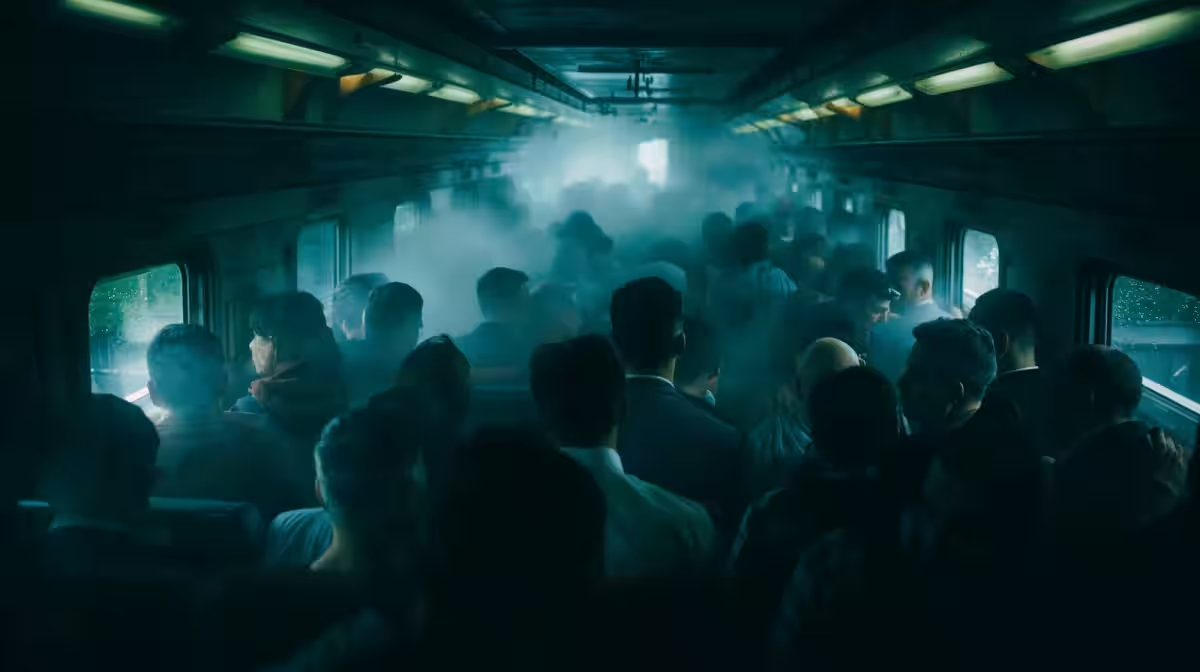
HONU Corporation, a pioneering company based in Tokyo, has set its sights on creating a train environment that aims for zero discomfort during rush hours. As part of the April Dream initiative, HONU is advocating for innovative solutions to address the challenges of crowded trains, particularly in the Tokyo metropolitan area.
The Current Situation
According to recent data, the average congestion rate on Tokyo's Yamanote Line has reached around 139% for the 2024 fiscal year. Although this represents a decline from rates exceeding 160% in previous years, it still creates extremely crowded conditions during peak hours, particularly on certain stretches of the route.
Understanding Congestion Rates
The following outlines the practical implications of various congestion rates inside train cars:
- - 100%: Full capacity, passengers either seated or holding onto poles.
- - 139%: Current average, passengers' shoulders touch, but newspapers can be read.
- - 150%: Shoulders brush against each other, considerable tightness near the doors.
- - 180%: Passengers can read folded newspapers, but there's significant bodily contact and pressure on personal space.
This level of congestion is particularly notorious during the rainy season, adding to the discomfort.
Humidity Control Measures by Rail Companies
In light of the discomfort caused by high humidity and overcrowding, rail companies have implemented various measures to manage humidity in trains. These include:
1. Automated Dehumidification via Air Conditioning Systems
- Modern trains are equipped with sensors that detect not only temperature but also humidity levels.
- Automatic Dehumidification Mode: The system automatically switches to dehumidification mode if the humidity exceeds a certain threshold, even when the set temperature is reached.
- Congestion Detection: Using load sensors to gauge passenger volume, the air conditioning system can adjust cooling and dehumidification based on the level of congestion, ensuring optimum comfort.
- Manual Adjustments by Train Conductors: Conductors monitor train conditions and can make manual adjustments based on real-time observations.
2. Forced Ventilation Systems
- The air conditioning units located on train roofs not only cool or heat the air but also play a critical role in ventilation.
- Fresh Air Intake: The system continuously brings in outside air, replacing the humid air inside the cars. Design calculations suggest that air within the train can be exchanged roughly every 5 to 7 minutes during commuter hours.
Innovative Suggestions from HONU
Hoping to enhance the in-train environment further, HONU proposes several innovative solutions:
- - Natural Materials: Incorporating materials such as plaster and diatomaceous earth in the train interiors to naturally regulate air quality (using non-combustible materials).
- - Catalytic Coatings: Applying high-efficiency deodorizing catalysts (Pt) on train interiors.
- - Automated Climate Control: Equipping the train with sensors linked to discomfort indices to automate climate control systems.
Company Overview
- - Company Name: HONU Corporation
- - CEO: Kenichi Uchida
- - Location: 9-1-7 Akasaka, Minato-ku, Tokyo 107-0052, Japan
- - Established: March 2008
- - Business Focus: Non-smoking solutions for lodging facilities; infection control measures for medical institutions.
- - Capital: 10 million JPY
- - Website: HONU Corporation
In conclusion, through its commitment to innovation and comfort, HONU Corporation is actively striving to redefine the commuter experience on Tokyo's crowded trains and is pursuing a vision of zero discomfort travel.


Topics Other)
【About Using Articles】
You can freely use the title and article content by linking to the page where the article is posted.
※ Images cannot be used.
【About Links】
Links are free to use.