




Cross Marketing and Meiji University's Professor Kato Joint Research on Consumer Attitude and Response Speed
Introduction
In a collaborative effort, Cross Marketing Co., Ltd. and Associate Professor Takumi Kato from Meiji University have conducted an insightful study to investigate the relationship between consumers' attitudes towards brands and their response speeds. Utilizing Cross Marketing's innovative service, “latent research”, the study aimed to determine whether those who answer questions about purchase intentions more quickly are indeed more likely to make a purchase. The results of this research were published in the International Journal of Japan Association for Management Systems.
Research Focus
This study targets a critical issue in marketing research known as “cognitive dissonance”, where individuals express a favorable purchase intention but fail to follow through with such purchases. Understanding the psychological mechanisms underlying consumers' decision-making processes is essential to improving survey accuracy. According to the dual-process theory, human decision-making can be classified into two distinct systems: System 1, which is fast and intuitive, and System 2, which is slow and analytical. In contexts such as food or cafes, where preferences tend to be stable and purchasing behavior is habitual, consumers often make decisions swiftly and subconsciously. Conversely, for high-investment items like cars or homes, consumers often engage in thorough information processing, leading to more deliberate decision-making.
Methodology and Findings
This research specifically examined everyday food items, focusing on green tea and cafes to assess whether faster response times in purchase intention inquiries correlate with actual purchasing behavior. By analyzing response speeds and incorporation of the proprietary “latent research” service, the study aimed to classify attitudes before and actions afterward.
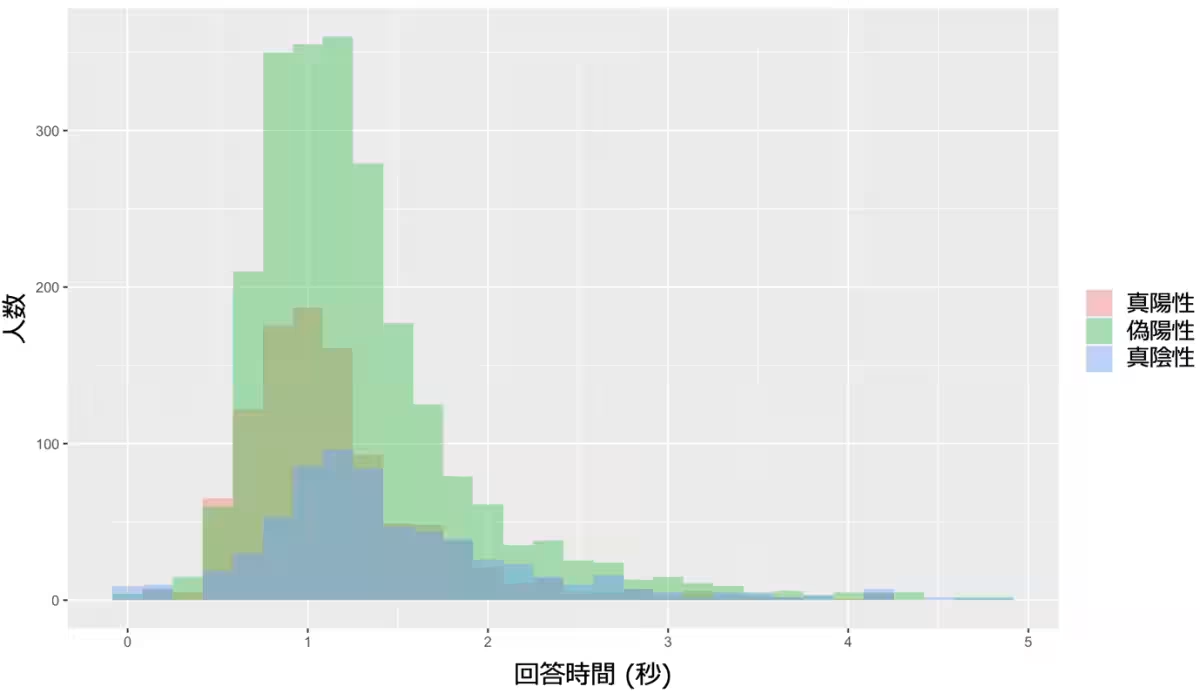
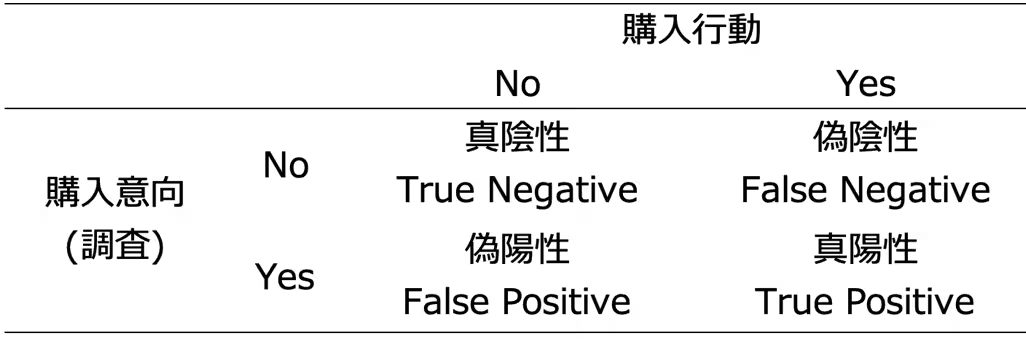
The findings substantiated that individuals who expressed a purchase intention in the survey and subsequently made a purchase (true positive) responded more swiftly than those who did not, either expressing a purchase intention but failing to act (false positive) or indicating no intention and also not purchasing (false negative). This indicates a potential usage of response time data as a threshold to discern the authenticity of purchase intentions.
Visual Results
Table 1: Correspondence between Survey Purchase Intention and Actual Purchase Behavior
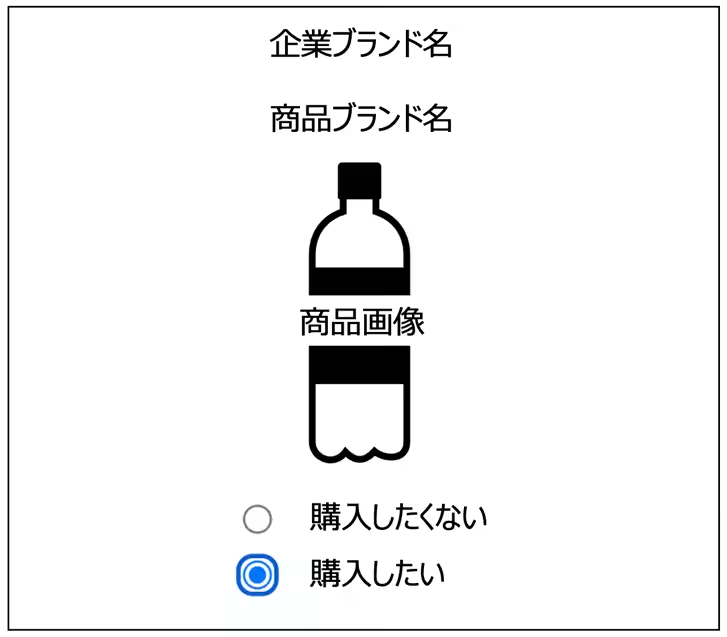
Figure 1: Survey Screen
Figure 2: Distribution of Response Times in Purchase Intentions Across Groups
Source: Kato, T., Minegishi, S., Kobayashi, R., Umeyama, T. (2025). Relationship between purchase intention response speed and purchase behavior. International Journal of Japan Association for Management Systems, 17(1), 41-46. https://doi.org/10.14790/ijams.17.1_41
Importance of Latent Research
As lifestyles evolve and consumers' consciousness shifts, companies are consistently seeking insights into consumer behavior through surveys and interviews. However, traditional survey methods often rely on conscious responses, making it challenging to tap into consumers' latent awareness or instantaneous feelings. To address this, Cross Marketing offers “latent research”, which measures reaction speed to images or texts displayed on smartphones or PCs to gauge intuitive responses.
For example, respondents can select either “√” or “×” when presented with an image after seeing the word “like.” This technique, known as “response latency,” provides insights into decision-making by capturing the noise associated with previously unconscious thoughts and feelings.
This innovative approach allows for the extraction of underlying preferences, helping understand which attributes influence purchasing decisions, thus facilitating product concept development, package evaluation, and brand image differentiation.
Future Directions
Moving forward, Cross Marketing remains committed to partnering with clients by incorporating various methodologies to provide tailored marketing research and solutions that meet evolving needs.
Company Overview
Company Name: Cross Marketing Co., Ltd.
Website: Cross Marketing
Location: 3-20-2 Nishi-Shinjuku, Shinjuku-ku, Tokyo Opera City Tower 24F, Tokyo, Japan
Founded: April 1, 2003
CEO: Mikihiro Igarashi
Business Activities: Marketing research services, consultation in marketing research.

Topics Consumer Products & Retail)
【About Using Articles】
You can freely use the title and article content by linking to the page where the article is posted.
※ Images cannot be used.
【About Links】
Links are free to use.