



Development of an Innovative High-Pressure SPS System for Material Synthesis
Unveiling a Revolutionary High-Pressure SPS Device
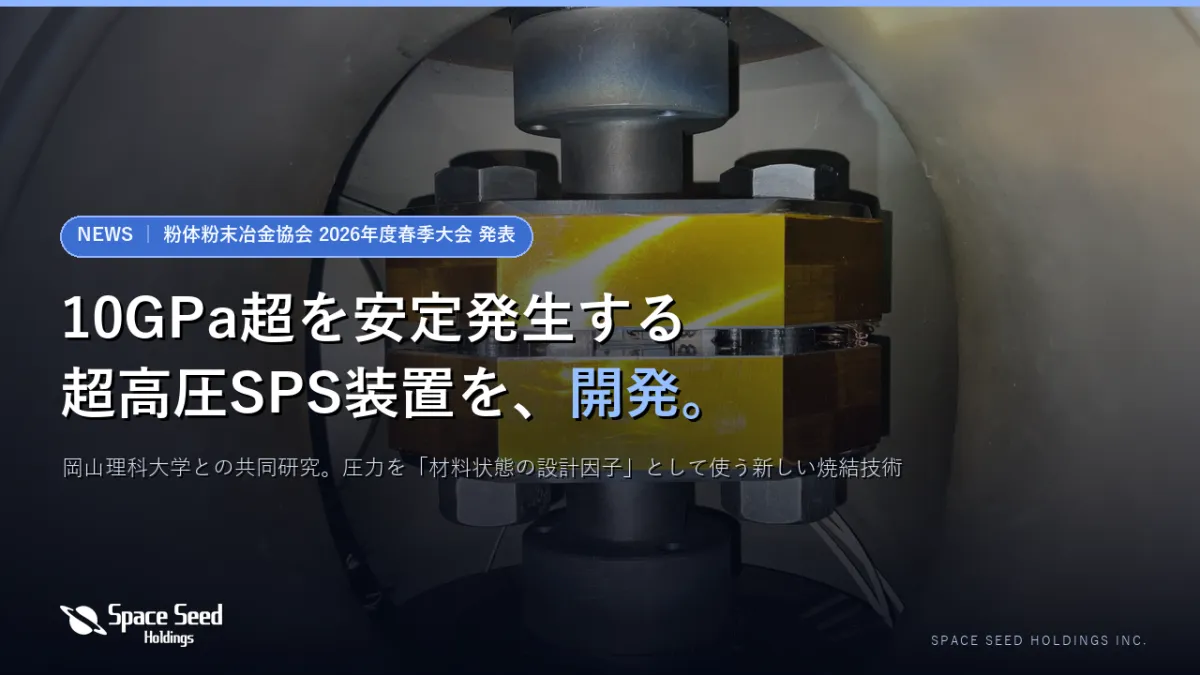
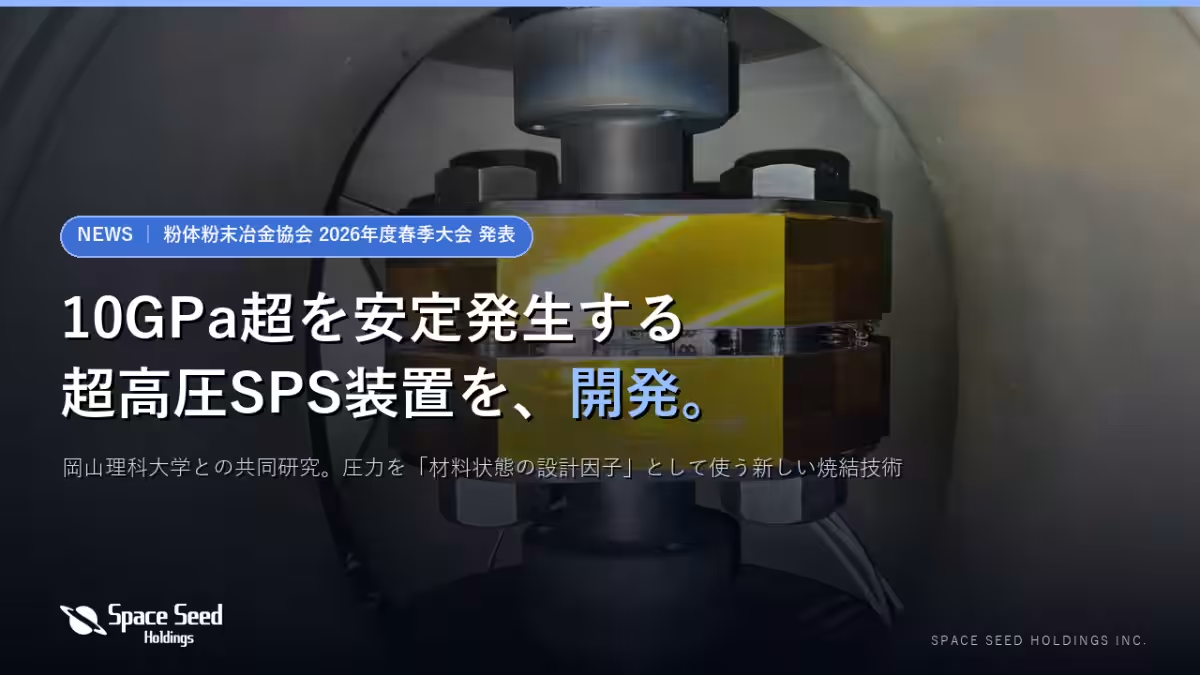
Space Seed Holdings Inc., located in Tokyo, in collaboration with Professor Yoshihisa Mori from Okayama University, has made a groundbreaking advancement in material synthesis. They have developed a new discharge plasma sintering (SPS) device capable of generating stable ultra-high pressures exceeding 10 GPa. The results will be presented at the Powder Metallurgy Association's 2026 Spring Conference, scheduled for late May 2026 in Osaka.
Overcoming Traditional Challenges
The newly developed SPS device addresses two significant challenges that have long plagued traditional ultra-high-pressure methods: the sample sizes are often extremely small, and the pressure and temperature distributions within the chamber are uneven. This innovative device is capable of sintering samples at the millimeter scale uniformly under consistent pressure, demonstrating a remarkable advancement in the field.
Presentation Overview
- - Title (Japanese): クランプ式高圧発生装置を組み合わせた超高圧SPS装置の開発
- - Title (English): Development of an Ultra-High-Pressure SPS System Incorporating a Clamp-Type High-Pressure Generator
- - Presenters: Professor Yoshihisa Mori¹, Hiroshi Kameyama¹, Kengo Suzuki² (1. Okayama University / 2. Space Seed Holdings)
- - Event: Powder Metallurgy Association 2026 Spring Conference, Osaka, Lecture No. 3-9A
Addressing the Limitations of Traditional SPS
Discharge plasma sintering (SPS) is a method that applies uniaxial pressure to powders while delivering pulse electricity, allowing for rapid sintering and densification at low temperatures. While conventional SPS systems typically operate at pressures between tens to hundreds of MPa, the research group has previously developed a high-pressure cell combining a piston cylinder capable of ultra-high pressures. They reported that increasing pressure notably lowers the glass transition temperature of SiO₂, highlighting the significance of pressure as a determinant not only of densification but also of the material's state.
Traditional piston cylinders, however, have an inherent limitation: the sample sizes are often submillimeter, leading to a significant disparity in pressure and temperature distributions within the cell. This discrepancy makes it challenging to quantitatively assess what occurs at specific pressures and temperatures since the higher the pressure, the more difficult it becomes to interpret the results.
Achieving Uniformity Through Innovation
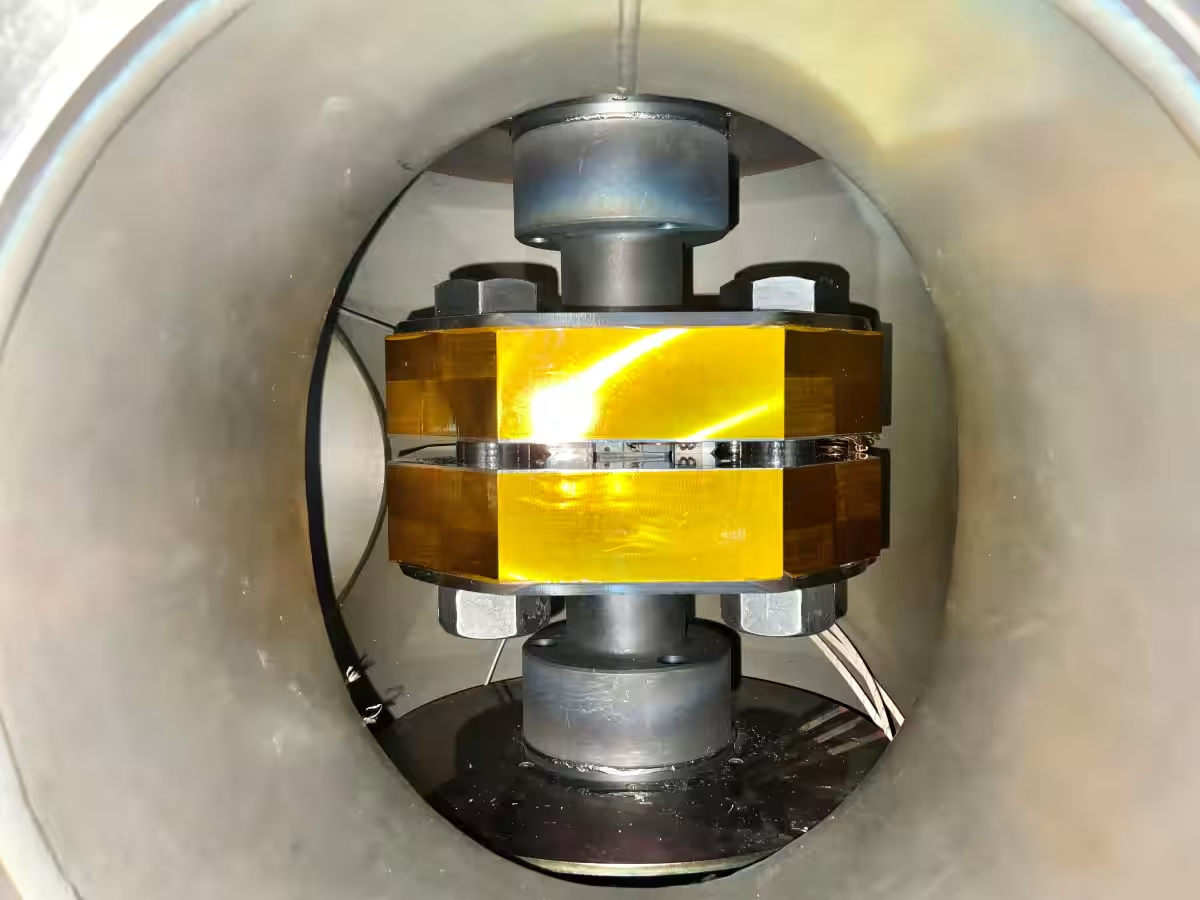
To overcome these issues, the research group built upon the successful palm cubic high-pressure generation system, which has a history of reliably measuring material properties across a range of pressures. They developed a novel clamp-type high-pressure generator, integrating a multi-anvil press with six anvils that exert isotropic pressure on the sample. This setup minimizes pressure distribution discrepancies and allows for a significantly larger sample volume compared to uniaxial piston-cylinder systems.
In this enhanced SPS chamber, pressures exceeding 10 GPa are achieved, well above those generated by single-axis systems. Pressure calibration was performed by referencing the electrical resistance change of bismuth (Bi) during phase transitions, enabling precise pressure estimations during testing.
Innovations in Heating Mechanisms
The addition of an insulating layer to the device allows for localized heating, achieving temperatures up to approximately 1273K with about 100A of electricity. During experiments at 70A, high temperatures were effectively confined near the sample, preventing the main body of the device from overheating. This innovative thermal management ensures accurate and repeatable results.
Experimental Validation and Applications
As part of the validation experiments, SiO₂ powder was subjected to SPS sintering, yielding samples of about 2mm in diameter and 1mm in height—substantially larger than those obtained via conventional piston cylinders. The transformation of the powder into a transparent glass was confirmed at a torque of 75N·m and a temperature of 873K, showcasing the device's efficacy in producing materials under low-temperature conditions comparable to previous high-pressure methods.
Future Prospects
The capacity to maintain uniform ultra-high pressure in conjunction with precise temperature control using accessible millimeter-scale samples marks a significant leap forward for quantitative evaluations of material synthesis conditions. This advancement promises applications in synthesizing new materials at lower temperatures, controlling non-equilibrium states, and exploring high-pressure composite materials such as diamond and cubic boron nitride (c-BN).
By providing a reliable way to manage pressure as a functional design variable, the research group aims to transform materials design from an uncertain process to a controlled, predictive science.
Looking forward, the team intends to enhance the accuracy of pressure identification in heated states and maintains a focus on ongoing collaboration with Professor Mori for accumulating synthesis data and developing further applications, including for space exploration programs through their "SPACE LAB." initiative.
Kengo Suzuki, the CEO of Space Seed Holdings, commented on their aspirations for future technologies: "Pressure is not just a force to compress materials; we envision it as a pen that rewrites the blueprint of material states. Our recent development enables us to produce millimeter-sized samples under uniform pressures, marking a significant step toward designing materials with foresight. Our long-term goal is to equip humanity with the technologies essential for living in space by 2040, capturing new material synthesis technology that is both energy-efficient and resource-optimized. We are confident that this device could become a foundational technology for our vision of the future."
Company Information
- - Name: Space Seed Holdings Inc.
- - Headquarters: 2-15, Hamamatsucho 2-chome, Minato-ku, Tokyo
- - CEO: Kengo Suzuki
- - Established: January 2024
- - Website: Space Seed Holdings
Topics Other)
【About Using Articles】
You can freely use the title and article content by linking to the page where the article is posted.
※ Images cannot be used.
【About Links】
Links are free to use.