




The Paradox of Evolution in Beetles: Implications for Parkinson's Disease Research
The Paradox of Evolution in Beetles: Implications for Parkinson's Disease Research
In a thought-provoking study conducted collaboratively by Okayama University, Tokyo University of Information Sciences, Tokyo University of Agriculture, and Tamagawa University, researchers have explored the implications of a unique behavioral phenomenon known as tonic immobility in beetles. This work, published in Scientific Reports, delves into how the behavioral traits of certain beetle species can potentially shed light on the mechanisms underlying Parkinson's disease in humans.
Decoding Parkinson’s Disease through Beetle Behavior
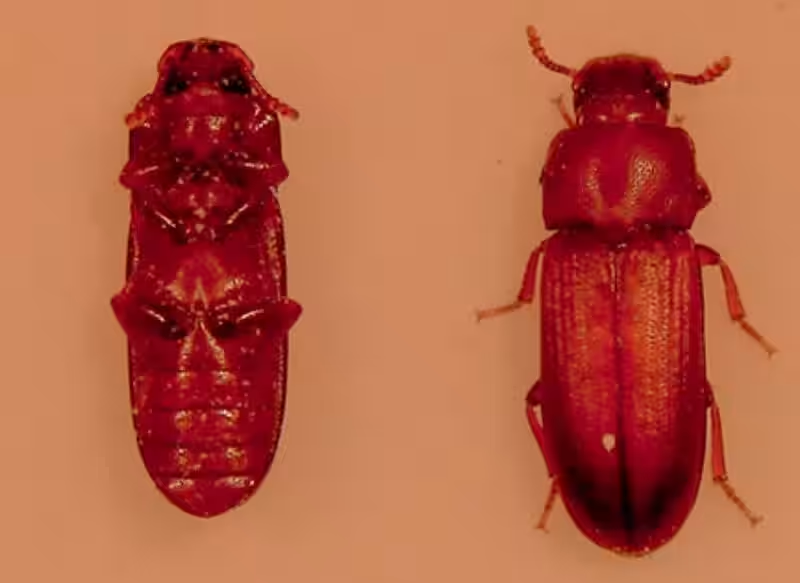
Parkinson's disease is a progressive neurodegenerative disorder characterized by motor dysfunction due to the deterioration of dopamine-producing neurons in the brain. Currently, there is no definitive cure for this debilitating condition. However, recent advancements in research might pave the way for new therapeutic avenues. In this context, the study investigates the genetic and physiological characteristics of the red flour beetle (Tribolium castaneum), a species known for its ability to remain motionless for extended periods—essentially playing dead as a survival strategy.
Professor Takahisa Miyatake, of Okayama University’s Graduate School of Environmental and Life Science, alongside other experts in the field, engineered a strain of beetles demonstrating elongated tonic immobility. This unique model allows researchers to analyze parallel findings with Parkinson’s disease, particularly focusing on dopamine levels in the brain, abnormal movement patterns, and genetic expression related to dopamine synthesis and tyrosine metabolism.
Key Findings from the Research
The study observed that beetle strains exhibiting prolonged immobility also experienced reduced dopamine levels, a similarity that mirrors the conditions found in patients with Parkinson’s disease. Through a comparative analysis of DNA sequences related to dopamine pathways in humans, the researchers unearthed numerous mutations present in the beetle lineages, suggesting a molecular basis that links behavioral evolution with neurodegenerative diseases.
These results indicate that the simplistic yet intricate model provided by beetles could significantly enhance our understanding of Parkinson's disease mechanisms, leading to the potential development of innovative treatment strategies. Insights drawn from such basic biological studies highlight the intricacies of how behavior can inform us about severe human ailments.
Evolutionary Significance in Research
Professor Miyatake emphasized the journey of this research, which dates back to 1997, exploring the perplexing phenomenon of tonic immobility. Observations noted that beetle strains with a propensity for long periods of immobility exhibited fewer movements, a condition attributed to dopamine depletion. The research progressed, unveiling a fascinating connection between this “useless” behavior and a human disorder.
The implications of understanding tonic immobility not only contribute to the biological discourse surrounding invertebrate adaptability but also signify an essential bridge connecting fundamental research with practical medical applications. The evolutionary cost of such a behavior demonstrates how adaptations can unravel unforeseen benefits for human health insights.
The research was supported by Grants-in-Aid for Scientific Research B and C and showcased at the international conference of biomedical science during April 2026.
Looking Ahead
As the discourse around neurodegenerative diseases continues to evolve, models like the Tribolium castaneum may play a crucial role in deciphering complex pathophysiological mechanisms. This research points toward a future where studying simple organisms can provide profound insights into human health, finally blurring the lines between basic science and clinical application.
For more in-depth details surrounding the research, please refer to the official publication available at Scientific Reports.
Conclusion
Ultimately, this research marks a significant milestone in both entomology and medical science, reaffirming that even the simplest behaviors in nature can hold the key to unlocking the mysteries of complex human conditions like Parkinson’s disease.







Topics Health)
【About Using Articles】
You can freely use the title and article content by linking to the page where the article is posted.
※ Images cannot be used.
【About Links】
Links are free to use.