




Okayama University Tackles Climate Change with Cellulose Nanofiber to Enhance Soil Water Retention
Okayama University Tackles Climate Change
As the threat of climate change looms large, vulnerable regions worldwide are bracing for the consequences of decreasing water supplies—particularly in Southeast Asia, where the lack of irrigation water could cripple the region's agricultural productivity.
In a pioneering study, researchers at Okayama University have discovered that cellulose nanofibers (CNF), sourced from plants, can be a game-changer for soil water retention during such critical drought periods. This remarkable material can store a significant amount of water that is available to plants, thereby aiding their germination and growth even in less favorable conditions.
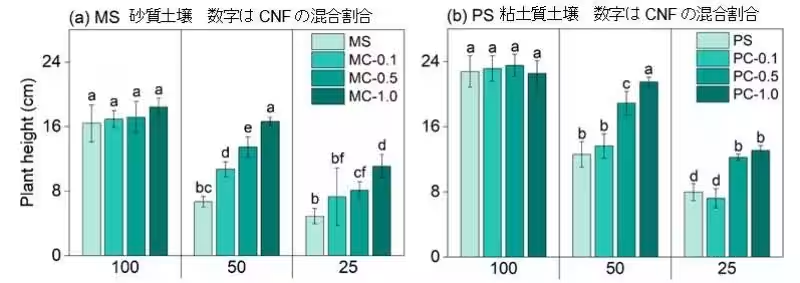
By applying just 1% of cellulose nanofibers to soil, the findings suggest that farmers could sustain plant growth on par with traditional irrigation methods, even if water usage decreases by as much as 50%. The potential benefits of this innovative approach reflect a promising solution for dealing with future water scarcity.
Overview of Findings
Professor Yasushi Mori from the Graduate School of Environmental and Life Science at Okayama University, along with doctoral candidate Ngo Thuy An, has spearheaded research indicating that the addition of cellulose nanofibers significantly enhances soil's ability to retain water. Their work highlights the importance of the moisture that is accessible to plants, revealing that minimal CNF application can lead to improved germination rates, increased amounts of available water, and enhanced plant growth equivalent to fully irrigated conditions.
These significant results are scheduled to be published in the top-tier international journals, “Environmental Technology & Innovation” in August 2024 and “Catena” in June 2025. The foremost paper has already garnered attention, as it falls within the top 5% of cited articles, indicating its international significance and interest.
The severe impacts of climate change—manifesting in the form of extreme rainfall and droughts—affect diverse regions across the globe. The advancements made in improving soil environments using natural materials like cellulose nanofibers stand to be a monumental leap forward in the 21st century, potentially transforming food production methodologies worldwide.
Insights from the Researchers
Professor Mori expressed his astonishment at how their research has expanded and underscored the importance of focusing on the water available for plant utilization.








Topics Consumer Technology)
【About Using Articles】
You can freely use the title and article content by linking to the page where the article is posted.
※ Images cannot be used.
【About Links】
Links are free to use.