


Development of Chiral Nanohoops with High Circularly Polarized Luminescence Using Gold Complexes
Introduction
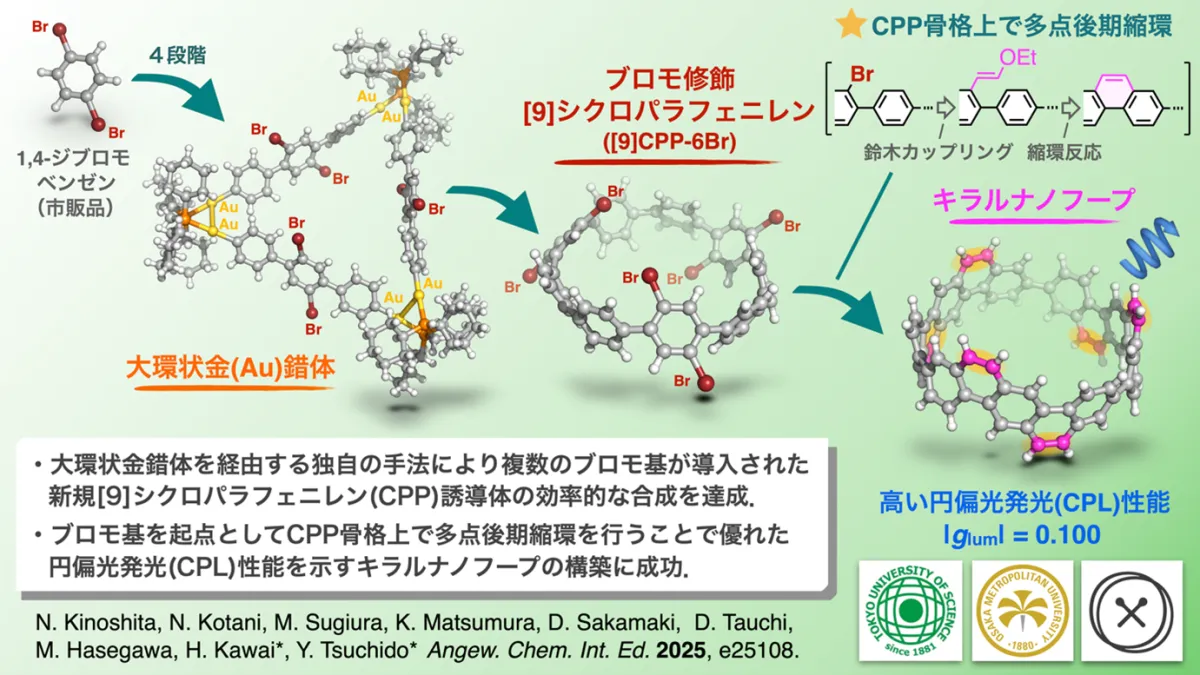
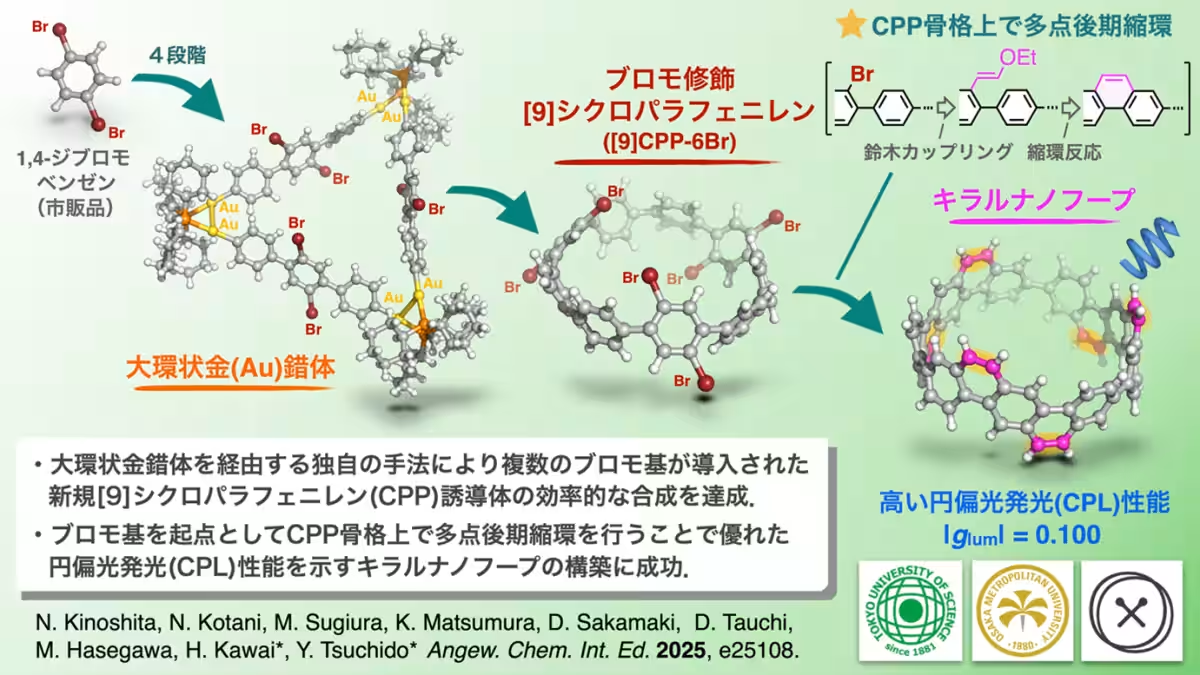
The Tokyo University of Science has achieved a significant breakthrough in material science with the successful synthesis of a new chiral nanohoop, demonstrating exceptional circularly polarized luminescence (CPL) properties. This innovation emerged from a unique strategy involving the precise placement of six bromine atoms in a cycloparaphenylene derivative called [9]CPP-6Br. This work is part of a collaborative research effort with Osaka Metropolitan University and Kitasato University.
Research Highlights
The research group, led by Naoya Kinoshita and Nanami Kotani, utilized a proprietary method known as the "macrocyclic gold complex method" to efficiently synthesize [9]CPP-6Br. This compound serves as a pivotal platform allowing for late-stage modifications essential for creating chiral nanohoops. The synthesized nanohoops are comparable to rare earth-containing organometallic compounds in terms of their CPL performance, providing a new direction for organic chiral optical materials.
Research Overview
Cycloparaphenylene (CPP) is characterized by its unique circular π-conjugated structure, where benzene rings are interconnected in a cyclic manner. This configuration grants CPP diverse electronic and optical properties, which can drastically change depending on the size of the ring or substituents introduced. The incorporation of chiral structures enables precise control over chirality-related optical characteristics, like CPL.
The primary challenge in the field has been the complexity associated with synthesizing these structures, particularly the need for selective functionalization at multiple sites. The research team advanced existing methods by successfully placing bromine atoms, which serve as reaction points for subsequent coupling reactions, onto the CPP framework. This allows for enhanced π-extension, leading to robust CPL.
Synthesis of [9]CPP-6Br
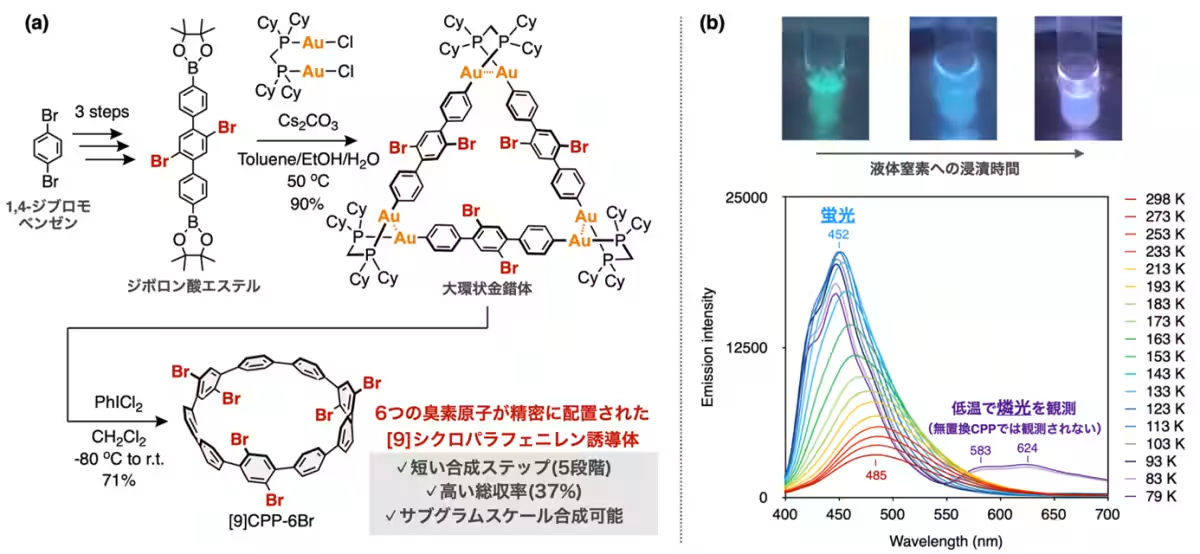
In this study, [9]CPP-6Br was synthesized through a five-step reaction involving commercially available 1,4-dibromobenzene, yielding a total efficiency of 37% at sub-gram scale. Interestingly, [9]CPP-6Br exhibits very little fluorescence at room temperature, which is a stark contrast to the strong fluorescence observed in typical CPP structures. This reduced fluorescence is attributed to the heavy atom effect due to the bromine substituents, promoting intramolecular transition processes.
Upon cooling the compound to liquid nitrogen temperatures and exposing it to UV light, distinct phosphorescent emissions were observed, indicating the material's potential for unique photonic applications.
Evaluation and Outcomes
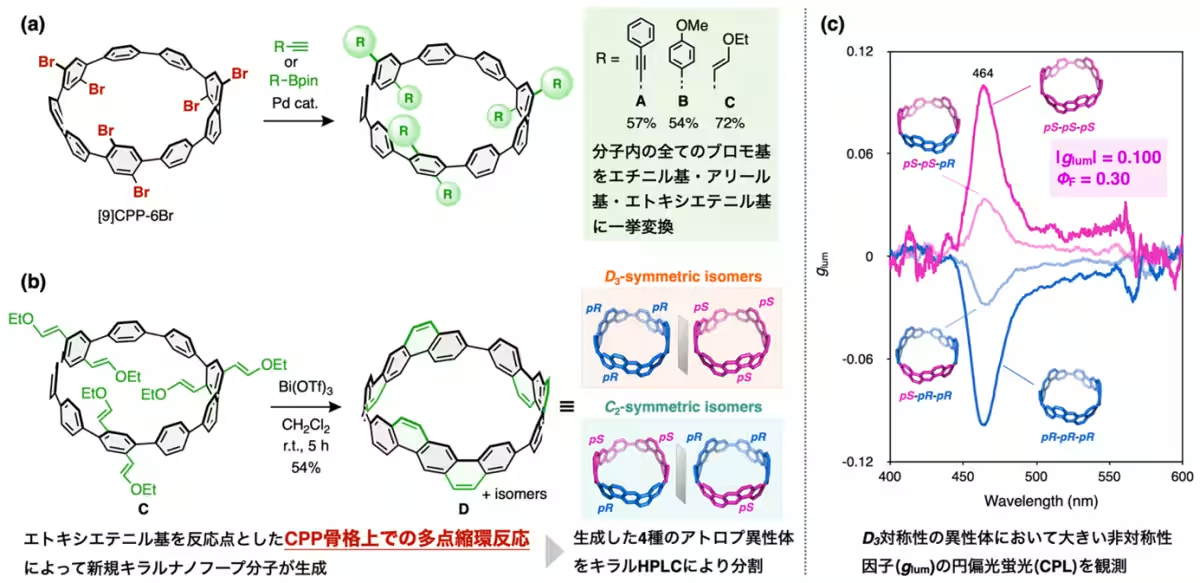
Evaluating the performance of [9]CPP-6Br as a platform for late-stage modifications, the team conducted palladium-catalyzed cross-coupling reactions. These reactions exhibited high efficiency, transforming all bromine substituents into various functional groups, showcasing the compound's potential for multiple-site functionalization.
Following these modifications, a novel chiral nanohoop was constructed featuring multiple condensed benzene units in a chair-like structure, supported by the precision of the synthetic strategy. The optical properties of these new compounds were subsequently evaluated using chiral HPLC, confirming notable CPL characteristics.
Implications of the Research
This research is paramount, as it establishes a versatile and efficient method for synthesizing complex chiral nanostructures. The financial backing from various scientific funds and collaboration between prestigious institutions underscores its importance. The potential applications of these high-performance chiral nanohoops in next-generation displays, holography, and optical encryption are unprecedented.
In summary, the groundbreaking findings from this study not only highlight innovative advancements in chemical synthesis but also pave the way for future developments in nanocarbon science, optical materials, and chiral technologies. The ability to finely tune molecular properties positions these compounds as vital players in various high-tech applications.
Topics Consumer Technology)


【About Using Articles】
You can freely use the title and article content by linking to the page where the article is posted.
※ Images cannot be used.
【About Links】
Links are free to use.