




Innovative Real-Time Turbulence Prediction Project Enhances Aviation Safety
Introduction
In a groundbreaking initiative, Japan Airlines, Tohoku University, Weathernews, and DoerResearch have collaborated on the "Real-Time Turbulence Prediction Project," which has recently gained approval from Japan's Ministry of Land, Infrastructure, Transport and Tourism. This project, set to commence in December 2024, aims to enhance aviation safety and reduce environmental impacts, with a target for societal implementation post-2027.
Understanding the Turbulence Challenge
Turbulence, particularly Clear Air Turbulence (CAT), poses a significant risk to aircraft. CAT occurs at high altitudes in clear skies and is characterized by sudden changes in wind speed and direction, making it nearly impossible to detect visually or with radar. Alarmingly, approximately 55% of domestic aviation incidents in Japan are attributed to turbulence. Furthermore, the frequency of CAT events has risen by 55% over the last 40 years, likely due to climate change. This escalation underscores the urgent need to balance safety with efficient flight operations.
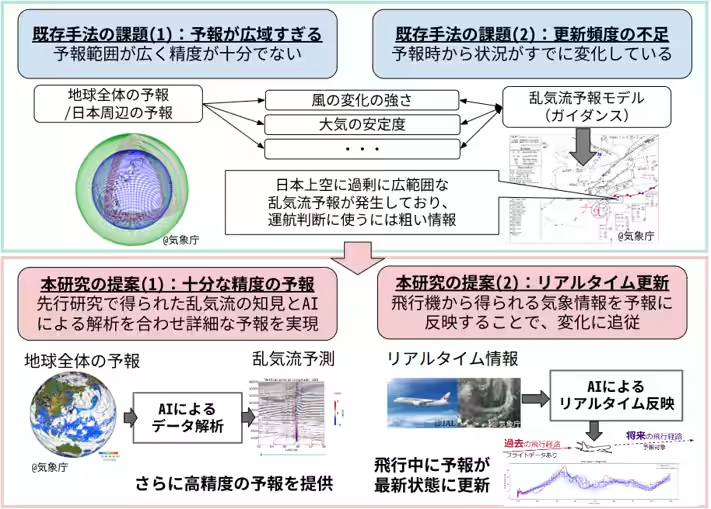
Current predictive systems fall short in updating frequently and adapting to swiftly changing atmospheric conditions. The Real-Time Turbulence Prediction Project aims to overcome these limitations by integrating global weather data with localized high-resolution analyses and real-time flight data collected from aircraft in operation.
Technological Innovations
The project is set to leverage machine learning technologies to create an AI-driven real-time turbulence prediction system. This system will allow for more accurate forecasting of atmospheric conditions over long durations, particularly beneficial for international flights that traverse varying weather patterns. Additionally, regions with infrequent flights, such as over oceans, will receive precise turbulence prediction data.
By improving the accuracy of turbulence forecasts and shortening lead times, the project aims to enhance safety standards while minimizing the need for altitude changes and excess fuel consumption. This not only promises cost savings on fuel but is also projected to significantly lower CO₂ emissions.
Roles of Participating Organizations
Each of the four partner organizations plays a crucial role in the project. Japan Airlines leads the initiative from the perspective of airline operations, while Tohoku University is tasked with scientific weather data analysis. DoerResearch focuses on developing predictive models, and Weathernews is responsible for establishing the service delivery framework. Together, these organizations will utilize their respective strengths to advance research and development towards practical application.
Future steps will involve refining the predictive capabilities and subsequently providing the latest information to the airlines and other stakeholders. By 2027, flight trials across various routes and aircraft types will be conducted to expand simulations of real-time updates, paving the way for successful social implementation.
Conclusion
The Real-Time Turbulence Prediction Project represents a significant leap forward in aviation safety and environmental stewardship. As the project unfolds, the collaborative efforts of Japan Airlines, Tohoku University, Weathernews, and DoerResearch will undoubtedly lead to innovations that make flying safer and more efficient for everyone.

Topics Consumer Technology)
【About Using Articles】
You can freely use the title and article content by linking to the page where the article is posted.
※ Images cannot be used.
【About Links】
Links are free to use.