



XELA Robotics Unveils Groundbreaking 2026 Technology Roadmap with Innovations in Tactile Sensors
XELA Robotics Achieves Integration Milestone and Promises Advanced Technology in 2026
In a recent announcement, XELA Robotics, a pioneering company based in Tokyo, showcased a significant technological milestone by successfully integrating its advanced uSkin® tactile sensors into the Tesollo DG-5F, a five-fingered humanoid robot hand capable of human-like grasping and manipulation. This integration will come into effect with commercial orders expected to begin in the second half of the first quarter of 2026. The tech-world eagerly anticipates this burgeoning development slated for presentation at CES 2026, which will be held from January 6 to January 9 in Las Vegas.
XELA's CEO, Alexander Schmitz, elaborated on the necessity for robotic systems to possess tactile capabilities akin to human sensations — an essential factor that has previously hindered total automation in numerous tasks. With the uSkin tactile technology, robots can detect contact, pressure, and motion with precision, boasting an extraordinarily sensitive weight threshold of just 0.1 grams. By endowing robots with 'human-like touch,' complex tasks are made both achievable and precise.
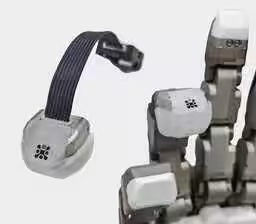
The integration into the Tesollo DG-5F was prompted by customer feedback, leading to the development of a solution that amplifies the capabilities of existing models. The tactile fingertip unit features 12 sensing points, a compact design (21.15mm in height, 25.72mm in width, and 22.02mm in length), integrated wiring, and a microcontroller. This unit offers human-like sensitivity while maintaining the original size of the robot hand, making it suitable for intuitive tool manipulations and intricate object handling across various applications, including research, industry, and service robotics.
This new tactile sensor system encapsulates not just the fingertips but also the areas around the joints and palms, including 'nail' functionalities for more refined object interactions. The Tesollo DG-5F, now equipped with these tactile sensors, offers a more enhanced interaction with objects, which can result in efficiencies across diverse sectors.
Moreover, the forthcoming smaller sensor points, expected to shrink from the traditional 4mm x 4mm to 2.5mm x 2.5mm, promise to enhance spatial density significantly. Thanks to the uSkin sensors, robots can ascertain the force exerted on objects as well as how those objects move within their grasp. The elastic and adaptive nature of the materials allows for customization according to specific needs, rendering it suitable for a variety of object geometries and robotic hands.
XELA Robotics currently caters to a wide range of rapidly growing fields in humanoid and industrial robotic hand markets, including manufacturing, logistics, agricultural, and warehousing sectors. Their hardware and software solutions have already been beneficial in delivering advanced tactile capabilities to clients within research institutions and various commercial realms. Indicatively, the resilient and cost-efficient uSkin sensors are engineered for seamless integration with parallel grippers, multi-finger adaptive grippers, custom end effectors, or existing robotic hands, substantially minimizing engineering effort, associated risks, and costs.
As anticipation builds for the CES 2026, XELA Robotics is set to showcase the uSkin sensor technology at the Las Vegas Convention Center, North Hall, Booth 8500. For those interested in attending meetings or demos, inquiries can be directed to [email protected]. As they boldly advance the realm of robotics with their tactile innovations, XELA Robotics stands at the forefront of revolutionizing our dynamic engagement with machine intelligence and automation.
Topics Consumer Technology)
【About Using Articles】
You can freely use the title and article content by linking to the page where the article is posted.
※ Images cannot be used.
【About Links】
Links are free to use.