



New Technology for Creating Polar Ionosphere Space Weather Maps Using AI
Bridging Science and Technology: Mapping the Polar Ionosphere's Electric Fields
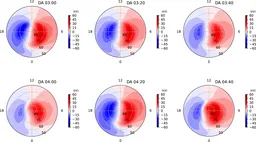
In a remarkable advancement in space weather forecasting, a team of researchers has successfully developed a new method that accurately reproduces the electric field distribution of the polar ionosphere. This innovative approach leverages a machine learning-based emulator named "SMRAI2.1" and integrates data from the international radar network, SuperDARN. The results of this study pave the way for creating more precise space weather maps that reflect the complex dynamics of the Earth's magnetosphere and ionosphere.
Understanding the Polar Ionosphere
The polar ionosphere, located at an altitude of approximately 100 to 1000 km above Earth, consists of a part of the atmosphere that is ionized and exists in a plasma state. In the high-latitude regions, the spatial distribution of electric fields is in constant flux. This variation in electric fields can influence orbital paths of satellites and ground infrastructures, making it vital to accurately monitor these changes for safe utilization of space environments.
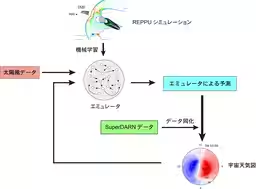
Traditionally, understanding the electric fields and associated currents in the ionosphere has required complex physical models. These models represent the physics of processes occurring in the magnetosphere. The research team previously developed an emulator that simulated outputs from a magnetosphere MHD (Magnetohydrodynamics) model, called "REPPU." However, capturing the fine temporal variations caused by complex physical processes remained a challenge.
The Breakthrough: Data Assimilation and Machine Learning
The collaborative research team comprised experts from various institutions, including the National Institute of Polar Research and the Okinawa Institute of Science and Technology, led by Professor Shinya Nakano. They utilized data assimilation techniques commonly used in weather forecasting to enhance their emulator—now known as "SMRAI2.1." This method allowed the integration of SuperDARN's ionospheric plasma velocity data to accurately reproduce electric field dynamics across the polar ionosphere.
The approach addresses the limitations of traditional numerical models by employing a machine-learning framework that resolves computational time issues typically associated with direct data assimilation. As a result, researchers can create a more accurate and dynamic representation of the polar ionosphere’s electric field distribution.
Enhanced Accuracy and Future Applications
With the new method, the researchers were able to demonstrate that actual electric field distributions fluctuate more dramatically than those produced by conventional MHD simulations. Furthermore, the technology enables the monitoring of ionospheric changes in areas where direct observation is not feasible.
The implications of this research extend far beyond the academic realm. By accurately representing the electric field distribution in the ionosphere, this new technology is expected to significantly improve space weather predictions, thereby enhancing the operational support for satellites and other critical societal systems. Additionally, it can deepen understanding of the space environment, paving the way for more effective applications in space exploration and communication technologies.
Institutional Contributions
The collaborative effort involved specific roles across various institutions: the National Institute of Polar Research was responsible for developing the emulator and managing SuperDARN data, while the National Institute of Information and Communications Technology contributed to the enhancement of the REPPU model and conducted real-time simulations. The integration of these diverse skills and knowledge highlights the interdisciplinary nature of this groundbreaking research.
Conclusion
The fusion of innovative machine learning techniques and observational data, as demonstrated in this study, heralds a new era in how we understand and predict space weather phenomena. By creating greater accuracy in modeling the polar ionosphere through advanced data assimilation, researchers are setting the stage for critical advancements in both scientific understanding and practical applications in the realm of space sciences and beyond.
Acknowledgements
This research was supported by various grants, including the Scientific Research Grant (A) and (B) from the Japan Society for the Promotion of Science, as well as funding from the Research Organization of Information and Systems.
Published in the journal "Space Weather", the findings demonstrate the potential of integrating cutting-edge technology with rigorous scientific methodology to enhance our understanding of the cosmos.
Topics Consumer Technology)
【About Using Articles】
You can freely use the title and article content by linking to the page where the article is posted.
※ Images cannot be used.
【About Links】
Links are free to use.