



Creating a New Standard: Quantum Communication Safety Measured by Photons
Introduction
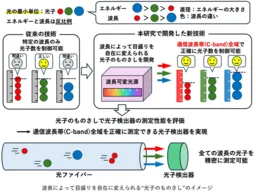
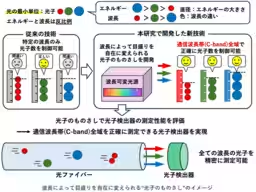
In a significant stride in the field of quantum technology, researchers from the National Institute of Advanced Industrial Science and Technology (AIST) have developed a novel wavelength-variable photon source that allows for accurate photon output control at a single-photon level across the entire C-band wavelength range (1530 nm to 1565 nm). This advancement is crucial for enhancing the safety of quantum cryptography communications and the reliability of optical quantum computers.
Key Developments
The new laser light source has been created to trace the number of photons output within national standards, thereby establishing a measurement metric known as a “photon ruler.” Through meticulous evaluation of how many photons emitted from this source are detected accurately by photon detectors, the research aims to address longstanding challenges in the field. High accuracy in measuring the detector efficiency across the entire C-band is essential for ensuring the integrity of quantum communications and computing.
The Role of Photons in Quantum Technology
Photons represent the smallest unit of light, classified as a fundamental particle. Their precise manipulation is expected to enable cutting-edge information communication technologies, including quantum communication and quantum computing. A crucial step in this process involves accurately detecting weak light signals that are common in photon communications. Previously, evaluating the efficiency of photon detectors across varying wavelengths across the C-band was an unresolved issue, primarily due to a lack of dependable wavelength-variable photon sources.
Innovations in Measurement
This innovative research focuses on establishing a wavelength-variable photon source that adheres to national standards, thus allowing for high-precision measurement of the performance of photon detectors. This means that the reliability of these detectors can now be assessed with the same level of precision as that found in national laser power standards. As a result, this breakthrough will significantly contribute to the advancement of secure quantum cryptography and precision in optical quantum computing.
Background and Motivation
Quantum technologies are poised to dramatically alter our daily lives and society at large. Applications that utilize photons are garnering significant attention in both research and industry. For instance, quantum cryptography, known for being theoretically secure against eavesdropping, leverages the unique properties of photons which cannot be subdivided further. To fully utilize these exceptional technologies, it is vital to possess a clear understanding of the quantity of photons conveyed from the source to the detector. However, the weakness of photons presents challenges in evaluating the performance of photon detectors. Until now, benchmarking for photon detectors in the C-band has only been performed at very limited wavelengths.
Research Journey
At AIST, ongoing developments in highly sensitive photon detection technologies have paved the way for new industrial applications in quantum information communication and high-sensitivity bioimaging. The current research emphasizes the critical need for precision metrology in quantifying photon numbers needed in quantum computing and cryptography.
This research initiative receives support from several governmental programs aimed at harnessing advanced quantum technologies for social challenges, including the Moonshot Research and Development Program and the Strategic Innovation Promotion Program.
Technical Aspects of the Photon Source
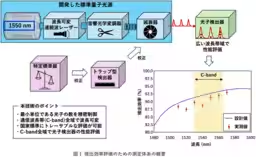
The cutting-edge research has successfully produced what is termed a “standard quantum light source.” This achievement stemmed from integrating a wavelength-tunable continuous-wave laser that can finely adjust wavelengths across the C-band. The stability of this laser makes it an ideal light source for generating signals. Further, acoustic optical modulators (AOM) are applied to convert continuous light into pulsed light, enabling both the precise timing required for experimental work and the measurement of photon energies utilizing attenuators. With calibrated trap detectors, the average photon count can be accurately defined, leading to the formation of a coherent state of photons ready for rigorous measurements.
Assessing Detector Performance
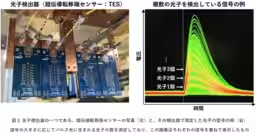
Employing this standard quantum light source, AIST evaluated the performance of their developed photon detectors (Transition Edge Sensors, or TES). The results demonstrated that photon detection efficiency assessments could successfully cover a full wavelength range from 1510 nm to 1570 nm within the C-band. The precision of these evaluations reached an impressive relative expanded uncertainty of less than 1.5% across various wavelengths, surpassing recent benchmarked standards from international metrology organizations.
Future Directions
The successful establishment of a quantum light source provides a solid foundation for rigorous evaluations of photon detector efficiencies throughout the C-band. This versatility is crucial as advancement in quantum cryptography communication and optical quantum computing continues to evolve. Future studies will focus on enabling broad wavelength detection, including currently untapped wavelengths to aid in the parallel processing capabilities necessary in quantum calculations.
Ultimately, this technology will play an essential role in facilitating the development of practical applications in the emerging quantum society. Continued collaboration combining quantum cryptography communications and optical quantum computing will accelerate the trajectory toward sustainable metrology technologies that support this new frontier.
Publication Details
This research was published online in the journal Optics and Laser Technology on July 25, 2025.
- - Title: Evaluation of Detection Efficiency of a Transition Edge Sensor at C-Band Wavelength
- - Authors: Takeshi Jodoi, Tetsuya Tsuruta, Mauro Rajteri, and Daiji Fukuda
- - DOI: 10.1016/j.optlastec.2025.113414
Topics Consumer Technology)
【About Using Articles】
You can freely use the title and article content by linking to the page where the article is posted.
※ Images cannot be used.
【About Links】
Links are free to use.