



Innovative Synthesis Method for Controlling Crystallinity in Nanoporous Materials
Breakthrough in Nanoporous Material Synthesis
Waseda University researchers have developed a revolutionary approach to synthesize nanoporous materials with controlled crystallinity. These materials, characterized by their nanoscale pores and single-crystal structure, are expected to play a significant role in various applications, particularly in energy conversion and catalytic processes that contribute to carbon neutrality.
Highlights of the Research
Unique Properties of Single-Crystalline Nanoporous Materials
Nanoporous materials composed of metal oxides with nanoscale pores are promising in fields ranging from catalysis to energy storage. Notably, single-crystalline nanoporous structures exhibit both the properties of traditional single crystals and the high surface area of nanoporous materials. These unique characteristics make them candidates for superior catalysts in various chemical reactions.
Development of a New Synthesis Method
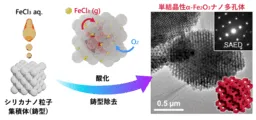
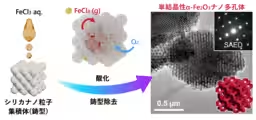
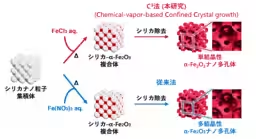
In this study, led by Takamichi Matsuno, the team focused on creating a new synthesis technique to overcome previous challenges in producing single-crystalline nanoporous metal oxides. By using a nanoporous template, they successfully diffused iron(III) chloride into the nanopores. The diffusion process allowed the precursor to react with oxygen, facilitating crystalline growth within the template. The resultant iron oxide nanoporous material demonstrated enhanced catalytic activity and thermal stability compared to traditional nanoporous structures composed of microcrystals.
Publication and Future Implications
This groundbreaking research was published online on June 30, 2025, in the journal „Chemistry of Materials.” The paper, titled "Quasi-Single-Crystalline Inverse Opal α-Fe2O3 Prepared via Diffusion and Oxidation of FeCl3 Precursor in Nanospaces," explores the synthesis of α-Fe2O3, revealing control over pore structure and crystal size, leading to improved properties for catalysis.
Existing Knowledge and Innovations
Previously, the synthesis of single-crystalline nanoporous materials was limited, primarily due to the complexity of synthesis methods. The introduction of iron oxide's crystallinity regulation via a novel template method marks a significant breakthrough. Utilizing silica nanoparticles as a mold, the researchers successfully generated nanoporous α-Fe2O3, providing insights into the correlation between crystallinity and functionality. Iron oxides are abundant and are utilized in various applications, including redox catalysts and electrode materials.
Achievements in Controlling Nanostructures
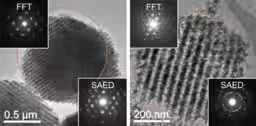
The researchers developed an effective method for controlling the structure and size of the crystallites within the nanoporous materials. Their approach has shown that the size and orientation of the crystallites are consistent, which contributes to better performance. This method allows continuous supply and diffusion of chlorides within the template, enabling the growth of well-defined crystalline structures.
Impacts on Research and Society
The findings indicate a significant development in the ease of synthesizing nanoporous materials with tailored properties. The potential applications of these materials span a wide array of industries, providing enhanced catalysts that can drive forward the pursuit of carbon neutrality. This innovation may lead to breakthroughs in energy-efficient technologies and sustainable materials.
Future Prospects
While the study has laid a solid foundation for synthesizing single-crystalline nanoporous materials, further research is necessary to evaluate the applicability of this method to other metal chlorides. The team plans to investigate various compositions to expand the utility of their technique, hoping to advance towards practical applications that facilitate energy conversion and catalysis.
Researcher's Commentary
Matsuno emphasizes the strong correlation between the composition, pore structure, and crystallinity of nanoporous materials. Increased freedom in the design of these materials will open up new applications and broaden the fields they can impact. This innovative synthesis method represents a pivotal technological advancement in designing functional materials.
Term Definitions
- - Nanoporous Materials: Materials characterized by nanometer-scale pores, offering high surface areas suitable for various applications, including catalysis and separation.
- - Crystallite Size: The size of single crystals within materials, critical for determining the properties and performance of nanoporous structures.
- - Gas-Phase Diffusion: A process whereby metal chlorides, when heated, remain stable in gas phase, allowing them to diffuse inside templates, contributing to crystal growth.
Paper Information
- - Journal: Chemistry of Materials
- - Title: Quasi-Single-Crystalline Inverse Opal α-Fe2O3 Prepared via Diffusion and Oxidation of FeCl3 Precursor in Nanospaces
- - Authors: Daichi Oka, Kohei Takaoka, Atsushi Shimojima, Takamichi Matsuno (Waseda University)
- - Publication Date: June 30, 2025, 8:00 AM (EST)
- - DOI: 10.1021/acs.chemmater.5c00155
Topics Consumer Technology)


【About Using Articles】
You can freely use the title and article content by linking to the page where the article is posted.
※ Images cannot be used.
【About Links】
Links are free to use.