



ABEJA and JR East Collaborate on Physical AI for Autonomous Delivery at Takanawa Gateway City
ABEJA and JR East: Advancing Autonomous Delivery with Physical AI
In an innovative partnership, ABEJA, a Tokyo-based technology company, is working with East Japan Railway Company (JR East) to revolutionize the logistics within the expansive Takanawa Gateway City project in Tokyo. This collaboration aims to implement autonomous delivery solutions powered by Physical AI, marking a significant step forward in urban automation and robotics.
Project Overview
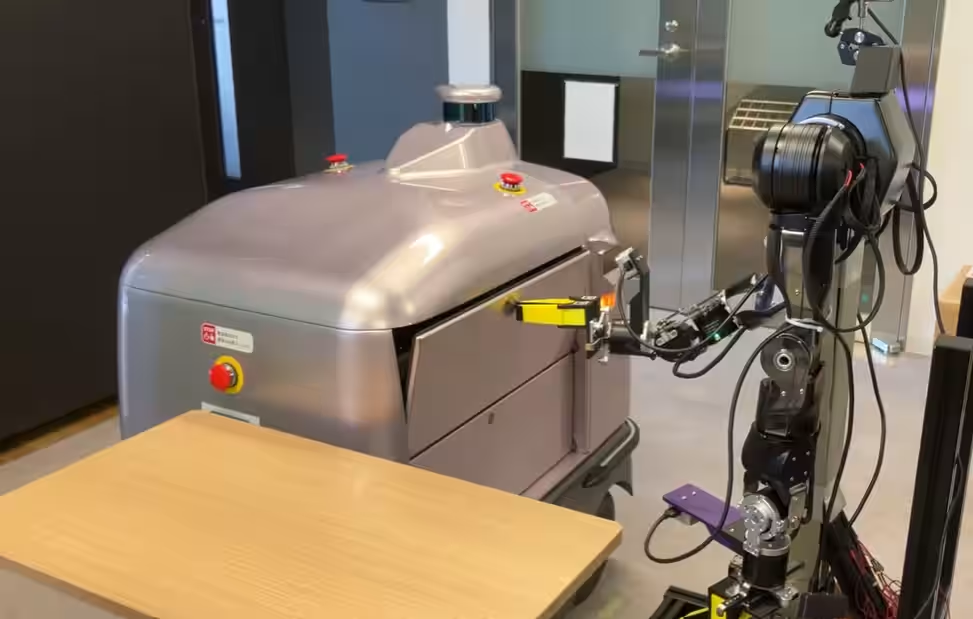
The Takanawa Gateway City, envisioned as a 100-year experiment station for enriched living, is set on the site of the historical Shinagawa vehicle depot. One of its key themes is mobility, especially as it integrates cutting-edge technology into everyday life. ABEJA's contributions to this initiative involve the complete automation of in-house logistics through sophisticated delivery robots, particularly focusing on a previously challenging aspect: the handover of packages to robots.
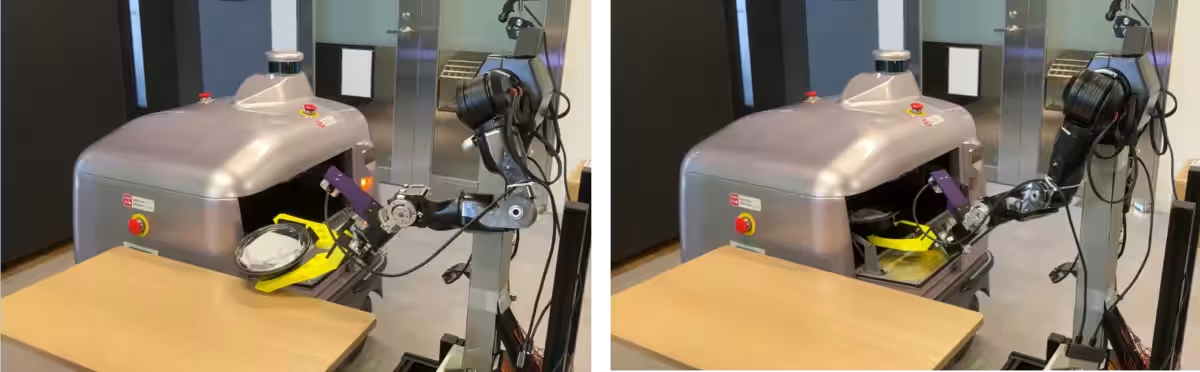
ABEJA has successfully integrated a dual-arm robot featuring a seven-axis articulating configuration. This robot mimics human flexibility, allowing it to recognize, grasp, and load packages onto delivery robots autonomously. This approach drastically reduces the need for human intervention in the delivery process, signaling a transformative shift in how deliveries could function in urban settings.
Background of ABEJA
Founded with the mission to implement a 'wealthy world’ through technology, ABEJA provides the ABEJA Platform, which operationalizes AI capabilities effectively in enterprises. By shifting the focus from mere proof of concept (PoC) to practical applications, ABEJA integrates decision-making through Agentic AI and Physical AI execution, fundamentally supporting business operations in real environments. This integration is designed under a 'Human in the Loop' architecture, which enables AI to be effective from initial deployment, paving the way for minimizing the traditional PoC phase.
The Challenge of Delivery Automation
The logistics of package delivery typically present numerous challenges, especially due to the variable nature of the items being handled and their spatial configurations. Traditionally, industrial robots struggled with these complexities, requiring high costs for deployment and adjustment, often leaving such tasks reliant on human workers. However, with the advancement of Physical AI, ABEJA successfully automated the entire process.
In the initial phases of the project, data was collected about the tasks at hand. The proprietary ABEJA Platform merged Physical AI with the dual-arm robot, enabling it to learn from human demonstrations. For instance, a human operator would demonstrate movements, while the robot captured visual data, joint angles, and force sensitivity. This process allows the robot to perform similar tasks autonomously in various conditions, recognizing objects with an accuracy akin to human perception.
Implications of Successful Automation
The successful tests have indicated that the dual-arm robot not only executes tasks with high precision but also exhibits adaptability. In instances of task failure or external changes in the environment, it can reassess and continue working, which is crucial for dynamic settings like Takanawa Gateway City. This adaptability underscores the potential of AI in mission-critical operations, continuously refining its processes through human feedback and intervention.
Future Prospects
Looking ahead, ABEJA aspires to enhance the collaboration between dual-arm robots and autonomous delivery systems. This synergy aims for a fully automated delivery process encompassing package handover and transportation throughout the Takanawa Gateway City.
With aspirations to drastically broaden the utilization of Physical AI in operational contexts previously exclusive to human capabilities, ABEJA sees this project as a vital step toward societal implementation of advanced robotic systems. Leveraging data from a wider area will empower ABEJA to develop intricate decision-making frameworks for logistics, optimizing how items are loaded and transported within urban environments.
Additionally, ABEJA plans to channel the knowledge derived from this project into the development of advanced AI architectures that can integrate visual, language, and motion instructions into actionable outcomes for enterprise-level missions.
Takanawa Gateway City: A Landmark in Urban Development
The Takanawa Gateway City project represents a fusion of history and innovation. By incorporating cultural and historical elements—such as the preservation of the high-rise embankment historically tied to the area's railway origins—JR East seeks to create a lively community characterized by continual growth of business and culture. With new facilities and connections to the Shinagawa station, including the opening of THE LINKPILLAR in March 2025, Takanawa Gateway City aims to set a precedent for future urban developments.
As ABEJA and JR East continue to collaborate on this groundbreaking initiative, the project is expected to serve not only as a benchmark for logistics operations but as a visionary model for future smart cities classically tied to historical roots.

Topics Consumer Technology)
【About Using Articles】
You can freely use the title and article content by linking to the page where the article is posted.
※ Images cannot be used.
【About Links】
Links are free to use.