



Reinventing Voice: The Future of Telecommunications in the Age of AI
Reinventing Voice in the Age of AI: Insights from MWC 2026
The Mobile World Congress (MWC) 2026 showcased groundbreaking advancements in telecommunications, particularly in the realm of voice services, as highlighted by Andy Hicks, Senior Principal Analyst at GlobalData. Hicks presented a pivotal white paper titled "Reinventing Voice: A Converged, AI-Enabled, and Multimodal Voice Core for the Next Generation of Telecommunications." This document elaborates on how telecommunications providers can leverage a fully converged voice network to deliver innovative AI-based services and redefine the inherent value of voice communications.
The Need for Fully Converged Voice Networks
In a rapidly evolving digital landscape, the demand for a fully integrated voice network has never been more crucial. As network operators transition from the legacy 2G and 3G technologies towards 5G and beyond, they face the challenge of maintaining essential services while managing multi-generational networks. A fully converged voice network capable of handling various service generations (2G, 3G, 4G, and 5G) emerges as a strategic necessity. This framework not only resolves operational complications stemming from the lifecycle of technologies but also sets the stage for seamless future improvements in service delivery.
Furthermore, with the global shift towards containerization, the adoption of a fully converged architecture enables a smooth transition from traditional Virtual Machines (VMs) to containerized applications. This shift aids operators in reducing total operational costs while ensuring ongoing innovation and adaptability in voice services.
Enhancing Voice Services Through AI
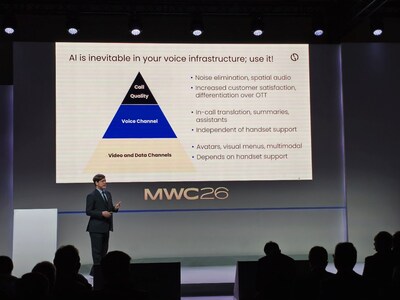
The rapid advancements in artificial intelligence present unprecedented opportunities for enriching voice services. Hicks posits that the profound integration of AI into voice communications can be achieved through three critical steps:
1. Improving Caller Experience: The initial phase involves the implementation of AI to enhance the fundamental caller experience, ensuring telecom providers gain a competitive edge over Over-The-Top (OTT) applications. Innovations such as intelligent noise suppression and advanced spatial audio immersion can elevate the quality of voice calls, transforming them into an unparalleled communication experience.
2. Integrating AI into Audio Channels: The next step is the incorporation of AI into audio channels to introduce novel functionalities, including real-time translation and intelligent call summaries. These enhancements can be rolled out rapidly without necessitating any modifications to end devices, offering operators a first-mover advantage in AI-powered voice innovation.
3. Advancing to Multimodal Innovations: Lastly, AI can be infused into video and data channels, progressing voice innovation from a mono-modal to a multimodal approach. This evolution enables the delivery of services like interactive customer support, digital health assistants, and the realization of the Call-as-a-Service concept, thereby broadening the scope of voice applications.
Hicks emphasized the imperative for operators to embrace the opportunities presented by AI. By utilizing a fully converged voice network as a foundation, telecom providers can propel service innovations forward and revitalize the core value of voice services, powered by advancements in both 5G and AI technologies.
For more insights, access the full white paper here.
Conclusion
The vision outlined by Andy Hicks at MWC 2026 is a clarion call for telecom operators to adapt and innovate in an increasingly AI-driven world. The future of voice services hinges on the successful integration of AI technologies within a converged network, ensuring that operators not only keep pace with the industry but also lead it into a new era of communication.
Topics Telecommunications)
【About Using Articles】
You can freely use the title and article content by linking to the page where the article is posted.
※ Images cannot be used.
【About Links】
Links are free to use.