



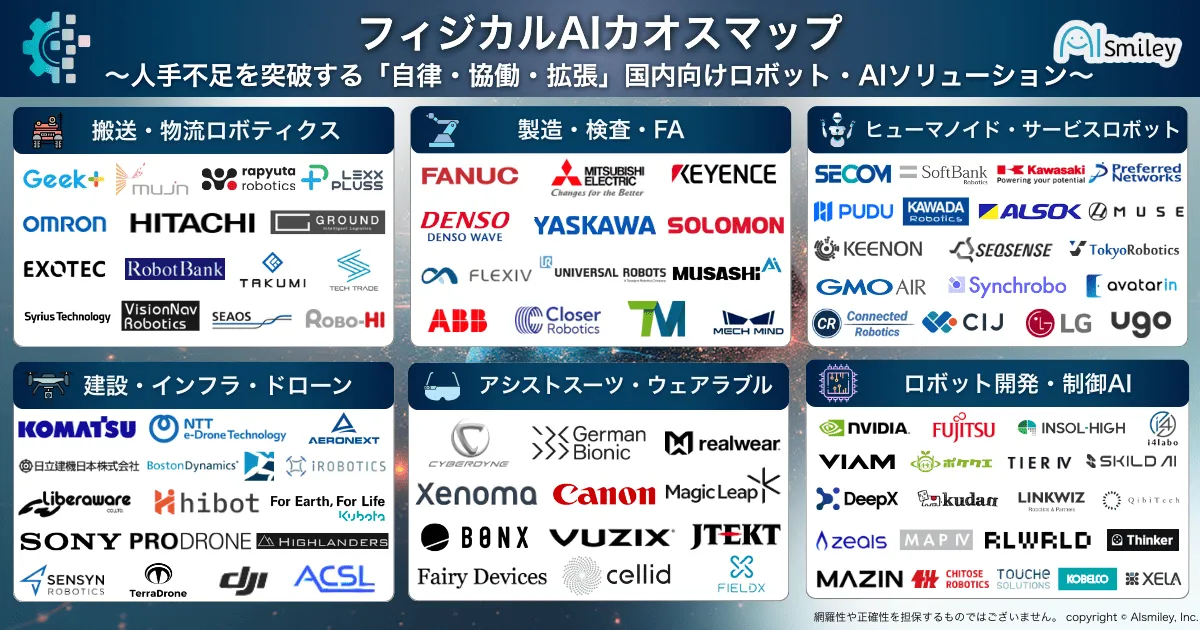
AIsmiley Unveils the Physical AI Chaos Map to Tackle Labor Shortages
The Launch of AIsmiley's Physical AI Chaos Map
AIsmiley, a leading domestic AI portal media based in Shibuya, Tokyo, has recently launched the Physical AI Chaos Map, a comprehensive guide designed to tackle the pressing labor shortages in Japan. This unprecedented release, set for January 26, 2026, features 100 cutting-edge robotic and AI solutions specifically tailored for the Japanese market. By categorizing innovative technologies under the themes of autonomy, collaboration, and augmentation, the map provides a valuable resource for organizations looking to automate and enhance their operations.
What is Physical AI?
Physical AI goes beyond traditional AI that operates solely on computers. Instead, it encompasses technologies that interact directly with the physical world through hardware such as robots and sensors. The integration of advanced reasoning capabilities from generative AI with robotics is paving the way for automation of complex physical tasks that were formerly undertaken by humans. The Physical AI Chaos Map organizes these solutions into user-friendly categories, allowing businesses to explore practical applications of this emerging technology.
Among the technologies featured in the map are:
- - Autonomous Mobile Robots (AMR) and collaborative robots that enhance operational efficiency.
- - Service robots capable of engaging with humans in natural dialogues and facilitating tasks such as serving food.
- - Construction drones and advanced construction technologies promoting safety and efficiency at job sites.
- - Assistive suits and wearable technologies that improve worker safety and capability.
- - AI development and control systems that empower robots with advanced decision-making and sensory abilities.
Addressing Labor Shortages
Japan faces a chronic labor shortage affecting various industries, including logistics, construction, and manufacturing, where the constraints of overtime regulations further exacerbate these challenges. The advent of Physical AI represents the dawn of new capabilities, offering promising alternatives as businesses aim to transcend labor-intensive models.
As we move into 2025 and 2026, significant advancements in robotics are anticipated, including humanoids equipped with large language models and robotic arms that learn from skilled workers. This pivotal period marks a transformation that can be termed the


Topics Consumer Technology)
【About Using Articles】
You can freely use the title and article content by linking to the page where the article is posted.
※ Images cannot be used.
【About Links】
Links are free to use.