



Diving into the Current State of Generative AI Adoption in Japan - Insights from DXPO Tokyo 2025
Overview of Generative AI Adoption at DXPO Tokyo 2025
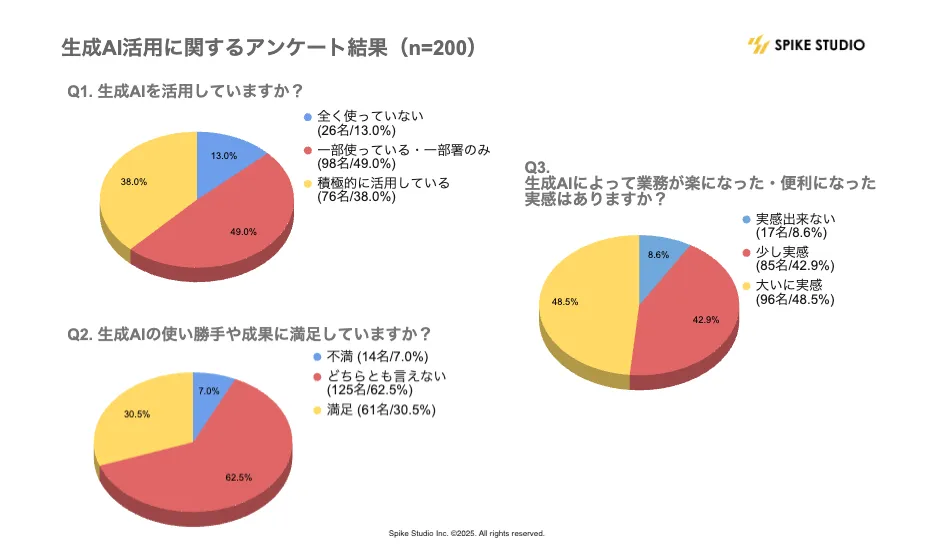
The recent survey conducted at DXPO Tokyo 2025 provides key insights into the current state of generative AI utilization among attending companies. The research indicates that a remarkable 87% of respondents have integrated generative AI into their operations.
Survey Methodology
The survey, spanning four days at the DXPO Tokyo event, targeted attendees at the booths for Back Office DXPO and Sales/Marketing DXPO. Data collection was done through casual interactions with attendees, allowing multiple responses from a single company. A total of 200 valid responses were recorded, focusing purely on individual feedback rather than corporate consensus.
Key Findings
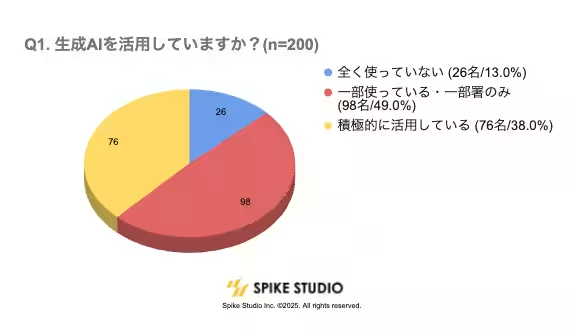
From the responses gathered, the breakdown of generative AI usage is as follows:
- - Not Utilized: 26 participants (13.0%)
- - Partial Usage: 98 participants (49.0%)
- - Active Utilization: 76 participants (38.0%)
This data confirms that generative AI has nearly escaped the "not implemented" status, with the vast majority of entities now engaging it in some capacity.
Respondent Insights
Feedback from non-users revealed issues within their organizations:
- - Many expressed a lack of executive support recognizing the need for AI.
- - Some felt limited by the difficulty in explaining the need or benefits of AI to their organization, hindering full adoption.
Partial users shared their challenges:
- - Participants noted mixed success in creating effective prompts and incorporating generative AI into daily tasks.
- - There’s uncertainty on how to measure contributions towards overall productivity or success effectively.
Active users, on the other hand, highlighted significant advancements from AI:
- - Many noted that tasks like email drafting and preliminary research have seen efficiency boosts due to AI assistance.
- - Users emphasized the necessity of a proper understanding of questions posed to AI to achieve suitable outcomes.
Satisfaction Levels with Generative AI
Satisfaction Breakdown:
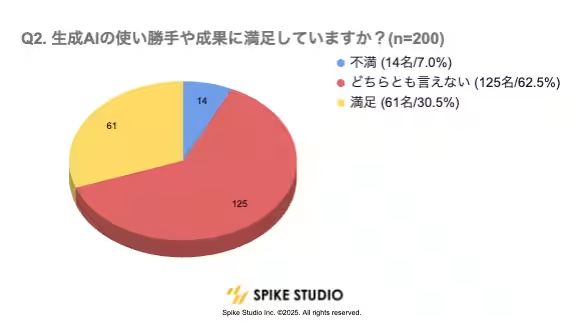
- - Dissatisfied: 14 participants (7.0%)
- - Neutral: 125 participants (62.5%)
- - Satisfied: 61 participants (30.5%)
While a significant 93% of respondents fall into the
Topics Consumer Technology)
【About Using Articles】
You can freely use the title and article content by linking to the page where the article is posted.
※ Images cannot be used.
【About Links】
Links are free to use.