




Innovative 3D Cultivation Research Unveils Mechanism Behind Uterine Gland Growth
Understanding Uterine Gland Development through 3D Culture
Researchers at Okayama University, led by graduate student Yosuke Sugino and Dr. Kohei Kawano, have made significant strides in understanding how uterine glands elongate during their development. Their findings, published in Bioscience Reports, unveil critical insights into the growth mechanisms of these glands using advanced three-dimensional (3D) culture systems.
Key Findings of the Study
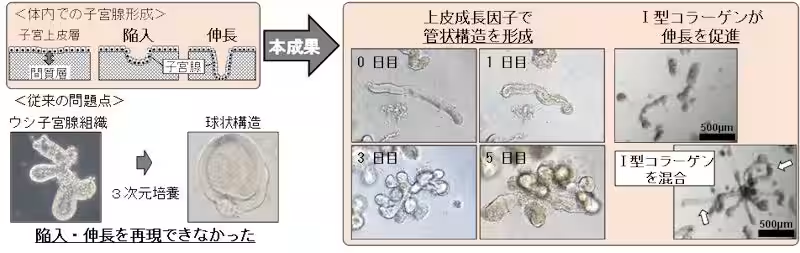
In normal 3D cultures, bovine uterine glands tend to form spherical structures. However, the team discovered that when epithelial growth factor is introduced, these glands can elongate and develop tubular structures resembling those in a natural environment. This discovery opens up potential pathways for reproductive science by creating more accurate models for studying uterine behavior and morphology.
Furthermore, by incorporating type I collagen, a protein found in the endometrium, the researchers were able to enhance the tubular elongation of the uterine glands. This finding indicates that the elongation process is not solely reliant on cell proliferation but also involves interactions with surrounding extracellular matrix components.
The significance of this research extends beyond mere academic curiosity; it has practical implications for infertility treatments in humans and improving conception rates in livestock. By mimicking the in-vivo conditions more closely, these 3D culture systems might lead to better therapeutic strategies for patients experiencing infertility.
The Research Team and Their Current Endeavors
The pioneering work was conducted by graduate students and faculty members from Okayama University’s Graduate School of Environmental Life Science, and it was initiated under the auspices of funding from the Japan Society for the Promotion of Science (JSPS). The research team emphasized the importance of understanding how organs and tissues are constructed within the body, aiming to continue unraveling these biological mysteries through meticulous study.
Yosuke Sugino noted his enthusiasm for this ongoing investigation, stating the goal to elucidate the intricate mechanisms of tissue formation further. Such advancements may guide future innovations in regenerative medicine and reproductive technologies.
Emerging Technologies and Future Prospects
The insights derived from this research could pave the way for novel techniques in developing artificial uterine environments, thus better reflecting the physiological conditions of the uterus. By fostering advancements in fertility solutions, both for humans and livestock, this study is poised to contribute significantly to reproductive health sciences.
Published on June 8, 2026, in Bioscience Reports, the researchers’ findings represent a critical step towards leveraging biotechnology for practical applications in fertility treatment and agricultural advancement.
Conclusion
As the fields of biotechnology and reproductive science evolve, studies like this one from Okayama University not only enhance our fundamental understanding but also hold promise for revolutionary applications. The researchers urge the scientific community to look toward these developments, as the possibilities for future innovations in reproductive health are remarkable.
For further information about this groundbreaking study, visit the official release from Okayama University.







Topics Health)
【About Using Articles】
You can freely use the title and article content by linking to the page where the article is posted.
※ Images cannot be used.
【About Links】
Links are free to use.