



Mapping Coral Reef Connectivity in the Southwest Islands of Japan
Introduction
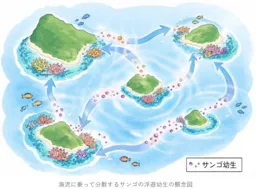
Coral reefs represent some of the most biodiverse ecosystems on Earth, but increasing threats from climate change are compromising their health. A recent study by researchers from the National Institute of Advanced Industrial Science and Technology (AIST) has revealed crucial insights into the connectivity of coral populations across Japan’s Southwest Islands. By integrating population genetic analysis with ocean current models, this research not only visualizes the ecological network that connects these reef systems but also identifies key areas that serve as sources of coral supply.
Research Background
The coral reefs in Japan's Southwest Islands are known for their exceptional biodiversity. However, they face rapid degradation due to phenomena such as mass coral bleaching driven by global warming. Understanding how coral populations maintain connectivity is essential for creating effective conservation strategies. Historically, studies focused on population genetics to assess genetic similarities and differences among coral groups. However, interpreting these data to create a broad ecological network has proven challenging due to the complex nature of coral connectivity.
In the past, genetic assessments often showed unexpected similarities among corals from geographically distant reefs. Thus, to accurately reveal the ecological connections among these reefs, the researchers aimed to combine genetic data with simulations of larval dispersal through ocean currents.
Methodology
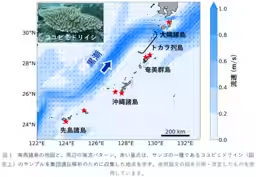
To explore the intricate relationships among coral populations, the researchers began by analyzing previously collected samples of the green coral species, Mida (Acropora) - a vital species within these ecosystems. They utilized the ddRAD-seq method to evaluate genetic differences between reef locations. Simultaneously, they employed the JCOPE-T ocean current model developed by the Japan Agency for Marine-Earth Science and Technology to simulate larval dispersal pathways.
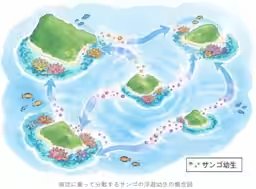
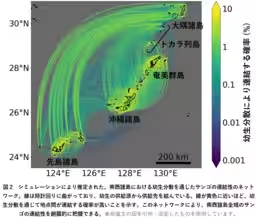
Their simulations involved releasing virtual coral larvae from all surveyed locations across the Southwest Islands, calculating over 10 million dispersal paths over a three-year period. This dual assessment revealed a low level of genetic divergence across the Southwest Islands, suggesting strong connectivity among populations over distances of up to 1,000 kilometers.
Results
The researchers constructed a visual representation of the ecological network connecting reef populations based on the simulated dispersal patterns. Findings indicated that the Kuroshio Current facilitates considerable larval dispersal from the southernmost area (the Sakishima Islands) towards the northernmost area (the Osumi Islands). This was especially evident in the Amami Islands, which appeared as a primary source of larvae to the Okinawa Islands due to complex current dynamics.
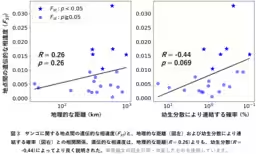
Moreover, the analysis revealed that the genetic differences among coral populations showed a weaker correlation with geographical distance compared to dispersal dynamics, contradicting findings from previous studies in regions such as Hawaii and the Caribbean where distance often correlates with genetic divergence. This emphasizes the necessity of considering both connectivity and ocean current influences in conservation planning.
Implications for Conservation
The insights gained from this study provide critical foundational data for biodiversity conservation strategies in the Southwest Islands. By identifying coral supply source areas, scientists can pinpoint regions to prioritize for restoration efforts when declines are noted in specific locations. Furthermore, this methodology is not limited to corals; it can potentially be applied to various marine organisms influenced by ocean currents, making it a versatile tool for broader ecological research.
Future Directions
The findings of this research, expected to be published in Scientific Reports, serve as a vital resource for future conservation planning and initiatives aimed at safeguarding biological diversity in marine ecosystems. Ongoing studies will continue to explore and apply these methods to ensure a comprehensive understanding of marine connectivity and its implications for broader biodiversity conservation efforts.
Conclusion
By merging population genetics with oceanographic data, this innovative approach greatly enhances our understanding of coral reef connectivity, revealing underlying mechanisms that can guide effective conservation practices in the face of climate change.
- ---
References:
- - Scientific Reports on Coral Connectivity Research
- - DOI: 10.1038/s41598-026-40448-z
Topics Environment)
【About Using Articles】
You can freely use the title and article content by linking to the page where the article is posted.
※ Images cannot be used.
【About Links】
Links are free to use.