




SCSK and Quemix Develop POD Readout Technology to Enhance Quantum Computing Measurements
New Technology in Quantum Computing: POD Readout
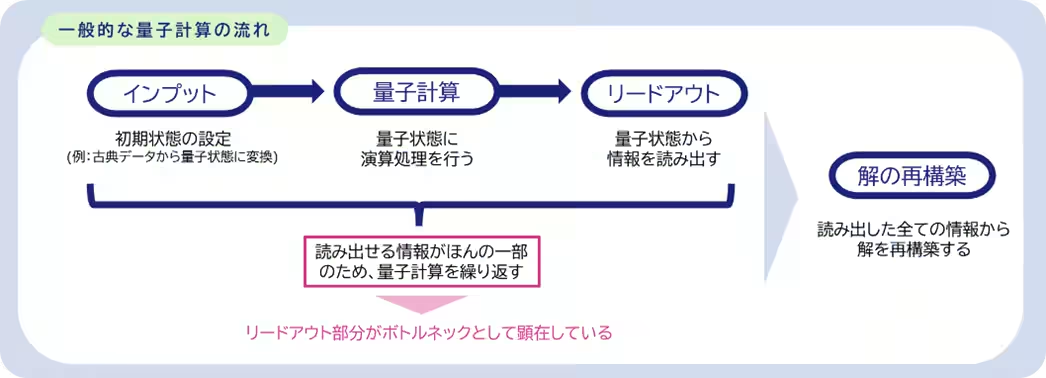
In a groundbreaking move, SCSK Corporation and Quemix, both based in Tokyo, Japan, have developed an innovative approach called POD Readout that addresses a significant bottleneck in quantum computing—namely, the measurement process. As quantum computing advances, the problem of efficiently extracting useful information from vast calculation results has become increasingly critical. The new POD Readout technology offers a solution that not only enhances measurement efficiency but also maintains the high-speed capabilities of quantum systems.
The Need for Advanced Simulations
With global challenges such as achieving carbon neutrality by 2050 and managing financial market risks, the demand for sophisticated simulations and analyses has never been greater. The rise in renewable energy sources necessitates stable power grids, high-efficiency energy equipment designs, and molecular-level simulations for the development of next-generation batteries and semiconductors. Traditional computers are reaching their limits in computational time and problem size, leading to heightened expectations for quantum computers as next-generation accelerators.
Despite recent advancements in quantum algorithms and hardware, practical implementation remains hindered by the costly measurement process following computations. While quantum calculations can be performed swiftly, massive expenses occur when extracting accurate numerical results, creating a significant bottleneck that undermines the inherent speed advantages of quantum technologies.
Overview of POD Readout Technology
SCSK and Quemix have jointly engaged in research since their capital and business partnership established in 2024. Focusing on fluid dynamics, they have created a new measurement technique called POD Readout to efficiently extract essential information from quantum computations.
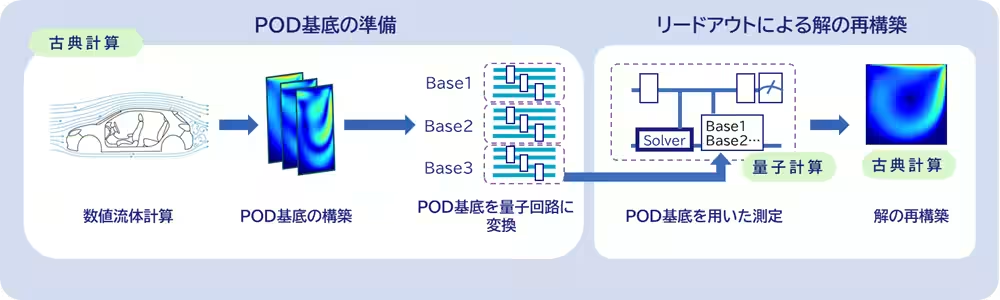
Unlike traditional methods that sequentially measure quantum states, POD Readout utilizes filters developed from classical numerical fluid calculations. These filters, known as POD Bases (Proper Orthogonal Decomposition Bases), are embedded into quantum circuits. This innovative measurement method extracts the degree to which components of the POD Bases are present in the quantum state, allowing for the direct extraction of significant features and efficient reconstruction of quantum states.
Key Features of POD Readout
- - Reduced Measurement Frequency with High Precision: By directly extracting vital information, this technology significantly lowers the number of measurements needed while maintaining accuracy.
- - Retention of Quantum Speed: POD Readout alleviates bottlenecks between quantum and classical components without compromising the speed of quantum calculations.
The POD Bases technique is particularly effective in dealing with simulation data that encompass vast information, enabling the extraction of representative patterns, reducing data size while preserving essential characteristics.
Contribution to Quantum Computer Practicality
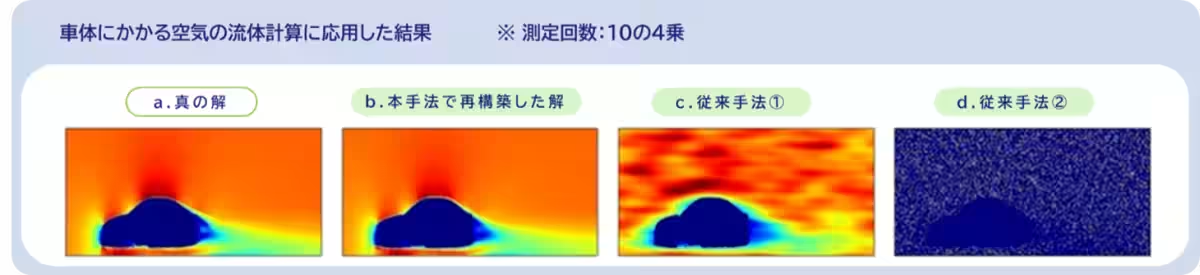
With the traditional measurement methods requiring a multitude of assessments, POD Readout has demonstrated the ability to decrease measurement frequency by up to 1/1000. The results showcase highly precise readings with significantly fewer measurements, as shown in benchmark data experiments.
This technology is expected to be advantageous in various fields:
- - Manufacturing: Accelerating numerical fluid dynamics simulations in aircraft and automotive design.
- - Materials Science: Speeding up molecular simulations for new battery and semiconductor materials.
- - Finance: Enhancing the speed of calculations for derivative pricing and risk analysis.
- - CG/Digital Twin: Improving physical simulations like light behavior for CG and digital twins.
Future Perspectives
Research will continue to expand the generalization capabilities of POD Readout for accurate measurements with minimal assessments, even for unknown bases. Collaborative efforts with clients are aimed at combining quantum computing algorithms through demonstration tests, fostering innovative solutions to contribute to carbon neutrality goals and strengthen industrial competitiveness.
Presentation at the Q2B 2026 Tokyo Conference
The collaborative research achievements will be presented at the Q2B 2026 Tokyo, an international conference dedicated to the business applications of quantum technology, taking place on June 4-5, 2026, at the Grand Hyatt Tokyo. This annual event brings together quantum computing vendors, researchers, government officials, end-users, and investors, creating a vital ecosystem in the quantum technology industry.
About SCSK Corporation
SCSK provides a full range of IT services from consulting to system development and IT management, creating solutions to various industry challenges through collaboration with clients and society.
Visit SCSK's official site
About Quemix
As a subsidiary of TerraSky, Quemix focuses on research and development in quantum computing and sensors, embodying the vision of realizing a future shaped by quantum technology.
Visit Quemix's official site
Contact for Inquiries
For inquiries regarding products and services, please contact:
SCSK Corporation, Advanced Technology Development Department
Email: [email protected]
All product names, company names, and service names are trademarks or registered trademarks of their respective companies.

Topics Consumer Technology)
【About Using Articles】
You can freely use the title and article content by linking to the page where the article is posted.
※ Images cannot be used.
【About Links】
Links are free to use.