




Examining Life Speed in Insects: Implications for Their Distribution Patterns
Examining Life Speed in Insects: Implications for Their Distribution Patterns
Recent research from Okayama University sheds light on how the speed of life can reshape the distribution patterns of species, especially invasive pests like the melon fly, _Zeugodacus cucurbitae_. Conducted by Professor Takahisa Miyatake and Assistant Professor Kentarou Matsumura, the study delves into the significance of developmental zero points and effective cumulative temperatures in pest management, challenging the traditional notions surrounding these indicators.
For many years, biologists have used developmental metrics to predict the spread and emergence timings of pests. These metrics, traditionally viewed as species-specific, have shown variability due to genetic differences within populations. However, until this study, there had been little exploration into the evolutionary pressures shaping these indicators.
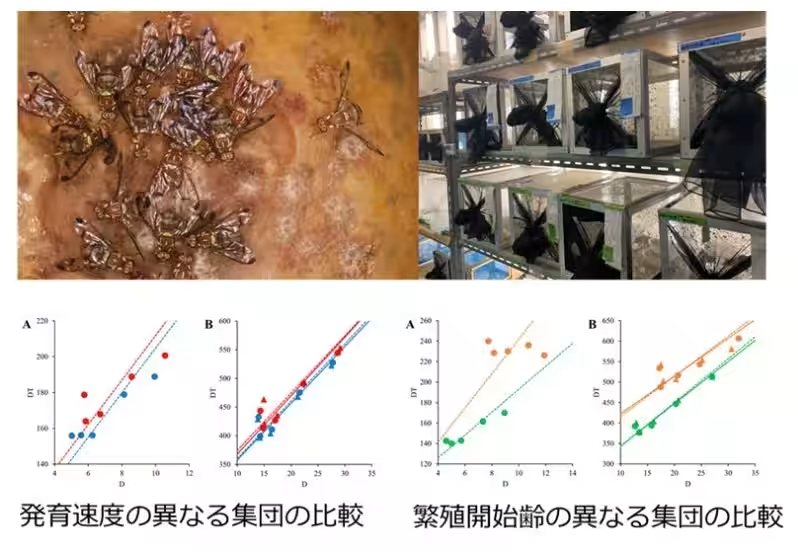
By artificially selecting life history traits in melon flies, the researchers demonstrated that accelerated evolution in developmental rates and reproductive timings alters these critical indicators over generations. This emphasizes the need to consider how rapid life strategies can lead to an expansion in the distribution ranges of invasive species.
The study assessed the melon fly's life cycle characteristics under varying temperatures, revealing significant differences in developmental metrics between populations selected for rapid versus slow growth. For example, when subjected to five distinct temperature conditions, larvae from fast-developing populations exhibited markedly different developmental durations compared to those from slower-growing populations.
Furthermore, differences were also noted in the reproductive timings among the populations, indicating that selection pressures lead to significant generation-over-generation shifts in both developmental metrics and life history traits.
This research is particularly relevant in the context of climate change, where shifting weather patterns are enabling non-native species to encroach on new territories. As Professor Miyatake pointed out during discussions, understanding how these species adapt to and proliferate in changing environments is crucial for predicting future ecological changes and shaping pest management strategies.
Published online in the journal _Entomologia Experimentalis et Applicata_ on October 6, 2025, this work demonstrates how human intervention through selection mechanisms profoundly impacts ecological dynamics. The findings offer a framework to foresee and possibly mitigate the agricultural risks posed by invasive species as they adapt to new environments.
Envisioning pest distributions through the lens of life history trait selection not only contributes to the scientific understanding of invasive species management but also highlights the need for a multifaceted approach in developing pest control frameworks. This approach blends efficient pest management with anthropogenic data collection, rooted in evolutionary biology.
With invasive species presenting greater threats to both agriculture and ecosystems, this study underscores the importance of thorough research methodologies in the field of insect ecology. As we advance, we must embrace comprehensive data collection efforts to stay a step ahead of biological invasions, focusing on the diverse factors influencing species distributions in our continually changing world.
In conclusion, the groundbreaking findings from Okayama University mark a significant step in understanding how evolving life history traits can impact the ecological landscape. Future research is essential for developing adaptive strategies that can manage the complexities of pest behavior in an era of rapid environmental change.






Topics Environment)
【About Using Articles】
You can freely use the title and article content by linking to the page where the article is posted.
※ Images cannot be used.
【About Links】
Links are free to use.