



Supine Exercises Show Promise for Balance and Agility Enhancement in Just Two Weeks
Introducing Supine Exercises for Enhanced Balance and Agility
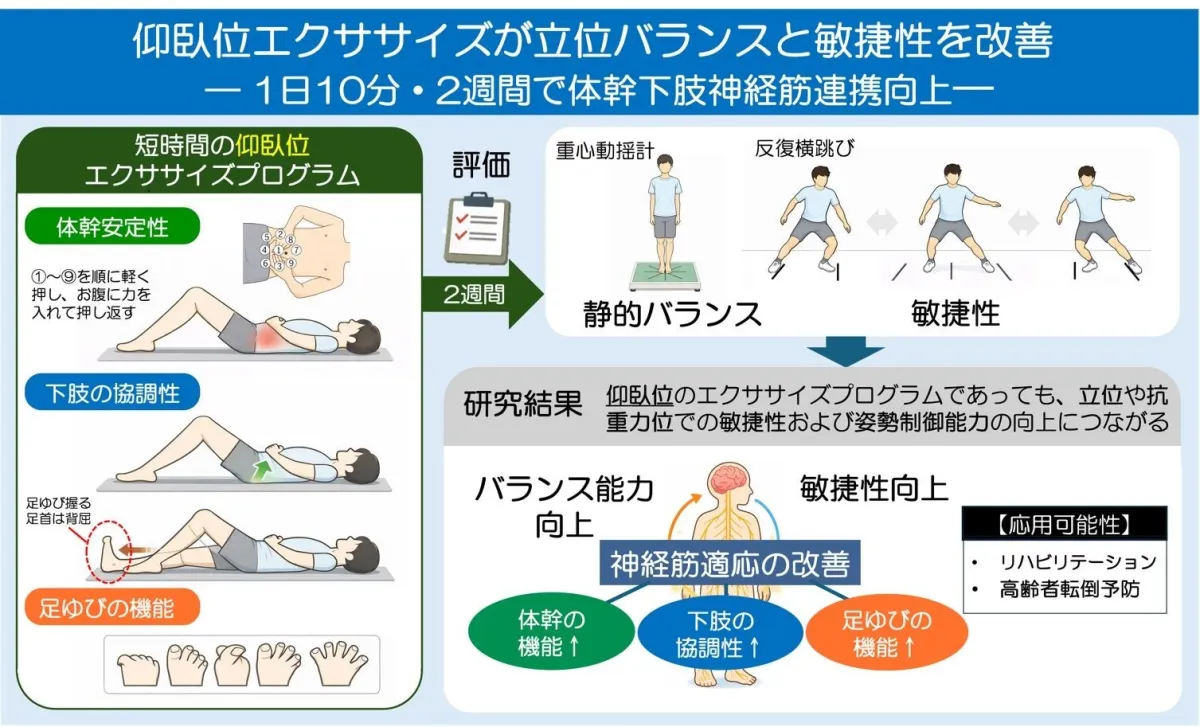
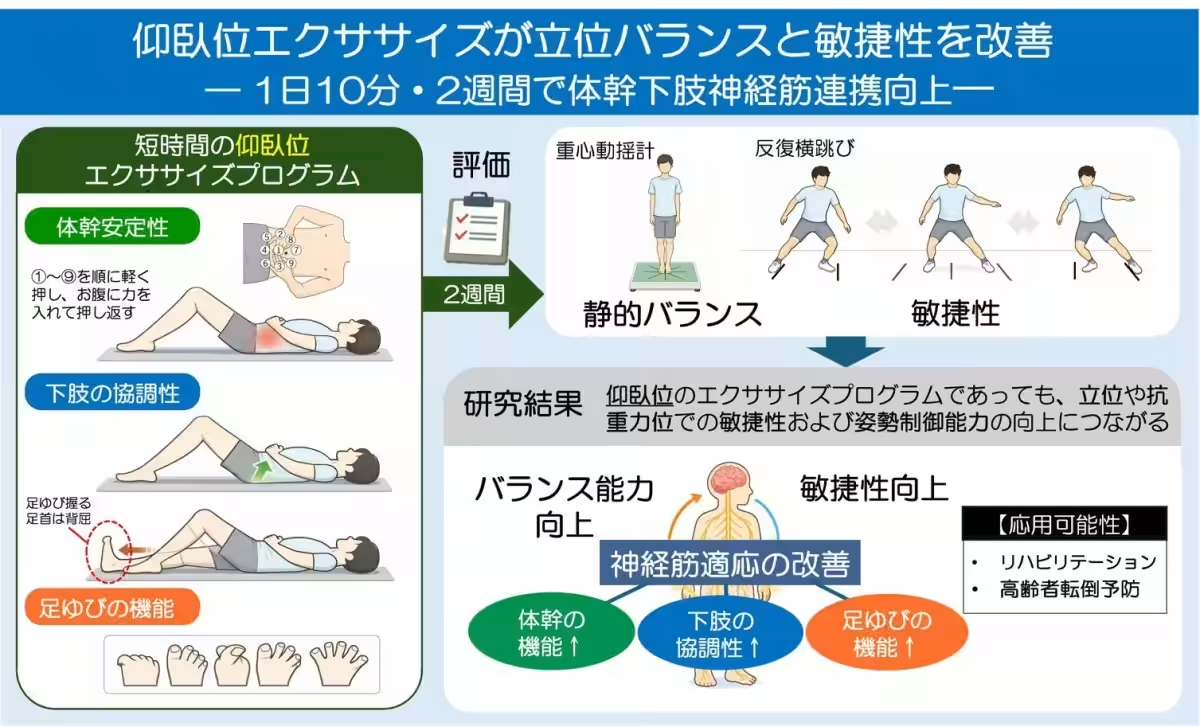
Recent research has demonstrated that short, supine exercises can lead to notable improvements in standing balance and agility. Conducted over two weeks, this exercise program—lasting only 10 minutes—effectively enhances trunk stability and lower extremity coordination.
Published in the open-access journal PLOS ONE on April 29, 2026, the study involved a diverse group of academics from various institutions, including Tokyo University of Agriculture and Technology, Kyorin University, and Osaka University. The collaborative effort examined the efficacy of supine exercises in a controlled environment, employing randomized crossover and pre-post trial designs.
Background on Balance and Agility
Balance and agility are foundational skills for bipedal human beings, essential for daily activities and physical performance. While traditional training typically emphasizes upright exercises, these can be challenging for older adults or individuals in rehabilitation settings, necessitating the development of a safer, more accessible option.
This study focused on a unique supine exercise program that involves little resistance while stimulating core stability and lower limb coordination. The method was designed to make it easier for participants to engage in the physical regimen safely.
Structure of the Research
Led by Ayako Atomi, a doctoral student at the Graduate School of Engineering, Tokyo University of Agriculture and Technology, the research team included several professors from various prestigious institutions. Their exploration aimed to evaluate how even minimal physical exertion could yield substantial benefits in agility and balance.
Through two experiments, metrics related to balance and agility—including static standing balance and agility tests—were administered to determine the impact of the supine exercises.
Key Findings
The findings from the research were noteworthy:
1. Significant Improvements in Flexibility and Agility: The results indicated marked enhancements in both agility and flexibility among participants.
2. Enhanced Static Balance Index: The static balance index improved significantly under narrower stance conditions, indicating a better capability to maintain stability.
3. More Efficient Body Movements: The efficiency of body movements during agility exercises, such as lateral jumps, improved; head and torso accelerations experienced a reduction, hinting at better movement control.
4. Muscle Strength Stability: Notably, no significant changes were observed in maximum muscle strength indicators such as grip strength or jump height.
These results underline the potential of supine exercises in elevating skills typically reserved for upright positions, such as agility and postural control capabilities. Achieving stability in the core while allowing the lower limbs to coordinate effectively in response to load is likely pivotal for improving overall movement efficiency.
Implications for Rehabilitation
The practical implications of this study suggest that supine exercises could serve as an effective training method for elderly individuals or those recovering from physical impairments. By providing an easily accessible and safe workout option, these exercises promote physical health without the risks associated with more strenuous activities.
Future Developments
Looking ahead, the research team plans to expand their inquiries into the sustainability of the exercise's benefits over time and its applicability for different demographics, particularly focusing on older adults experiencing mobility challenges or degenerative joint diseases.
Contact for Research Inquiries:
Professor Toshiyuki Watanabe
Tokyo University of Agriculture and Technology
Email: [email protected]
Phone: 042-388-7289
Contact for Media Inquiries:
Kyorin University Public Relations Office
Email: [email protected]
Phone: 0422-44-0611
The future of fitness, especially for vulnerable populations, is looking brighter thanks to these innovative approaches that blend safety with effectiveness.
Topics Health)
【About Using Articles】
You can freely use the title and article content by linking to the page where the article is posted.
※ Images cannot be used.
【About Links】
Links are free to use.