



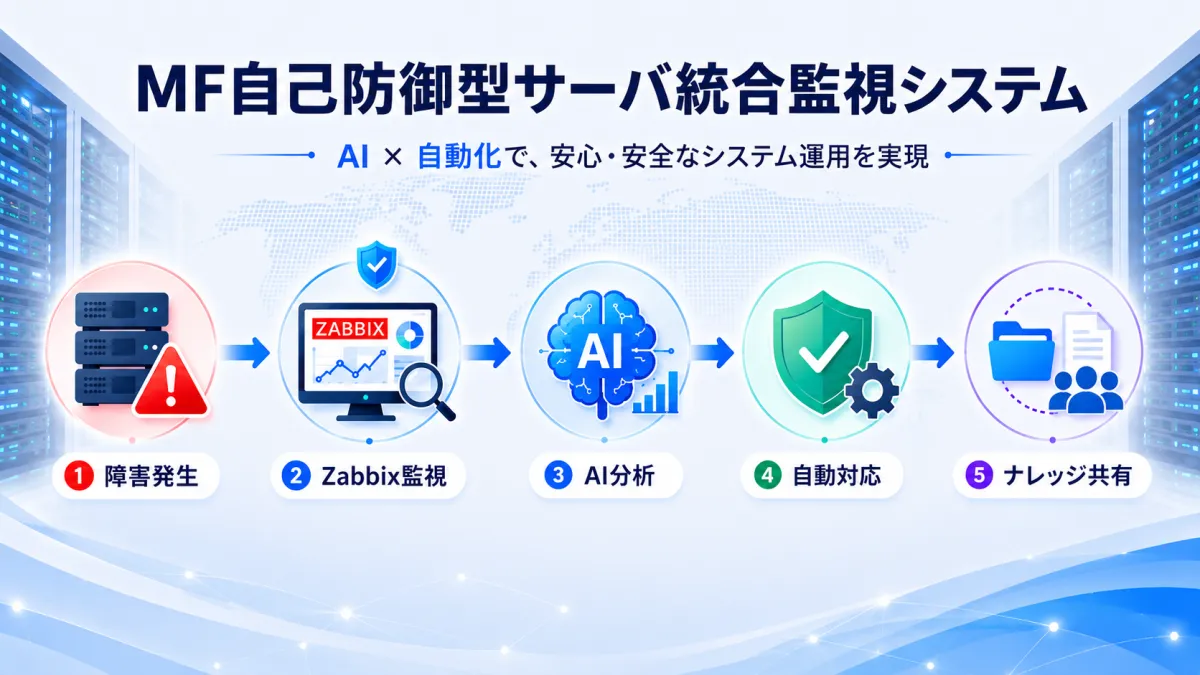
Media Fusion Launches Automated Server Monitoring System for Rapid Response to Abnormalities
Media Fusion Launches Innovative Server Monitoring System
On August 31, 2026, Media Fusion, headquartered in Osaka, Japan, will officially release the MF Self-Defense Server Monitoring System, a cutting-edge solution designed to automate the detection of server anomalies and facilitate immediate responses without requiring manual login by the personnel in charge. This self-defense operational framework aims to drastically enhance the efficiency and effectiveness of server management within organizations.
Background: Revolutionizing Initial Response to Server Anomalies
In recent years, managing publicly available servers over the internet has increasingly become a challenge. Cyberattacks and sudden surges in traffic, alongside the growing operational burden due to the increase in servers and cloud environments, have compounded the complexities of server management. Organizations face several critical issues:
- - The need for rapid responses to cyber threats and traffic spikes.
- - Variability in monitoring configurations and operational quality due to an increasing number of servers.
- - A bottleneck in the process where personnel need to log in to ascertain the situation after an anomaly is detected.
- - Quality of response being dependent on individual experience, leading to inconsistent outcomes.
- - Lack of centralized documentation of response history, making knowledge retention difficult.
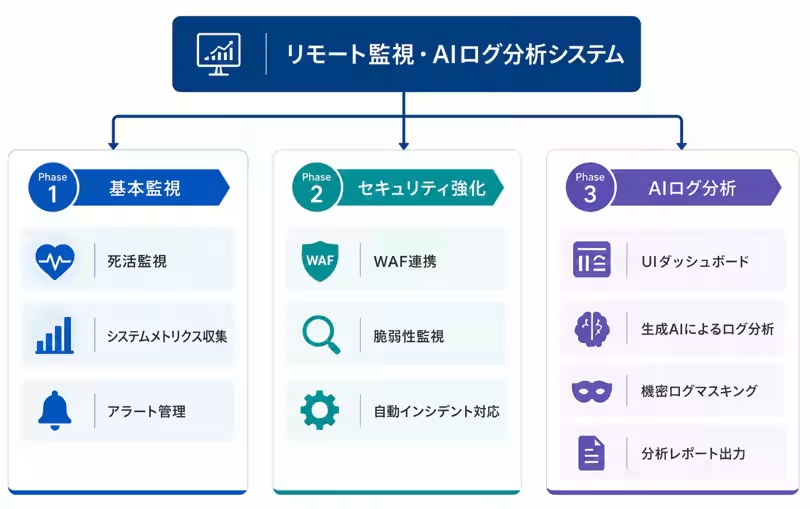
The MF Self-Defense Server Monitoring System is developed as an integrated operational framework to overcome these challenges. Built on the open-source monitoring application Zabbix, this system combines automated anomaly detection, self-defense mechanisms, AI-driven log analysis via Azure OpenAI, and knowledge sharing through Microsoft SharePoint. This integration allows organizations to manage monitoring, vulnerability assessment, incident response, AI analysis, and knowledge management all from a single platform, ensuring a more streamlined and uniform quality of server operations.
Comprehensive Integration of Monitoring and Maintenance Operations
Historically, server operations have been fragmented, with monitoring, incident response, vulnerability management, log analysis, and information sharing distributed across different tools and teams, leading to significant delays in situational awareness and handover processes. The MF Self-Defense System consolidates all necessary functionalities into one cohesive platform:
- - Unified monitoring of the status of servers, networks, and middleware using Zabbix.
- - Automated detection of vulnerabilities by cross-referencing public vulnerability information with server configuration.
- - Automated initial response through pre-set rules, allowing for the automatic blocking of IP addresses or suspension of affected services when anomalies occur.
- - Automatic log collection and sharing of relevant logs during incidents that are stored in SharePoint for easy access and management.
- - AI-based log analysis that evaluates log data to provide insights on potential causes, affected services, and recommendation actions.
- - Knowledge management enables the accumulation of incident response history and analysis results, facilitating rapid problem-solving using previous case studies.
Speedy Implementation and Standardized Operational Quality
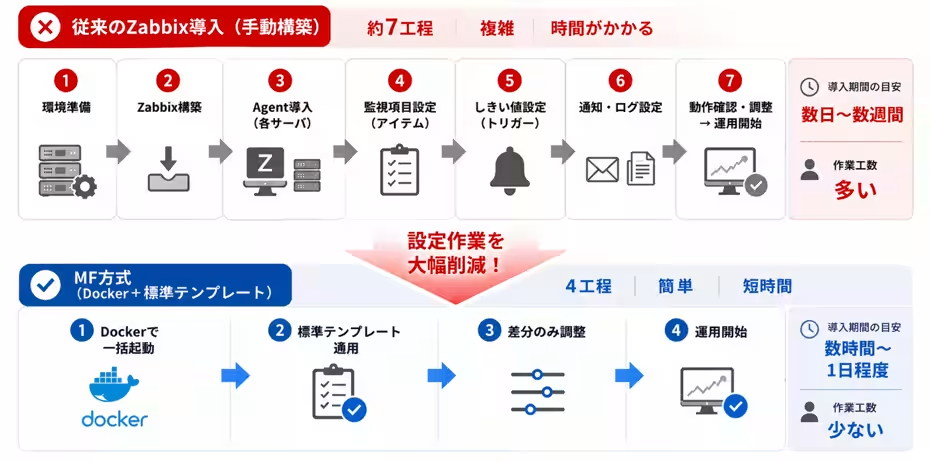
This system promises quick deployment and response times, leveraging the standard monitoring and notification features of Zabbix while integrating proprietary extensions. Key features include:
- - Rapid implementation of Zabbix through standardized monitoring templates and Docker capabilities.
- - Template standardization, allowing for efficient configuration of monitoring parameters, thresholds, and notifications, reducing the workload for personnel.
- - Quick setup using Docker simplifies the operational readiness process, and facilitates easier upgrades in line with operational needs.
Unique Functionalities and Benefits
Built on the robust infrastructure of Zabbix, the MF Self-Defense Server Monitoring System offers additional features that enhance security and operational efficacy:
- - Automated heavy traffic countermeasures that temporarily block IPs generating excessive traffic based on CPU usage or network load.
- - Emergency measures for detecting unusual behaviors such as ransomware attacks, triggering alerts and executing pre-set responses accordingly.
- - Comprehensive alert management that allows for real-time tracking and historical record checking of alerts to prevent response oversights.
- - Unified management of vulnerabilities and configurations, automatically retrieving public vulnerability data to inform systems of required actions based on severity levels.
- - Continuous monitoring of essential software, including databases and security applications.
- - Seamless integration of log collection and sharing, ensuring timely awareness of operational issues before personnel log into the affected servers.
- - AI-supported analysis carried out through Azure OpenAI for actionable insights, keeping sensitive information anonymized.
- - Operational knowledge sharing via Microsoft SharePoint to ensure best practices and insights are institutionalized rather than retained by individuals.
- - Enhanced collaboration by enabling support interactions based on real-time data shared with the MF user support management DX system.
Anticipated Use Cases
This system is particularly beneficial for organizations that operate internet-facing servers where external threat risks are heightened, allowing for uniform monitoring across multiple servers. It is designed with the following target sectors in mind:
- - Target Organizations: Universities, research institutions, local governments, and private companies.
- - Target Departments: System management teams and operational divisions.
- - Target Server Systems: Internal business systems (HR, accounting, performance management, etc.) and public-facing systems (websites, portals).
Product Overview
Product Name
MF Self-Defense Server Monitoring System
Key Functions
1. Swift implementation and configuration of Zabbix with standardized templates and Docker usage.
2. Enhanced functionalities including automated traffic management, emergency anomaly responses, alert history tracking, and AI-driven log analysis.
Offering Format
Docker-based integrated monitoring server and resident agent package, requiring the implementing organization to provide the Docker runtime environment and Azure OpenAI licensing.
Target Users
University and research institutions, local governments, private sector companies, and managed service providers.
Price Range
Initial setup costs begin at ¥500,000 with ongoing maintenance starting from ¥300,000, customizable based on the number of monitored servers and software applications.
Release Date
August 31, 2026
For more details, inquiries can be directed here.
Topics Consumer Technology)
【About Using Articles】
You can freely use the title and article content by linking to the page where the article is posted.
※ Images cannot be used.
【About Links】
Links are free to use.