



Reconfiguring Psychological Safety: Clinical Organizational Science and Edmondson's Theory
Reconfiguring Psychological Safety in Organizations
In the evolving landscape of organizational theories, the intersection between Clinical Organizational Science (COS) and psychological safety has gained notable attention. This integration is essential for navigating the complexities of modern organizational life, particularly in Japan, where concepts of psychological safety are increasingly recognized yet often misunderstood.
Understanding Clinical Organizational Science (COS)
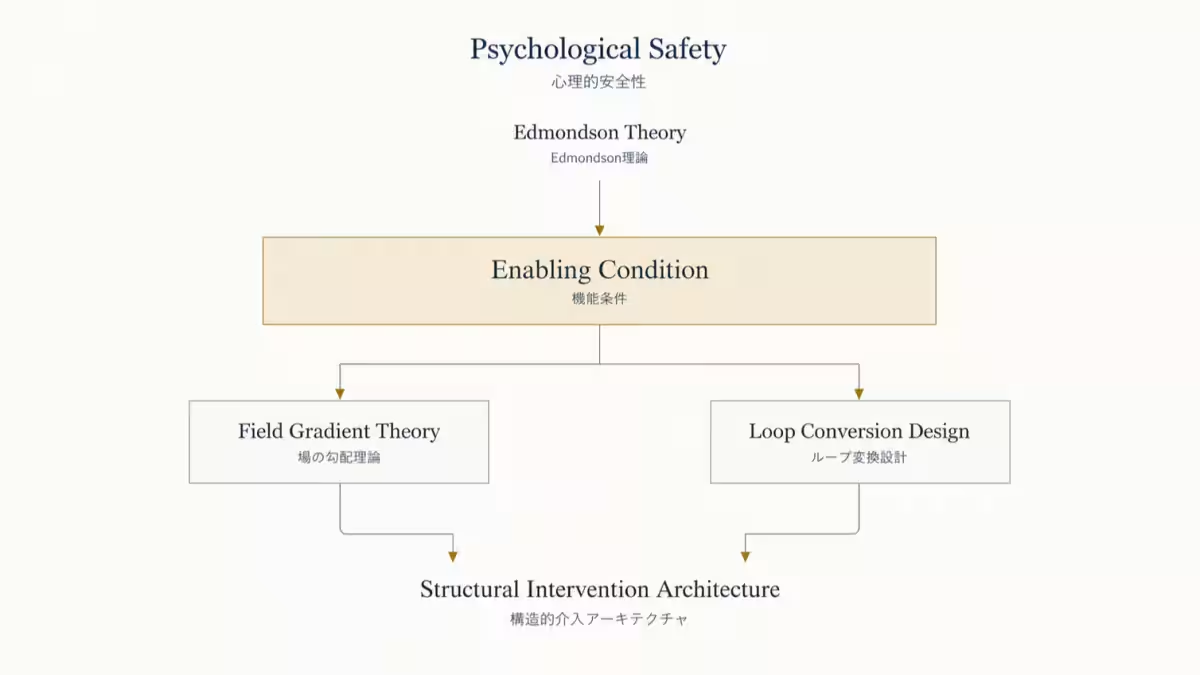
COS is presented as a robust framework that synthesizes complex systems science, neuroscience, organizational psychology, and behavioral sciences. It aims to conceptualize the interaction structures that actively reproduce the stable states of organizations. Unlike traditional models that see organizational change through the lens of individual behavioral shifts, COS focuses on the transition of organizational attractors. The primary techniques employed in COS include Field Gradient Theory, Loop Conversion Design, and Neural Base Design.
One of the critical innovations within COS is the concept of the “emergence bridge,” which helps to connect individual habitual actions to organizational-level transformations. This perspective not only enhances understanding but also provides practical tools for fostering meaningful change within organizations.
Amy C. Edmondson's Psychological Safety Theory
At the heart of the conversation is the work of Amy C. Edmondson, whose research provides a foundational understanding of psychological safety in team settings. Edmondson demonstrates that the capacity for team members to take interpersonal risks fosters learning behaviors, problem sharing, candid communication, and valuable lessons from failures. Her theory has become integral to contemporary discussions of organizational development, human capital management, and agile methodologies.
The connection between COS and Edmondson’s insights is profound. COS strongly embraces the idea that when negative information is shared within an organization, understanding whether this information leads to defensive behaviors or is treated as shared problems acts as a crucial indicator of the organizational attractor state. Therefore, psychological safety remains not just a peripheral concept within COS but a core structural condition.
Redefining Psychological Safety
Traditionally, psychological safety has been understood as an abstract cultural trait characterized by factors such as a supportive atmosphere and acceptance from leadership. COS challenges this notion by redefining psychological safety as a structural condition crucial for facilitating transitions in organizational attractors. It argues that psychological safety should not be an outcome of successful change but rather a foundational condition established through Neural Base Design as Field Gradient Theory and Loop Conversion Design are activated.
Practical behaviors such as trust, active acknowledgment, gratitude-sharing, physical check-ins, and practices like “3Good1More” serve to reinforce psychological safety as a structure of interaction rather than just an ambiguous “climate.” This reconfiguration positions psychological safety as a vital architectural element in COS’s structural interventions, making it a measurable and actionable component of organizational change.
Observational Indicators of Psychological Safety in COS
In the framework of COS, psychological safety is treated not as an intangible atmosphere but as observable patterns of interaction. Important indicators include:
- - Reactions to Negative Information Disclosure: Are failures, problems, and bad news treated as shared issues rather than triggering defensive responses?
- - Distribution of Voices: Is input from individuals dispersed across different hierarchies rather than concentrated at the top?
- - Confirmation Responses: Are acknowledgments and responses occurring spontaneously after communications?
- - Embedding 3Good1More Practice: Are positive and developmental observations structurally integrated into the organization?
These indicators are not definitive measures but rather potential observational targets that COS presents for future empirical investigation.
COS's Perspective on Psychological Safety
It is essential to clarify that COS does not advocate for a simplistic view where psychological safety can be designed or manufactured at will. Factors such as interpersonal relationships, power distances, past organizational experiences, management attitudes, and evaluation systems intricately influence psychological safety. COS emphasizes the need to approach psychological safety from the perspectives of interaction structures, feedback mechanisms, and organizational rhythms, which will result in more testable interventions.
The Voice of Leadership
Makoto Yamanaka, the CEO of DroR, emphasizes, “Psychological safety is a familiar term even among Japanese companies. However, the question remains: ‘How can we embed this concept within our organizations?’ COS shifts away from viewing psychological safety merely as a cultural goal, treating it as a fundamental structural condition necessary for transformative change.” By doing so, COS does not seek to replace Edmondson’s research but rather aims to reposition it from the practical side of implementation.
This reconfiguration requires independent validation through future research and practice.
Conceptual Analysis and Future Directions
The recent study published in Frontiers in Psychology serves as a conceptual analysis, proposing a new theoretical framework. It does not claim to have validated all COS techniques; rather, it seeks to integrate disparate scientific insights and redefine organizational transformation as a structural intervention issue.
Furthermore, this series aims to engage with existing theories not to replace them but to provide a nuanced understanding of how COS interconnects with concepts such as psychological safety and organizational routines.
The journey of COS is just beginning. Expect the next installment, focusing on COS and organizational routines theory, which will explore how individual habits connect to the conditions essential for organizational routine reproduction.
Acknowledgements and Sources
This research follows rigorous peer-review processes and highlights DroR's commitment to practical research applications aimed at enriching organizational interactions. For further information on this topic, refer to the original paper and related sources available online.
Topics Business Technology)
【About Using Articles】
You can freely use the title and article content by linking to the page where the article is posted.
※ Images cannot be used.
【About Links】
Links are free to use.