




The Resilience of Topological Magnons Against Heat: A Theoretical Breakthrough
The Resilience of Topological Magnons Against Heat: A Theoretical Breakthrough
In a pioneering study, researchers from Waseda University, in collaboration with institutions in Germany, have theoretically demonstrated the heat resilience of topological magnons — a special quantum state appearing in magnetic materials. This finding represents a significant advancement in understanding how these magnons behave under high temperatures, positioning them as potential cornerstones for future ultra-low power spintronic technologies.
Key Findings
The research group established a new theoretical framework that effectively encapsulates complex quantum effects arising from the collisions and interactions among multiple magnons. This innovative approach successfully predicts that topological magnons, previously thought to be fragile in the presence of heat, can maintain their properties at significantly higher temperatures than anticipated. The study emphasizes the quantitative stability of these magnons in chromium bromide (CrBr3) and chromium iodide (CrI3) based systems and highlights their potential for use in low-energy information technologies.
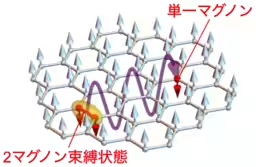
The theoretical underpinnings were published in the prestigious journal, Physical Review X, on June 10, 2026, outlining the systematic approach employed to explore the interaction of topological magnons within ferromagnetic crystals. The research especially illuminates the interaction between single magnons and those forming bound states, which are crucial for maintaining stability amidst thermal excitations.
Theoretical Advances and Experimentation
The investigation began with the understanding that within magnetic materials, the collective fluctuations of electron spins manifest as waves known as magnons. These magnons are promising candidates for efficient information processing due to their capability to convey information without accompanying charge transport. However, past research had not sufficiently explained how temperature influences the energy and lifespan of these excitations in real-world scenarios.
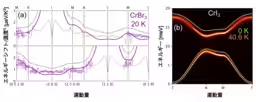
The new theories enabled researchers to effectively replicate the results of neutron scattering experiments that provide empirical data on the behaviors of CrBr3. By incorporating advanced techniques, such as the resummation method, the researchers were able to characterize the temperature-dependent changes in magnon energies and lifetimes accurately.
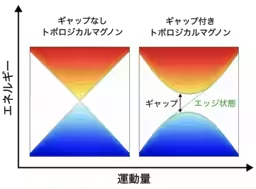
In the case of CrI3, the model predicted that even as thermal effects increase, the band gap—the energy difference between the conductivity and valence bands—remains stable up to critical curie temperatures, marking a significant finding in the study of topological materials.
Implications and Future Directions
This breakthrough offers a theoretical foundation for future explorations into materials and devices leveraging topological magnons. The ability to predict how these magnons behave under realistic temperature conditions will enhance the design processes for materials intended for practical use, particularly in spintronics where low heat generation is paramount.
Furthermore, the research opens the door for investigating other types of magnetic materials that could exhibit robust topological properties at elevated temperatures.
While this study primarily focused on van der Waals ferromagnets, future endeavors will need to consider the impact of various practical factors such as defects, impurities, and sample shape, all of which can significantly affect magnon behavior.
As researchers continue to bridge the gap between theoretical predictions and experimental validation, efforts will be directed towards discovering new materials with larger gaps that are less influenced by thermal broadening. This will foster the development of groundbreaking information processing technologies which rely on magnons and could revolutionize the energy efficiency of future digital devices.
In conclusion, this research not only advances our fundamental understanding of quantum materials but also paves the way for innovative applications in energy-efficient technologies. As we race towards more sustainable and powerful tech solutions, the stability of topological magnons amidst thermal disturbances might very well hold the key to the next generation of information technologies.

Topics Consumer Technology)
【About Using Articles】
You can freely use the title and article content by linking to the page where the article is posted.
※ Images cannot be used.
【About Links】
Links are free to use.