




Urgent Call for Action: Environmental Impact of AI Energy Use
Urgent Call for Action: Environmental Impact of AI Energy Use
A groundbreaking report from the United Nations University (UNU) raises serious concerns about the environmental costs linked to the extensive energy consumption of artificial intelligence (AI). With projections indicating that by 2030, data centers powering AI will consume approximately 945 billion kilowatt-hours of electricity globally—an amount almost three times the combined annual energy use of Pakistan, Bangladesh, and Nigeria—the urgency for action is unmistakable. The report emphasizes that this energy consumption will also lead to a staggering water footprint equivalent to the annual domestic water needs of 1.3 billion people living in Sub-Saharan Africa and a land footprint exceeding 14,500 square kilometers, which is roughly twice the size of the Jakarta metropolitan area, home to over 32 million people.
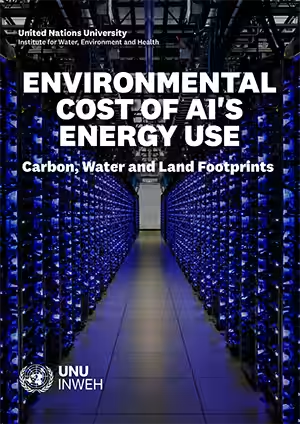
The shocking findings, detailed in the UNU's report titled "Environmental Cost of AI’s Energy Use: Carbon, Water, and Land Footprints," reveal the interconnected consequences of AI energy use. While researchers have long warned about greenhouse gas emissions from data centers, UNU scientists underscore the need to consider not merely carbon emissions but also the broader environmental costs AI inflicts on water and land.
Dr. Kaveh Madani, Director of UNU-INWEH and leader of the research team, asserts, "This report is not an indictment of the technological innovation that enriches billions of lives globally". Instead, it serves as a call to responsibility in harnessing AI. He emphasizes the importance of addressing unintended adverse effects proactively to ensure that AI remains a sustainable and equitable force. AI represents a technological revolution of our time, and we have limited time to ensure its development stays within nature's limits while ensuring those living close to the necessary mineral resources and areas where electronic waste is managed also benefit from AI innovations.
Misunderstood Footprints
The report reveals widespread miscalculations regarding AI's environmental costs. Most evaluations today focus on carbon emissions resulting from training large models, but AI systems consume power not just at training but also during cooling and energy generation. Consequently, water and land footprints resulting from energy infrastructure and supply chains are also significant yet often overlooked. These three footprints do not always correlate; for instance, transitioning from coal to bioenergy may reduce carbon emissions by an average of 70%, yet increase water footprints over 30 times and land footprints 100-fold. The report warns that assessing AI’s sustainability based solely on a single metric can lead to overlooking critical trade-offs, potentially imposing additional environmental burdens on regions already grappling with water and land shortages.
From an infrastructural perspective, numbers inflate rapidly. By 2025, the global data center electricity consumption is estimated to reach 448 billion kilowatt-hours. If viewed as a country, data centers would rank as the 11th largest consumer of electricity, surpassing France but falling just behind Saudi Arabia.
Dr. Miriam Akker, the report's lead author, remarked, "We were astounded to discover that choices deemed environmentally friendly from a decarbonization standpoint often had a paradoxically adverse impact on water and land resources." She cautioned against the temptation to believe that renewable energy infers a clean AI infrastructure, cautioning that this mindset simply addresses one issue while creating new challenges, frequently affecting unsuspected regions adversely.
Energy Demand Beyond Development
Historically, much of the debate surrounding AI's environmental impact has centered on the energy consumed during the training of enormous models. For instance, training GPT-3 required around 1.3 billion kilowatt-hours, while GPT-4 is estimated to consume between 500 and 700 billion kilowatt-hours.
However, the report indicates that such views are outdated. Once models are publicly available, inference—that is, the continual operation to address user queries—accounts for 80-90% of AI's energy consumption. For example, ChatGPT is estimated to handle about 2.5 billion prompts daily, consuming approximately 383 billion kilowatt-hours of electricity per year. To offset the carbon emissions tied to this activity, it would require nurturing 2.6 million saplings over ten years, with the planting area equating nearly to the size of Manhattan Island.
The water footprint of operating ChatGPT similarly measures up to the necessary annual domestic water for approximately 500,000 people living in Sub-Saharan Africa, while the land footprint is greater than 800 soccer fields.
Video Generation: An Emerging Environmental Crisis
The energy consumed per task in AI processes varies dramatically. Basic text inquiries, presented in chat formats, utilize about 200 times the energy consumption compared to simple text classification tasks. On the other hand, generating a single AI image may require as much as 1,450 times more energy than classification tasks. Even more alarming is the power consumed by AI in generating short videos—equivalent to classifying spam emails 200,000 times. The efficiency of these settings, often determined by default during product initialization, can culminate in significant environmental footprints.
Why Efficiency Does Not Curb Impact
The report cites "rebound effects (Jevons Paradox)" to illustrate that as models become more efficient, costs decrease, leading to increased usage—a cycle that ultimately nullifies improvements in efficiency. Without setting clear limits on token counts, resolution, and output volumes, increases in consumption often overshadow any efficiency gains.
Professor Madani, a co-author of the report and the recipient of the 2026 Stockholm Water Award, states, "While many assume advancements in AI will lead to reduced energy footprints, that's merely one facet of a broader issue." The growing efficiency in AI and energy usage translates to even greater consumption, ultimately resulting in a total footprint that outstrips any savings achieved through optimization efforts.
Disparities in Cost and Benefits
AI’s rapid global deployment brings uneven burdens and benefits across regions. Numerous case studies highlighted in the report illustrate how AI services present severe local challenges worldwide. In Ireland, data centers represented a staggering 21% of the nation’s total electricity demand in 2023, even exceeding urban household consumption. Furthermore, Ireland's transmission and distribution operators have paused new connection approvals near Dublin until 2028. This case study exemplifies the dire outcomes of prioritizing rapid AI infrastructure expansion over energy planning, a path that other nations may inevitably follow.
In Mexico's Querétaro state, prolonged drought coincided with infrastructure expansion, putting further strain on water resources. Uruguay faced construction plans for a data center consuming vast water resources, overlapping with a drought in 2023 that depleted freshwater supplies sufficient for safe drinking.
Moreover, AI infrastructure might generate up to 2.5 million tons of electronic waste annually by 2030, with large quantities processed in low-income countries lacking adequate safety measures. The critical minerals needed for AI hardware are primarily sourced from regions with lax environmental regulations.
Digital Divide: 90% of AI Computing Power in Two Countries
While environmental costs accompany AI infrastructure development, significant economic, security, and sovereignty benefits motivate wealthy nations to accelerate the construction of data centers. Only 32 countries possess dedicated AI data centers worldwide, with over 90% of their capacity concentrated in just two countries. In contrast, more than 150 nations lack any AI computing capabilities. The report presents this disparity not only as an economic issue but also as an environmental justice challenge, reflecting a structure where countries excluded from AI benefits shoulder burdens like mineral extraction and electronic waste management, while strategic gains accrue to wealthier nations.
Dr. Chaltz Malwala, President of UNU and United Nations Under-Secretary-General, states, "The global system that supports AI must be managed sustainably and equitably. Our entrenched digital divide resulting from the concentration of AI infrastructure development in privileged global areas poses serious challenges to fair AI development. While AI can pave the way for human progress and happiness, the realization of such benefits hinges not on technology but on governance."
Roadmap for Sustainability and Equity
The report advocates for constructing a "Responsible AI Ecosystem" founded on six principles: 1) Transparency, 2) Efficiency from design stages, 3) Equity and environmental justice, 4) Responsibility for the entire lifecycle of products, 5) International cooperation, and 6) Sustainable use. Recommendations include integrating AI infrastructure into electricity, water, and land use policies at the governmental level, mandating unified environmental footprint reporting, and prompting users to adopt minimal energy-consuming models and formats for task execution.
Environmental Impact by Numbers
- - 945 billion kilowatt-hours: Global data center electricity demand forecasted for 2030, about 3% of total forecasted global electricity usage and roughly double France's electricity consumption in 2025.
- - 9.3 trillion liters: Projected water footprint associated with data center electricity use in 2030, equivalent to the annual domestic water needs of 1.3 billion Sub-Saharan Africans.
- - 14,500 square kilometers: Projected land footprint from data centers in 2030, double the area of Jakarta metropolitan region, home to over 32 million people.
- - 80-90%: Estimated share of energy consumption attributed to AI inference.
- - 2.5 billion prompts: Estimated daily prompts processed by ChatGPT, contributing to approximately 383 billion kilowatt-hours of annual electricity consumption.
- - 1,450 times: Energy consumption for generating AI images compared to basic text classification tasks.
- - 90%+: Proportion of AI dedicated cloud computing capacity concentrated in just two countries, the U.S. and China.
- - 2.5 million tons: Projected annual generation of electronic waste linked to AI by 2030, equivalent to the disposal of approximately 250 Eiffel Towers each year.

Topics Policy & Public Interest)
【About Using Articles】
You can freely use the title and article content by linking to the page where the article is posted.
※ Images cannot be used.
【About Links】
Links are free to use.