



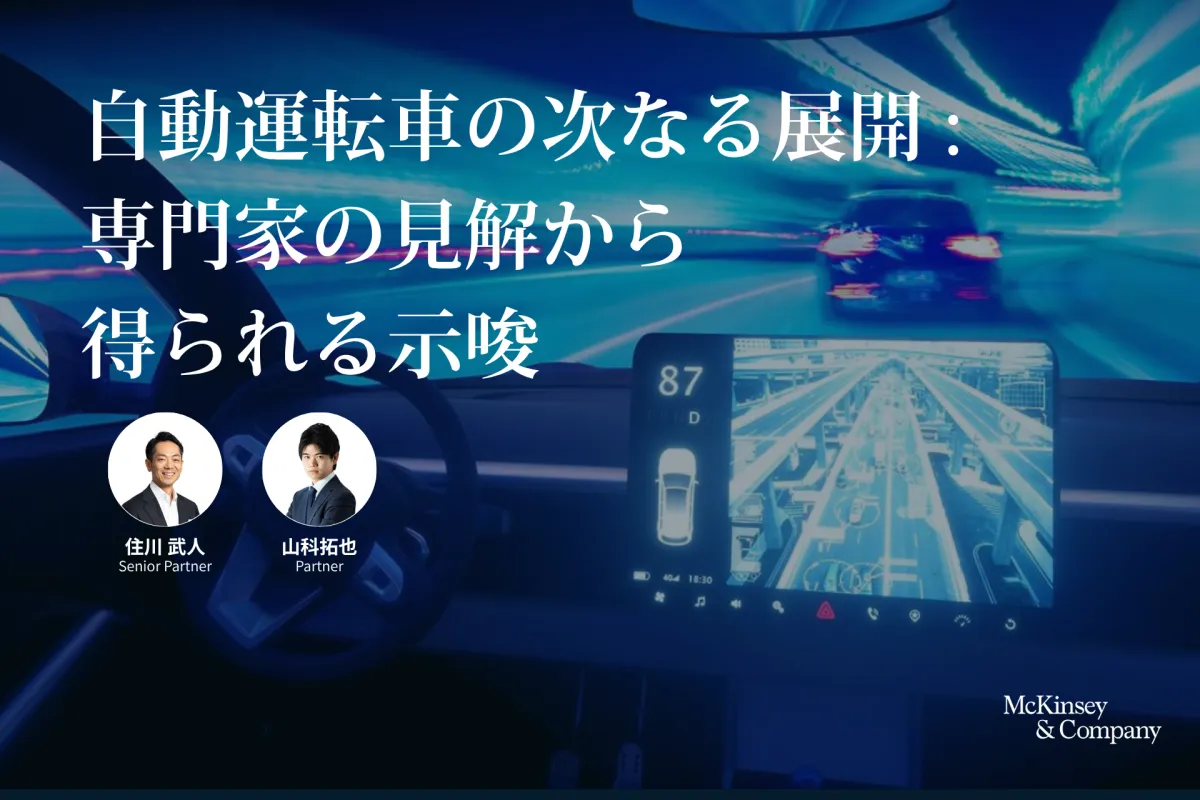
Shifting Expectations: From Complete Automation to Commercial Viability in Autonomous Vehicles
McKinsey's New Insights on Autonomous Vehicles
On June 11, 2026, McKinsey & Company released a groundbreaking white paper titled "The Next Developments in Autonomous Vehicles: Insights from Experts." This document analyzes industry leaders' perspectives on the timing for the widespread adoption of autonomous driving technology, development investments, technological infrastructure, and procurement strategies. The findings are curated from the third segment of the Autonomous and Ride AI collaboration, executed by the McKinsey Center for Future Mobility (MCFM), which involved the participation of 91 decision-makers from various automotive, transport, and software sectors across Europe, North America, and Asia.
Key Themes of the White Paper
The white paper indicates that discussions around autonomous vehicles are moving away from simplistic inquiries regarding when full automation will occur. While advancements continue with the market launch of Level 3 vehicles and the expansion of commercial robo-taxi operations, the timeline for widespread adoption of these technologies has been pushed back for several use cases. Factors such as development and validation costs, the diversification of technological stacks regionally, and uncertainties surrounding safety and regulations contribute to the complexities in strategic decisions made by companies.
The white paper aims to illuminate the gap between expectations and implementation, providing Japanese automotive manufacturers, suppliers, and technology firms with valuable insights on where to invest, collaborate, and develop competitive strategies in various markets.
Major Findings
- - The anticipated timeline for widespread deployment of many autonomous vehicle use cases is now delayed by an average of 1-2 years compared to the 2023 survey. Full-scale deployment of Level 4/5 robo-taxis is expected by 2030, while complete self-driving trucks for urban areas are projected for 2032.
- - In the personal passenger vehicle market, experts predict that Level 2+ will dominate by 2035, with 49% believing it will emerge as the most prevalent option, whereas only 39% expect Level 3 and higher to take center stage.
- - As autonomous vehicle levels increase, the development costs can escalate significantly. For instance, software alone may require over $3 billion in investments for robo-taxis and fully autonomous trucks.
- - The primary pain point in developing Advanced Driver-Assistance Systems (ADAS) is the high cost, particularly for software development, integration, testing and verification, and data collection and storage.
- - Approximately 61% of experts predict the formation of a unique technological stack in China, indicating that autonomous vehicle technology may not conform to a single global standard but adapt according to regional requirements, regulations, and supply chains.
- - It is also anticipated that the dominant model in software development will shift towards hybrid systems that combine traditional algorithms with end-to-end (E2E) AI systems.
Strategic Implications for Japanese Companies
Japanese companies are encouraged to strategize not by waiting for complete automation, but by identifying which use cases can realistically create value in the consumer vehicle market. They need to prioritize their investments across technologies such as Level 2+/ADAS for mass-market vehicles, Level 3 for premium vehicles, urban robo-taxi applications, and autonomous trucks.
In the competitive landscape revolving around software, semiconductors, sensors, maps, data, and validation infrastructure, Japanese firms should not attempt to do everything in-house. Instead, they should focus on areas where they hold an advantage and leverage partnerships or standardization in non-core domains.
Notably, the potential divergence in technological stacks and regulatory environments in the U.S., China, and Europe requires a reconsideration of the traditional global model for Japan's automotive industry. Transitioning from viewing autonomous driving merely as a technological development to encompassing customer value, accountability, safety, and profitability in business design will be crucial for future competitive advantage.
About McKinsey & Company
McKinsey & Company stands as a global leader in management consulting, providing essential support to organizations and public institutions in solving significant challenges. By leveraging cross-industry insights and advanced analytical capabilities, McKinsey contributes to the sustainable growth and transformation of its clients.
Topics Consumer Technology)
【About Using Articles】
You can freely use the title and article content by linking to the page where the article is posted.
※ Images cannot be used.
【About Links】
Links are free to use.