



Expectations for Next-Generation Cooling Technology Using Ga-Based Quasicrystals with Strong Magnetocaloric Effects
Observing Massive Magnetocaloric Effects in Ga-Based Quasicrystals
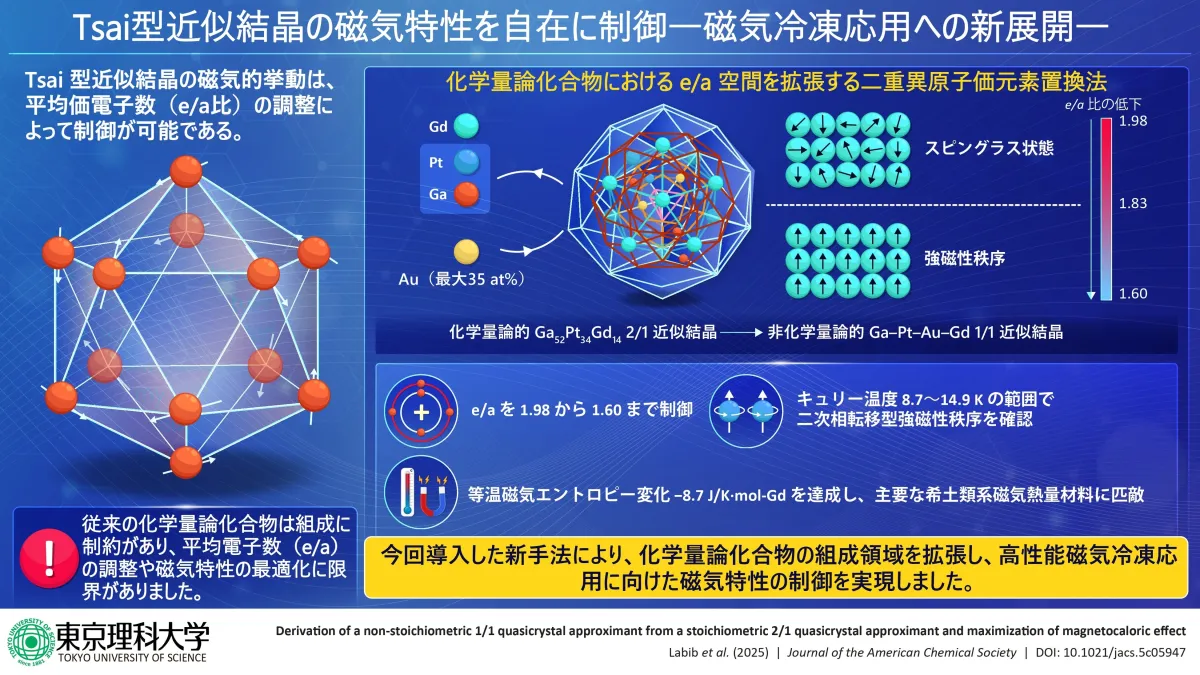
Recent advancements in material science have brought to light exciting possibilities for next-generation cooling technologies. Researchers from the Farid Labib at Tokyo University of Science succeeded in synthesizing a new class of quasicrystal materials that exhibit remarkable magnetocaloric effects. The study focuses on the development of a novel synthesis technique called "double hetero-valent elemental substitution," which allows for the simultaneous substitution of two different elements with distinct valences. This innovative method facilitated the transition from a ternary Ga-Pt-Gd 2/1 approximant to a quaternary Ga-Au-Pt-Gd 1/1 approximant.
Key Findings
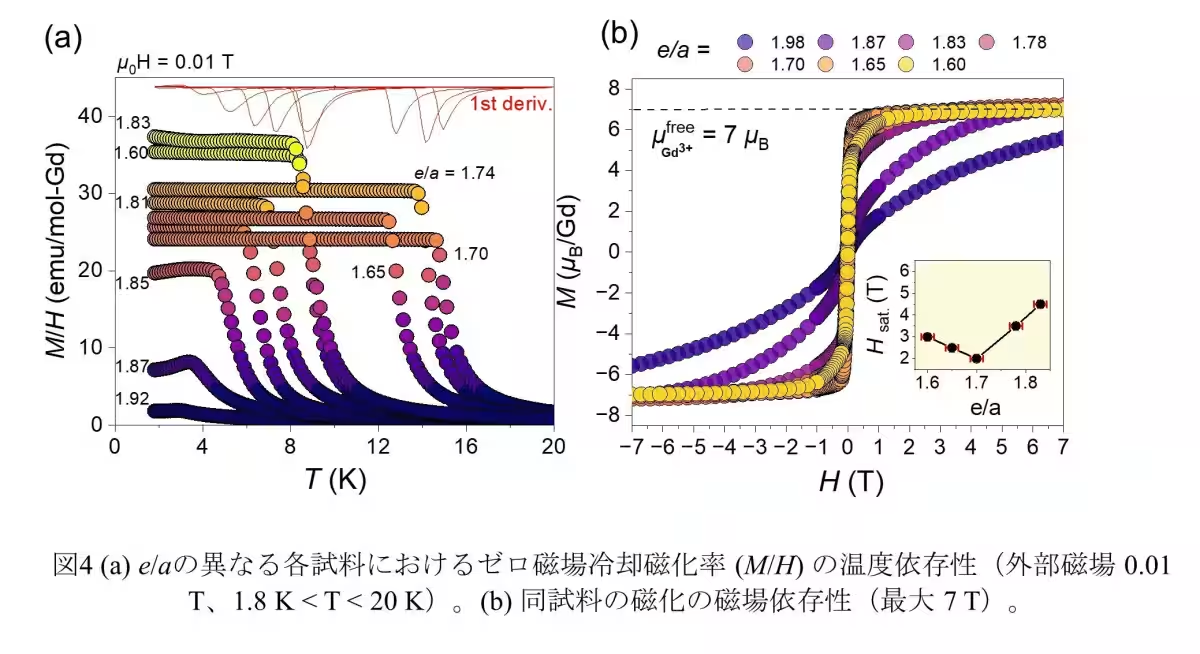
The research demonstrated a systematic ability to control the average valence electron count (e/a) within the range of 1.92 to 1.60. Particularly, at an e/a value of 1.83, the materials showcased a remarkable isothermal magnetic entropy change ΔSM of -8.7 J/K mol-Gd under a magnetic field of 5 T. This is recognized as the highest recorded value for approximant and quasicrystal materials to date, establishing a promising foundation for environmentally friendly sub-Kelvin cooling techniques utilizing cryogenic systems.
Research Overview
The research team, consisting of Takaharu Tamura along with other academics, utilized the previously established Ga-Pt-Gd 2/1 approximant as a starting point, successfully synthesizing various compositions of the quaternary Ga-Au-Pt-Gd 1/1 approximant by variably substituting Ga and Pt with gold in an argon atmosphere using arc melting. This substitution not only preserved the crystallographic symmetry typical of high-quality intermetallic compounds but also broke the chemical stoichiometric constraints, greatly enhancing the compositional flexibility. Importantly, the resultant approximants exhibited a physical transformation from spin-glass to ferromagnetic behaviors as the e/a was varied, showcasing that specific values yielded optimal magnetic thermal effects.
The research also highlighted that at e/a = 1.83, the isothermal magnetic entropy change reached -8.7 J/K mol-Gd at 5 T, with even more promising performance at higher magnetic induction levels. This performance aligns closely with those materials currently used in high-performance magnetocaloric cooling applications.
Implications for Future Applications
Professor Tamura emphasized the broad implications of their findings, suggesting these materials could present alternatives to current cooling technologies relying on more scarce resources, such as liquid helium. As this study is set to be published online in the Journal of the American Chemical Society, it brings to light the potential for materials designed through tailored electronic properties to reshape the landscape of environmentally friendly refrigeration systems. The successful introduction of double hetero-valent elemental substitution technique could serve as a stable method for enhancing the performance of magnetic cooling technologies.
Concluding Remarks
The knowledge gained from manipulating the valence electron count in quasicrystals opens a new pathway for developing advanced cooling methods in a sustainable manner. The research also enhances our understanding of the interplay between electronic configurations, structural stability, and their resultant magnetic properties.
Given the important implications for various industries, including those focused on energy conservation and advanced materials application, this research signifies a promising stepping stone towards realizing next-generation cooling technologies that are both effective and environmentally conscious.
Topics Consumer Technology)
【About Using Articles】
You can freely use the title and article content by linking to the page where the article is posted.
※ Images cannot be used.
【About Links】
Links are free to use.