



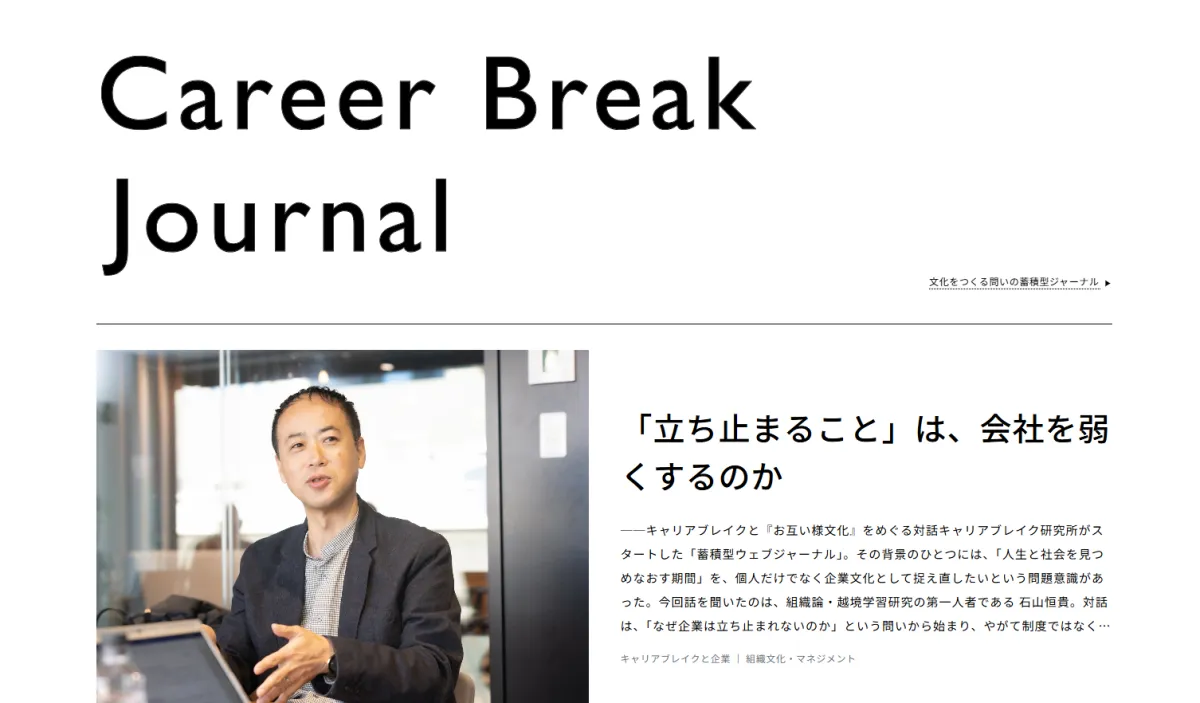
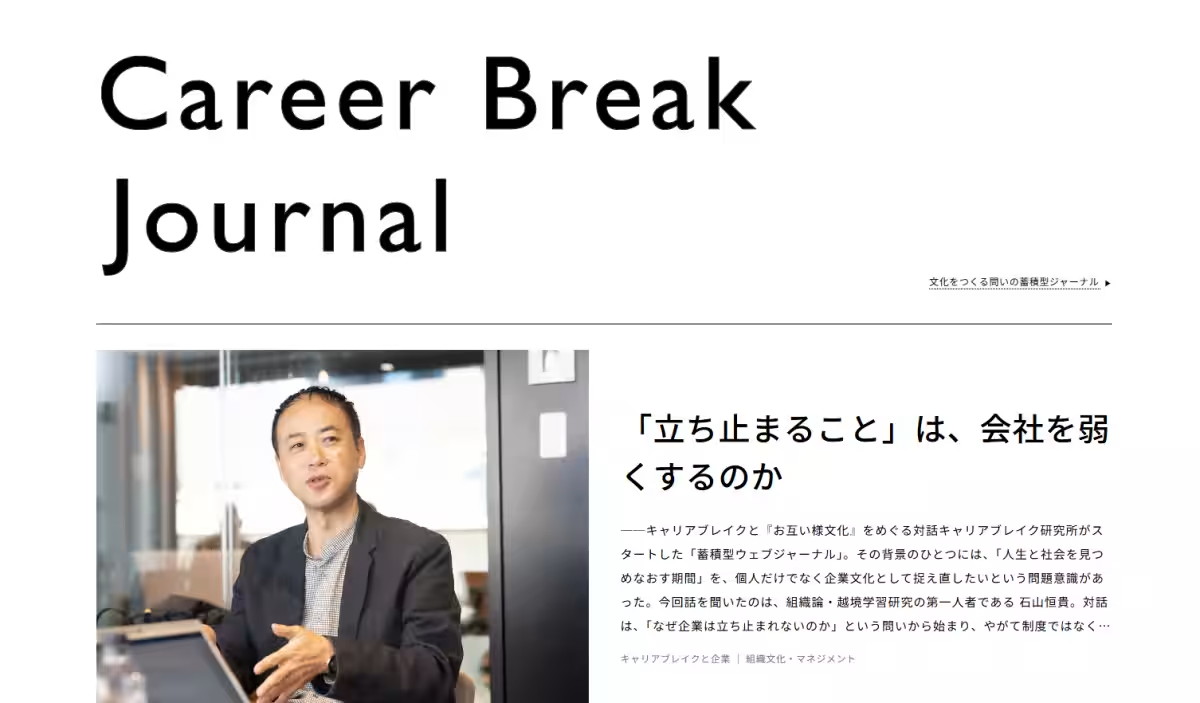
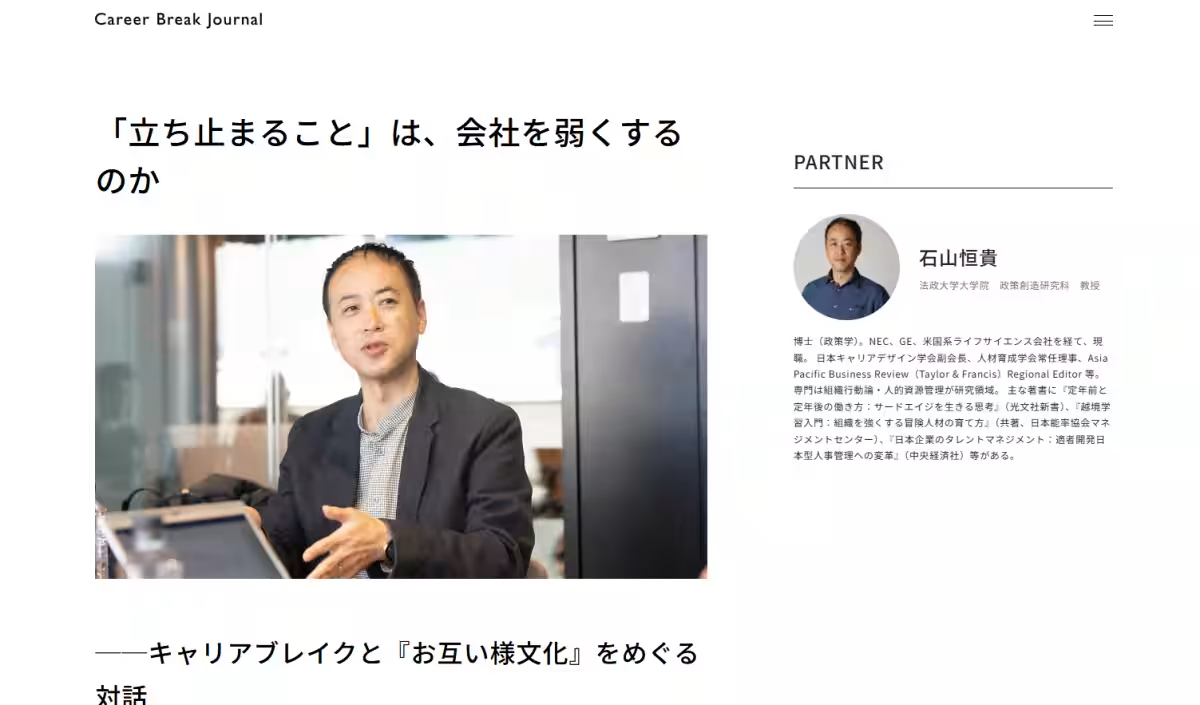
Exploring the Essence of Organizational Change: A Dialogue with Professor Tsunetaka Ishiyama
Understanding Career Breaks and Organizational Culture
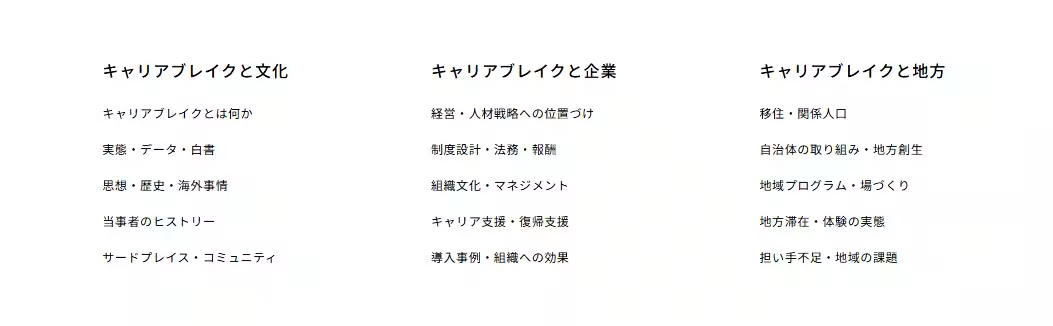
The Career Break Research Institute, located in Tarumi-ku, Kobe, has launched its inaugural web journal, the Career Break Journal. This journal aims to continuously share insights on the philosophy, reality, and societal design surrounding the concept of career breaks—a period for individuals to reflect on their lives and society through temporary leave or sabbatical.
The first article features a compelling dialogue with Professor Tsunetaka Ishiyama from Hosei University, a leading expert in organizational behavior and boundary-crossing learning. The discussion pivots around an intriguing question: Does taking a pause weaken a company? Through this conversation, it will be examined how the notion of career breaks is not merely an individual’s vacation but engages with the very core of corporate culture.
The Background of Publication
Since its establishment in 2022, the Career Break Research Institute has been dedicated to establishing the culture of career breaks into Japanese society, which is estimated to be experienced by around 1.5 million individuals annually. This includes ongoing collaborative research with Professor Akiko Kataoka from Waseda University, culminating in the upcoming publications, Career Break – Letting Go is Not a Blank in 2024 and the Career Break White Paper 2025, which will derive insights from a survey of 300 respondents to understand the impacts of career breaks on personal self-efficacy.
However, as these initiatives progressed, the necessity of accumulating and disseminating “practical information” for companies and local governments wishing to adopt career breaks became evident. Thus, the Career Break Journal is birthed as a medium to perpetuate discussions around rest, pauses, and their implications on organizations and society.
First Article Overview: Does Pausing Make Companies Weaker?
The first dialogue opens with a thought-provoking inquiry directed at business leaders who claim to prioritize employee happiness: Why do you think happiness solely comes from running alongside the company? This challenges the post-war Japanese corporate model that equated continuous dedication to the company with happiness.
During the dialogue, Professor Ishiyama warns that future corporate failures will stem not from a lack of sales but rather from unsuccessful recruitment and retention efforts. He posits that companies that do not grasp the significance of career breaks will find themselves at a disadvantage in the competitive hiring landscape.
Moreover, the issue of
Topics Other)
【About Using Articles】
You can freely use the title and article content by linking to the page where the article is posted.
※ Images cannot be used.
【About Links】
Links are free to use.