



Development of a New Platform Using Live Cells for Drug Discovery Targeting Rare Vascular Malformations
Introduction
In an exciting development, a multidisciplinary research team from Kyorin University, along with other esteemed institutions, has created an innovative platform aimed at discovering new treatments for rare vascular malformations. This platform employs advanced bioluminescence technology to measure critical signaling processes in living cells, offering a groundbreaking approach to drug discovery.
Research Background
Vascular malformations, a group of disorders marked by abnormalities in the formation and stability of blood vessels, can lead to severe health complications. Among these, venous malformations often involve mutations in the TIE2 gene, known to be critical for blood vessel stability. Treatment options like surgical interventions are commonly used; however, certain conditions such as Blue Rubber Bleb Nevus Syndrome (BRBNS) can present multiple vascular lesions that are not easily managed by conventional methods. The complex nature of TIE2 mutations complicates the understanding and treatment of these conditions, necessitating innovative solutions.
Overview of the Findings
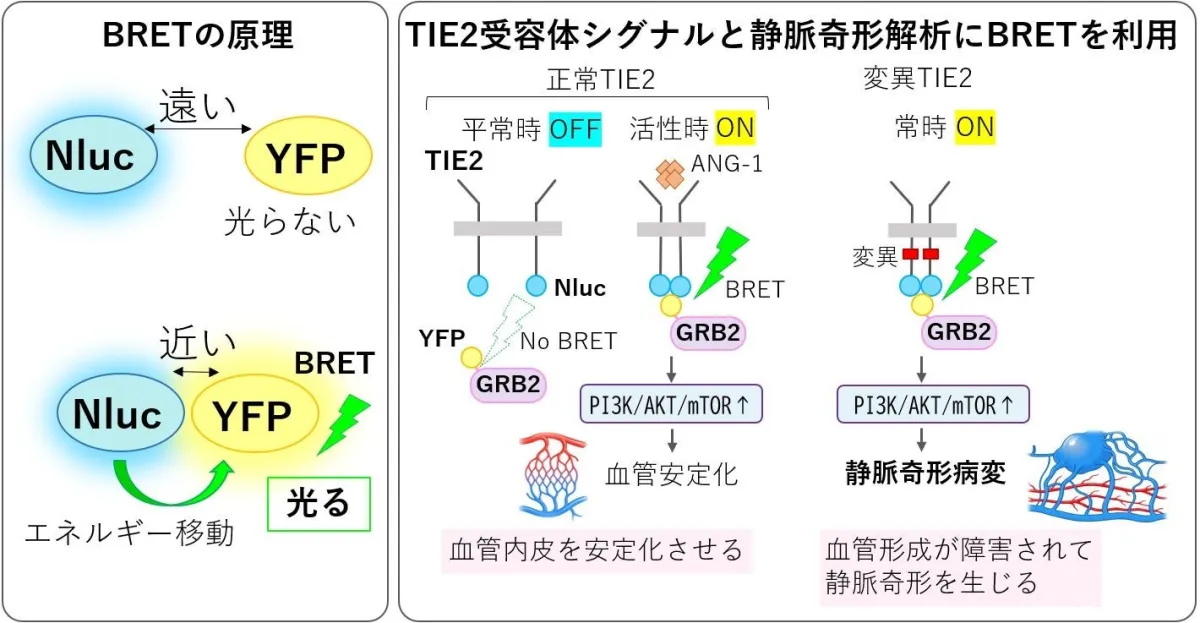
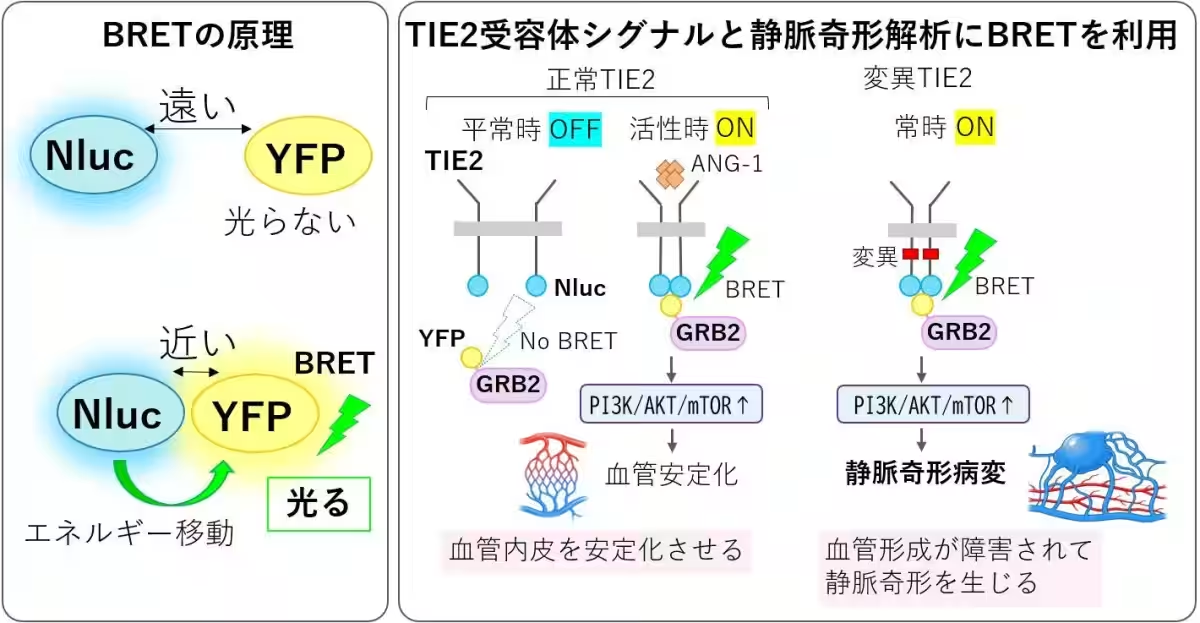
The research team developed the TIE2-GRB2-BRET platform, a novel approach that measures TIE2 activation at the cellular level through bioluminescence resonance energy transfer (BRET). By fusing the luminescent protein NanoLuc to TIE2 and the fluorescent protein YFP to GRB2, the platform is capable of detecting the proximity between these proteins, which indicates TIE2 activation. This cutting-edge technology allows for real-time observations of signaling processes within live cells, enhancing the evaluation of TIE2-related mutations and drug responses.
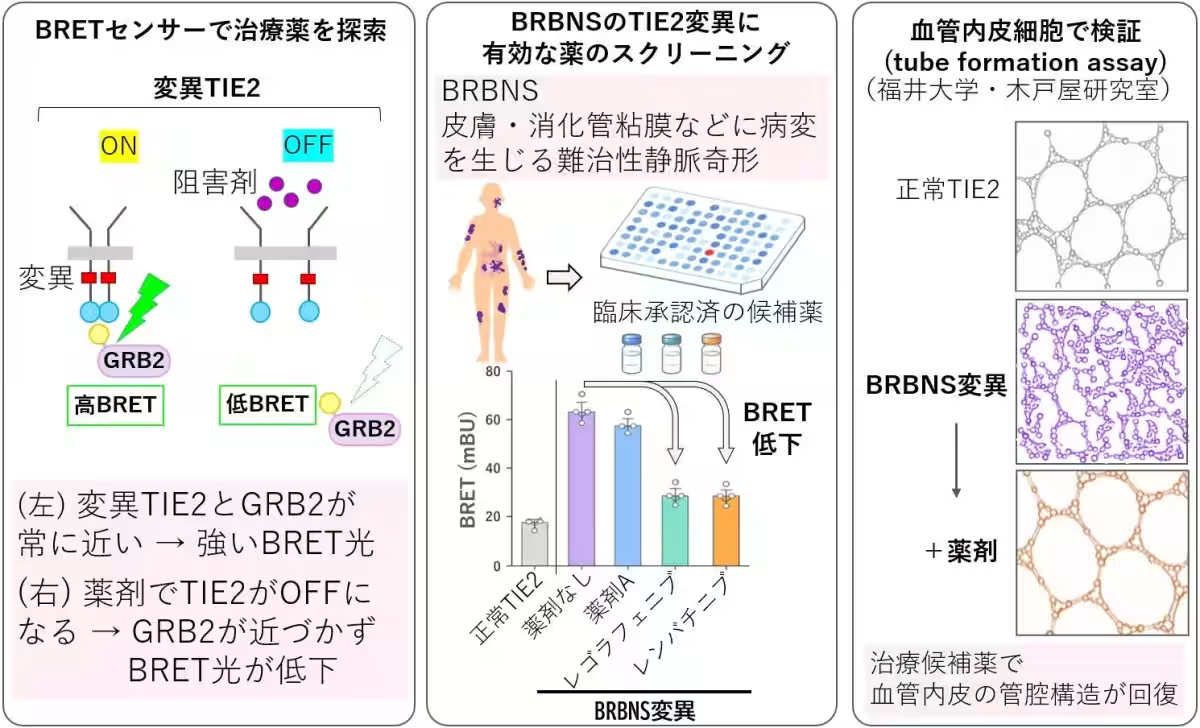
Initial tests validated that the platform could effectively respond to its physiological ligand, Angiopoietin-1 (ANG-1). Further investigations into various TIE2 mutations revealed their specific signaling strengths, shedding light on the underlying mechanisms of BRBNS. Notably, the platform successfully screened existing drugs, identifying two that were able to inhibit BRET signaling linked to the TIE2-T1105N–T1106P variant.
Significance of the Research
What sets this research apart is its ability to visualize the TIE2 signaling pathway through light emissions, thereby quantifying the effects of pathogenic mutations and potential drug responses. While previous studies used protein analysis techniques that required cell destruction, this new platform preserves the integrity of live cells, allowing for more dynamic drug screening processes.
The potential of this platform lies not only in its immediate applications for BRBNS but also in its broader implications for other rare vascular malformations associated with TIE2 mutations. The concept of drug repositioning, which entails exploring existing drugs for new therapeutic uses, is particularly valuable for rare diseases where developing new drugs can be challenging.
Future Perspectives
Building on this promising foundation, the research team plans to conduct large-scale screenings of additional approved drugs using the TIE2-GRB2-BRET platform. Their goal is to identify suitable drug candidates that can effectively address challenging vascular disorders such as BRBNS. By leveraging existing safety data from previously approved drugs, the team hopes to fast-track the discovery of effective new treatments for these rare conditions.
Conclusion
The development of the TIE2-GRB2-BRET platform marks a significant advance in understanding and treating rare vascular malformations. As researchers continue to refine and explore this technology, it holds the potential to open new avenues in drug discovery and patient care, ultimately leading to improved outcomes for individuals affected by these rare conditions.
References
Publication: A High-Sensitivity TIE2–GRB2 BRET Platform for Functional and Pharmacologic Profiling of Pathogenic Variants Associated with Venous Malformations
Authors: Matsutani H, Oishi A*, Izumi-Tamura T, Hayashi Y, Kurita M, Muto T, Yoshimi A, Ueno H, Shiraishi T, Harii K, Takushima A, Kidoya H, and Ozaki M.
Journal: Angiogenesis
Publication Date: August 13, 2026
DOI: 10.1007/s10456-026-10071-7
Topics Health)
【About Using Articles】
You can freely use the title and article content by linking to the page where the article is posted.
※ Images cannot be used.
【About Links】
Links are free to use.