



Huawei Digital Power's CI GFM ESS Achieves Success in Extreme Ignition Test
Huawei Digital Power's CI GFM ESS Achievements in Extreme Testing
In a groundbreaking achievement, Huawei Digital Power's Commercial & Industrial Hybrid Cooling Energy Storage System (CI GFM ESS) has successfully passed a rigorous extreme ignition test, validated by TÜV Rheinland. This test, conducted in a leading national fire safety laboratory, marks the first industry-wide assessment of an Energy Storage System (ESS) under the latest UL 9540A2025 standards, making it a significant milestone in energy storage technology.
The Extreme Verification Environment
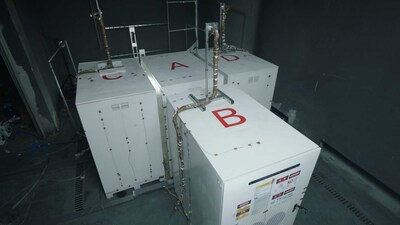
The ignition test was designed to create the most challenging verification environment in the industry while assessing the safety performance of energy storage systems under extreme ignition scenarios. To simulate severe conditions, an overloading procedure was implemented at the battery pack level to induce thermal runaway in 60 battery cells simultaneously. This method presents a substantial increase in severity compared to tests that apply to only one or a few cells.
The rigor of the evaluation was further heightened by employing the ignition testing procedure specified in UL 9540A2025, which maximized oxygen availability through an open door, fully loading all battery packs to 100% state of charge (SOC). Additionally, all proactive and passive fire-fighting systems were disabled during the tests, meaning that the ESS relied solely on its construction to withstand combustion at full energy capacity.
Outstanding Safety Performance
Under these extreme conditions, Huawei's CI GFM ESS demonstrated exceptional safety performance, reinforced by its innovative five-level protection design. This includes:
1. Thermal Isolation Between Cells: This feature effectively slows the spread of thermal runaway between cells, serving as the first line of defense for system safety.
2. Complete Metal Battery Pack Housing: The housing can withstand temperatures exceeding 1,500 °C and maintains structural integrity under severe fire exposure, thereby minimizing damage.
3. Overpressure Oxygen Blockade with Directed Smoke Venting: This innovative design diverts flammable materials and significantly reduces fire hazards.
4. Fire-Resistant Labyrinth Structure: All ESS sealing surfaces are equipped with a labyrinth structure that effectively prevents the spread of flames.
5. Enhanced Container Fire Protection: The armored container ensures comprehensive fire safety.
Solid Verification Data
Data from the tests unequivocally confirm the safety and reliability of Huawei's CI GFM ESS. When the fire temperature reached 961 °C, the maximum temperature of a neighboring ESS’s cells was merely 45.3 °C, well below the threshold for opening the explosion-proof cell vent. The system complied fully with the UL 9540A2025 requirements, with no fire spread occurring between units.
The measured maximum heat release rate (HRR) was reported at 3 MW. The entire combustion process completed in less than three hours before extinguishing itself, demonstrating efficient heat management capabilities under open-door combustion conditions.
Conclusion
The successful results of the extreme ignition test underscore Huawei Digital Power's commitment to advancing the safety and reliability of energy storage technologies. With the CI GFM ESS, industries can now leverage state-of-the-art energy storage systems designed to maintain performance and safety even in the most challenging situations. This achievement not only positions Huawei at the forefront of the energy storage sector but also sets a new benchmark in safety standards for the energy industry.
Stay tuned for more updates as Huawei continues to innovate and lead in the realm of energy solutions.
Topics Energy)
【About Using Articles】
You can freely use the title and article content by linking to the page where the article is posted.
※ Images cannot be used.
【About Links】
Links are free to use.