




Enhancing Success Rates for New Ventures with Lean Startup Training
Innovations in Business Training: Lean Startup Program
In the ever-evolving landscape of modern business, companies are increasingly confronted with the pitfalls of uncertainty and rapid change. In this context, Riskiil has introduced a groundbreaking program called the Lean Startup Training, aimed at significantly improving the success rates of new ventures while minimizing costs. This training is meticulously designed to equip participants with methodologies for value validation even in high-risk environments.
Understanding the Market Challenges
The contemporary business environment is characterized by its volatility. Traditional, rigid planning methods often lead to substantial financial losses when newfound discrepancies between products and customer needs emerge only after heavy investments. Recognizing this issue, numerous organizations are now emphasizing the elimination of 'wasted development', effectively requiring skills that allow for the agile establishment of businesses. The purpose of the Lean Startup Training Program is to provide guidance in navigating this ambiguity through iterative hypothesis verification, enhancing the potential for new business initiatives' success.
Overview of the Lean Startup Training Program
Riskiil's training focuses on the fundamental principles of constructing businesses that resonate with customer demand, all while cutting unnecessary costs. Here’s a brief look at the components of the training:
Target Audience
- - New business developers
- - Young employees, mid-career professionals, and managers
Skills Acquired
- - Mastery of hypothesis verification cycles in uncertain conditions
- - Enhanced capabilities in establishing high market-value ventures with minimal investment
- - Improved judgment skills for making pivots or scaling based on verified results
Unique Features of the Program
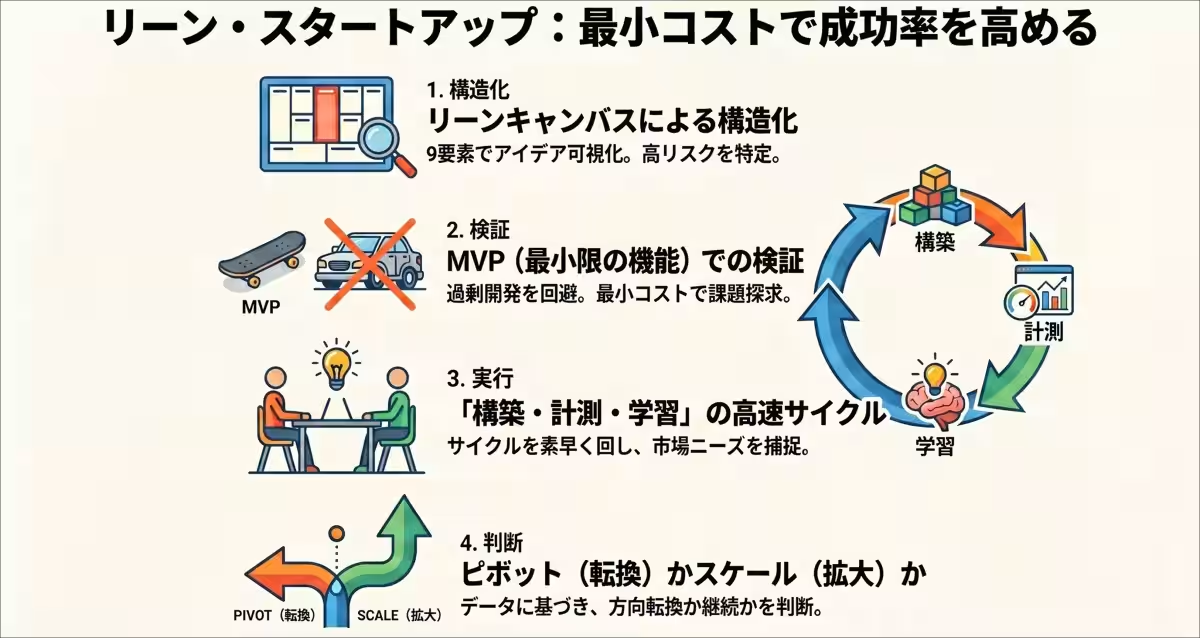
1. Understanding the Importance of Validation: Participants are guided to grasp not only the critical nature of validation but also to distinguish it from conventional methods, understanding why learning through experimentation is crucial in unpredictable settings.
2. Using Lean Canvas for Structural Analysis: Structured around nine elements, the Lean Canvas tool helps identify business risks, clearly prioritizing aspects for validation and encouraging efficient development.
3. Establishing Objective Decision-Making Criteria: By distinguishing between quantitative and qualitative data, the program lays out clear standards for decisions regarding the continuity or redirection of business ventures.
Sample Curriculum Overview
Here are select topics from the Lean Startup Training:
- - Overall Concept of Lean Startup (Comparative Understanding with Traditional Methods)
- - Hypothesis Thinking and Problem Definition (Formulating Testable Customer Problem Hypotheses)
- - Understanding Lean Canvas (Structuring Business Ideas and Identifying Risks)
- - Designing MVPs (Minimum Viable Products for Hypothesis Testing)
- - Validation and Learning (Practical Application of Build-Measure-Learn Cycle)
- - Criteria for Pivots and Scaling (Judging when to pivot or scale up)
About Riskiil
Riskiil is dedicated to offering a diverse range of training programs tailored to meet various business needs. They feature a unique flat-rate pricing structure that makes business training accessible, including the new Lean Startup Training program. Operating under the motto “More Training,” Riskiil focuses on clear pricing and practical content to assist businesses in overcoming their challenges effectively.
Note: This article reflects content valid as of May 2026.

Topics Business Technology)

【About Using Articles】
You can freely use the title and article content by linking to the page where the article is posted.
※ Images cannot be used.
【About Links】
Links are free to use.