



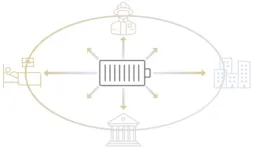
Guidelines for Safe Battery Systems in Critical Infrastructure Released
Introduction
On May 14, 2023, the National Institute of Technology and Evaluation (NITE) published the first edition of its safety guidelines for battery systems used in critical infrastructure. This document aims to ensure that essential services such as administrative services, telecommunications, and power supply remain functional during emergencies and disasters, without causing secondary disasters.
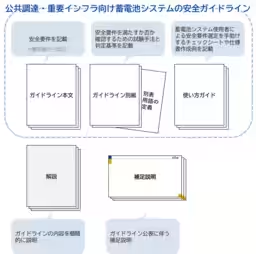
The preliminary guidelines were initially released on December 23, 2022, including a supplementary explanation. The latest edition not only solidifies the main guidelines but also provides supplementary materials, a user guide, and detailed commentary.
Background for the Guidelines
Our daily lives and economic activities heavily rely on critical infrastructures. Any disruption to their functionality can have severe repercussions. Battery systems play a crucial role in maintaining the operation of these infrastructures by providing backup power.
However, recent incidents involving battery systems have raised significant safety concerns, particularly as these systems become more prevalent due to the integration of renewable energy sources. With no established safety standards for battery systems during emergencies, NITE’s guidelines are timely and necessary.
The Ministry of Economy, Trade, and Industry (METI) has called on NITE to develop a safety guideline aimed at improving the reliability of battery systems by 2023. This initiative is particularly vital as the share of renewable energy in Japan's power generation is expected to rise significantly by 2040.
Overview of the Guidelines
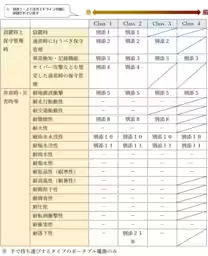
The first edition of these guidelines is designed to prevent secondary disasters, such as fires and explosions due to impacts or flooding during emergencies. By categorizing safety requirements from a user-centric perspective, these guidelines facilitate the broad application of battery systems in critical infrastructure across Japan.
Emphasizing adherence to international disaster prevention standards such as ISO 37179:2024, the guidelines include comprehensive safety requirements. They are structured based on deliberations held by committees involved in the guideline formulation.
Additional documents, such as testing methods and criteria for assessing compliance with safety standards, are included for manufacturers. Subsequent editions of the guidelines are expected to include further information on additional safety requirements.
Implications for Manufacturers and Local Governments
Battery manufacturers and system integrators are encouraged to align their production processes with the guidelines to contribute positively to the safe implementation of battery systems. Through the establishment of specifications and grant schemes by local governments, it is anticipated that compliant battery systems will proliferate in the market.
The successful adoption of these guidelines could ensure that, even in emergencies, critical services continue to function effectively, thereby enhancing public safety and resilience against disasters.
Overall, these guidelines represent a significant step forward in promoting the safe use of battery systems in essential infrastructure, directly contributing to national safety and disaster preparedness.
Conclusion
In summary, the introduction of safety guidelines for battery systems by NITE marks a crucial advancement in safeguarding Japan's critical infrastructure. Open communication and collaboration among battery manufacturers, integrators, and local governments will be essential to maintaining and enhancing the reliability of essential services during adverse conditions.
Topics Policy & Public Interest)

【About Using Articles】
You can freely use the title and article content by linking to the page where the article is posted.
※ Images cannot be used.
【About Links】
Links are free to use.