




Development of High-Performance Low-Temperature Thermal Oscillator Using Superconductors
Development of High-Performance Low-Temperature Thermal Oscillator Using Superconductors
Recent research has led to the development of an innovative ultra-low temperature thermal oscillator by jointing high-purity lead (Pb) with copper (Cu) using soldering. The functionality of this thermal oscillator is grounded in the drastic changes in thermal conductivity during the superconducting to normal conducting transition. This novel device can generate thermal oscillations with minute vibrating magnetic fields. The mean temperature stabilization achieved through this setup offers promising applications for calibrating ultra-low temperature sensors, such as Transition Edge Sensors (TES) used in astrophysical studies, as well as in precise low-temperature thermal property measurements.
Ultra-low temperature thermal oscillators are designed to operate around a few Kelvin, producing alternating heat that is essential for sensing technologies and precision material testing in space observation contexts. Traditional methods of generating alternating thermal oscillations involve toggling the heater on and off, resulting in heating during the ON phase and cooling during the OFF phase. However, the differences in thermal relaxation mechanisms under these two conditions present challenges in maintaining average temperature stabilization, achieving high-frequency oscillations, and controlling the waveform effectively. Thus, there has been a pressing need for a new class of thermal oscillators where the heating and cooling mechanisms are interoperable.
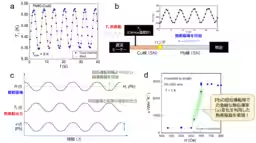
Professor Yoshikazu Mizuguchi and research fellow Poonam Rani from the Graduate School of Science at Tokyo Metropolitan University successfully created a thermal oscillator by soldering high-purity Pb and Cu wires. They achieved thermal oscillation at temperatures below the superconducting transition temperature of Pb (7.2 K). Utilizing the steep change in thermal conductivity during the superconductor's magnetic-field-driven transition, they applied a vibrating magnetic field to induce oscillating thermal conductivity in Pb, which was effectively transmitted to the Cu wire, producing uniform thermal vibrations without magnetic thermal resistance.
Future investigations into the high-frequency characteristics of this thermal oscillator are anticipated to yield diverse scientific and practical applications, notably in calibrating ultra-low temperature sensors and conducting precision thermal property measurements. This significant research outcome was reported on May 28 in the journal Materials Today Advances, published by Elsevier. Parts of this study received funding from JST's Strategic Creative Research Promotion Program ERATO and young researcher support from Tokyo Metropolitan University.
Research Background
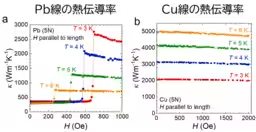
The team has concurrently focused on the development of magnetic thermal switching materials and thermal diodes utilizing superconductors. These components are critical for thermal control at ultra-low temperatures and are expected to undergo further enhancements in the future. Their thermal switching materials leverage the high thermal conductivity and significant changes at the transition temperature typical of type I superconductors. For instance, precise thermal conductivity measurements indicated that high-purity Pb wires achieve a magnetic thermal switching ratio exceeding 20 times when transitioning from a superconductive to a normal conductive state. Additionally, the designs employing Pb-Al junctions have been explored, leveraging the notable changes in thermal conductivity in response to magnetic fields.
The device designed in this study addresses the challenges faced by conventional oscillators. The generated thermal oscillation at a few Kelvin could significantly advance their application in temperature calibration for ultra-low temperature sensors and in precise measurements of material properties.
Details of the Research
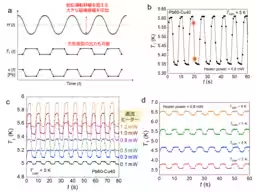
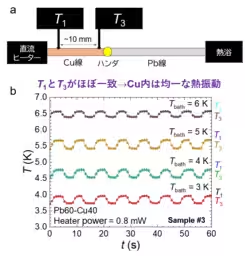
In the current study, pure (5N) Pb and Cu wires were soldered together using Sn-Pb solder, fabricating the required materials for the thermal oscillator. They created samples with varying lengths of Pb and Cu ratios, including Pb60-Cu40, Pb50-Cu50, and Pb40-Cu60. Experimentally, the Pb60-Cu40 sample successfully generated sine wave-like thermal oscillations. The setup involved connecting the Pb side to a thermal bath while placing a DC heater on the Cu side. Thermal vibrations were monitored using a Cernox thermometer attached to the Cu wire.
Measurements confirmed that the thermal oscillation output mirrored the time-varying magnetic field applied. Notably, when larger magnetic field amplitudes were applied, the thermal oscillations shifted closer to a square wave form in output, indicating robust behavior even under strong magnetic influences. The last set of measurements, taken from varying distances along the Cu wire, established that uniform thermal oscillations occurred, presenting significant advantages for applications requiring diverse thermal output configurations.
Significance and Potential Impacts
The thermal oscillator developed in this study is anchored on new principles leveraging drastic shifts in thermal conductivity during the superconducting transition rather than conventional heater ON-OFF cycles. This innovation emphasizes the necessity for further development of similar oscillators utilizing the same principles evidenced by the performance of high-purity metallic superconductors. The prospects are vast, with potential applications centered around accurate temperature calibration of ultra-low temperature sensors like TES and enhancements in efficiently measuring low-temperature properties involving specific heat and thermoelectric coefficients. The ongoing validation of the maximum possible following frequency of this operational principle is expected to broaden the scope of applications significantly.
Terminology Guide
- - Transition Edge Sensor (TES): A detector leveraging superconducting characteristics to measure energy by observing sharp changes in resistance due to absorbed X-ray energy.
- - Superconductivity: A quantum phenomenon occurring at low temperatures, characterized by zero electrical resistance and perfect diamagnetism.
- - Thermal Conductivity: A physical quantity indicating a material's capability to conduct heat, with higher values signifying easy thermal transmission.
- - Magnetic Thermal Switching Materials: Materials whose thermal conductivities variably respond under applied magnetic fields, utilized for ‘thermal switching.’
- - Thermal Diode: Material that allows heat flow directionality, creating a rectification effect based on temperature differences.
This pioneering study suggests a promising future for advanced thermal management in scientific applications and beyond.


Topics Other)

【About Using Articles】
You can freely use the title and article content by linking to the page where the article is posted.
※ Images cannot be used.
【About Links】
Links are free to use.