



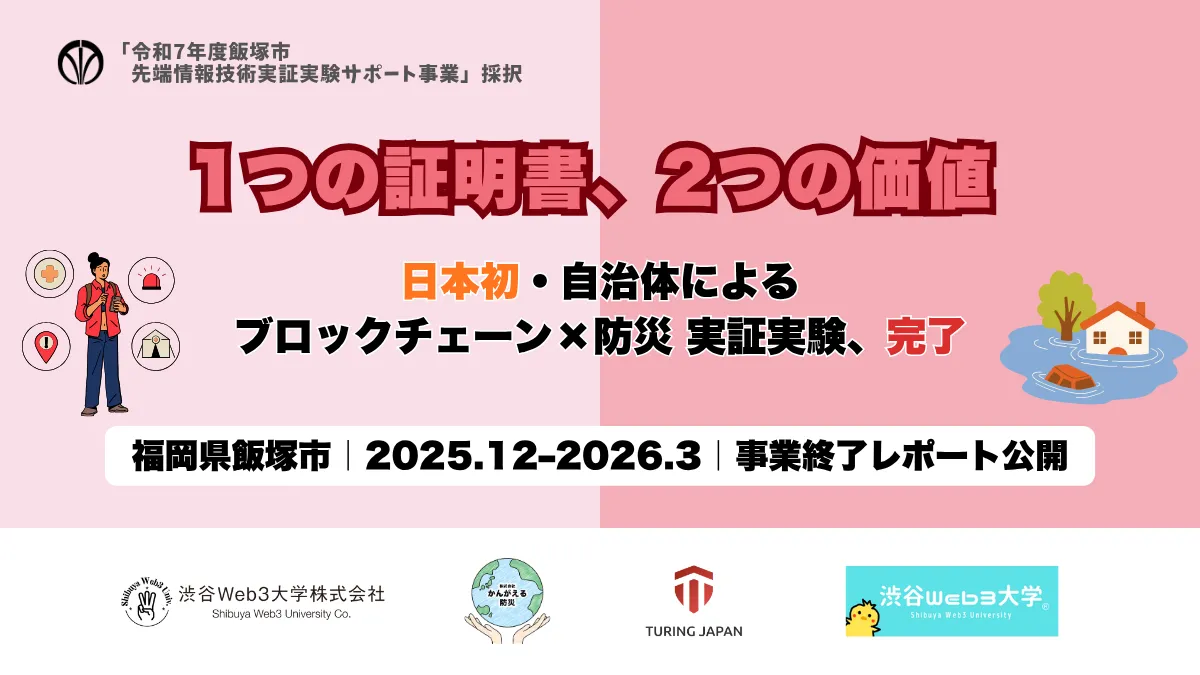
Japan's First Local Government Blockchain Disaster Prevention Project Successfully Concludes in Iizuka
Japan's First Local Government Blockchain Disaster Prevention Project Successfully Concludes in Iizuka
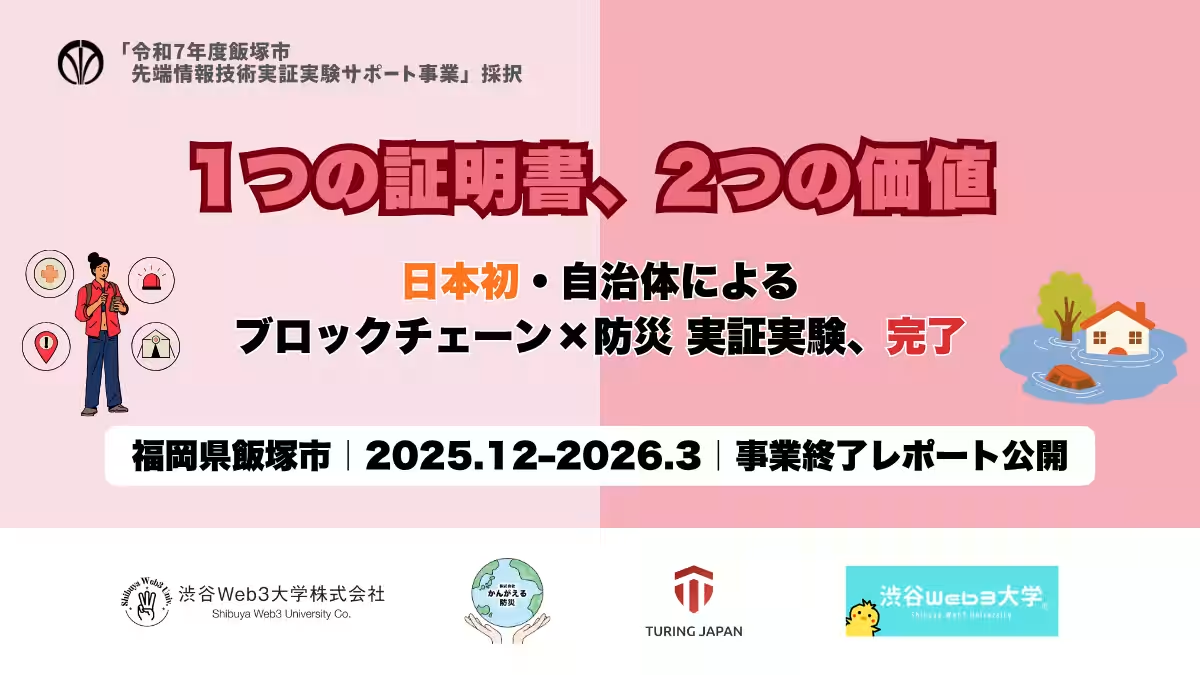
In a groundbreaking initiative, Iizuka City, together with three companies, has successfully completed Japan's first local government demonstration project utilizing blockchain technology for disaster prevention. This initiative, which combines Decentralized Identifiers (DID) and Verifiable Credentials (VC), was carried out from December 2025 to March 2026, with the findings summarized in a comprehensive report submitted on July 27, 2026.
Project Overview
The project, officially titled the "Fiscal Year 2023 Iizuka City Advanced Information Technology Demonstration Experiment Support Project," was designed to explore the use of blockchain in enhancing disaster response capabilities. Iizuka City, known for its forward-thinking approach, was the first municipality in Japan to declare a positive stance on blockchain technology back in November 2021. The project involved collaboration with:
- - Shibuya Web3 University (represented by CEO Hitoshi Kitamura)
- - Kangaeru Bosai, a disaster prevention consulting firm led by President Toshiyuki Takagi
- - Turing Japan, headed by President Mari Ishikawa
Objectives and Techniques
The project was based on a core concept of "One VC, Two Values," aiming to transform a single certificate into two distinct functionalities: serving as proof of disaster preparedness during normal times and enabling personal identification at evacuation centers during emergencies.
To this end, DID/VC technology was utilized with the support of two types of blockchain: IOTA and Toshiba's DNCWARE Blockchain+. The project included a series of workshops, quizzes, and role-playing exercises designed to enhance community engagement in disaster preparedness.
Challenges and Insights
One of the key motivations for selecting disaster prevention as the project focus stemmed from the on-ground realities in Iizuka City. The local disaster response had relied heavily on traditional paper-based processes, which proved inefficient during chaotic situations. Stakeholders recognized the urgent need for a shift to a more digital approach, hence the focus on streamlining evacuation center operations.
This project not only aimed to improve operational efficiency but also sought to instill a culture of continuous disaster preparedness among residents. The quizzes, designed without fixed answers, aimed to encourage critical thinking about disaster scenarios. This initiative was particularly impactful for community members, with participants expressing an eagerness for continued engagement beyond the project duration.
Results Achieved
The project yielded impressive results in terms of improving response times during emergencies. Through simulations, it was demonstrated that using DID/VC reduced the time for verifying identities at evacuation centers to approximately 69 seconds, compared to 151 seconds using traditional methods. The promising outcomes underscore the potential for blockchain technology to fundamentally transform municipal disaster response protocols.
Key Takeaways
Following the conclusion of the project, stakeholders emphasized that while innovative, the introduction of technology must be complemented by a human-centered approach to ensure its viability and effectiveness. Communication barriers were identified as a challenge when introducing new terminologies like DID and VC, suggesting the need for user-friendly adaptations moving forward.
Project leaders recognized that successful implementation requires integrating blockchain technology with existing municipal systems to enable seamless operations during disasters. With a strong foundation in community engagement and forward-thinking administration, the project has begun paving the way for enhanced disaster management frameworks in Iizuka City and beyond.
Future Directions
Looking ahead, Iizuka City plans to continue its exploration of blockchain for disaster prevention in future fiscal years. The insights gained from this initial study will guide the development of additional projects aimed at utilizing technology for disaster preparedness, including unique identification methods for evacuees and enhanced collaboration with local residents.
Through this initiative, Iizuka City has not only set a precedent in Japan for harnessing advanced technologies for public safety but has also reinforced the importance of fostering a culture of resilience and preparedness within local communities. The journey is ongoing, with future efforts expected to bring even greater innovations in disaster prevention and community engagement.


Topics Policy & Public Interest)


【About Using Articles】
You can freely use the title and article content by linking to the page where the article is posted.
※ Images cannot be used.
【About Links】
Links are free to use.