



Innovative Sensors for Early Detection of Landslide Hazards in Japan
Detecting Landslide Hazards: A New Approach
Landslides are a significant environmental threat in Japan, primarily triggered by heavy rainfall leading to surface collapse. To mitigate this risk, early detection mechanisms that monitor both soil moisture and slope angles are essential. However, traditional methods have faced challenges, particularly when dealing with soil that retains high moisture levels, which can result in inaccuracies. Additionally, the inability to simultaneously measure slope angles has hindered effective monitoring.
Recognizing these issues, the Tokyo Metropolitan Industrial Technology Research Institute (Tokyo Tech) and Daiki Chemical Engineering Co., Ltd. have collaborated to develop a groundbreaking sensor system. This innovative technology is capable of simultaneously monitoring soil moisture and slope angles with high precision, even in water-saturated soils. The advancement is expected to significantly enhance the early detection of surface collapse during heavy rainfalls, promoting public safety and proactive disaster management.
Monitoring Landslide Hazard Zones
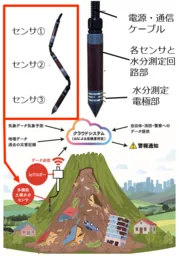
The new sensor system can accurately measure moisture content and slope angles at different soil depths, which is crucial for reliable landslide predictions. Some notable advantages of this system include:
- - High precision measurement of moist soils: The sensors can gauge water content accurately even in saturated conditions, which has historically been a challenge for previous technologies.
- - No need for extensive excavation: The installation of the sensors does not require large-scale digging, making it more feasible for rapid deployment.
- - Data collection at varying depths: The technology allows for the acquisition of necessary data at depths of approximately 2 meters, providing a comprehensive insight into soil conditions.
Technical Highlights
The effectiveness of the new sensor lies in its innovative design and functionality:
- - Electrode Structure for Precise Measurements: The sensor features a specialized electrode structure (currently under patent application) that accurately measures dielectric properties of moisture in the soil from the side.
- - Integrated slope sensors: It incorporates a slope sensor with a resolution of 0.01 degrees, enabling simultaneous measurements at different depths. The preliminary criterion for identifying pre-collapse phenomena is set at a mere 0.02 degrees per hour.
With these advancements, the potential for more reliable early warnings of landslides is significantly improved, potentially saving lives and property during extreme weather events.
Future Plans
Daiki Chemical Engineering Co., Ltd. plans to launch these sensors for commercial sale starting in September. Furthermore, there will be a live demonstration of the technology at the Crisis Management Industry Exhibition 2025, to be held at Tokyo Big Sight from October 1st to 3rd. This exhibition will provide a platform to showcase the sensor's capabilities and promote its applications in disaster risk mitigation.
In summary, as Japan faces increasing risks from natural disasters exacerbated by climate change, innovations like these sensors offer promising solutions for enhanced safety and preparedness against landslide hazards.
Topics Environment)
【About Using Articles】
You can freely use the title and article content by linking to the page where the article is posted.
※ Images cannot be used.
【About Links】
Links are free to use.