



Protecting Privacy in Financial Transactions: New AI Techniques for Fraud Detection
Enhancing Fraud Detection with AI
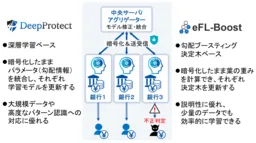
A recent collaboration among the National Institute of Information and Communications Technology (NICT), Kobe University, and Eltes has yielded promising results in the fight against fraud in the banking sector. Utilizing innovative privacy-preserving federated learning technologies named DeepProtect and eFL-Boost, the researchers successfully conducted a proof-of-concept experiment to detect fraudulent remittances in partnership with three banks: Chiba Bank, China Bank, and Sumitomo Mitsui Trust Bank.
Background of the Study
The initiative, backed by the Japan Science and Technology Agency (JST), aims to develop secure inter-organizational data collaboration techniques that respect user privacy. Since 2016, these institutions have been dedicated to advancing big data analysis methods employing artificial intelligence (AI) to detect anomalies and fraud in financial transactions, particularly focusing on protecting the sensitive data of users.
The scope of the research has evolved since its inception. In 2019, it transitioned into a practical study phase, including real-world implementation of a fraud detection system with the cooperation of banks. By 2022, NICT and Kobe University set out to engineer a social implementation of fraud detection systems based on continuous learning models, which would not only enhance accuracy but also adapt to the ever-evolving nature of fraudulent activities.
The Experiment
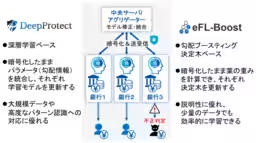
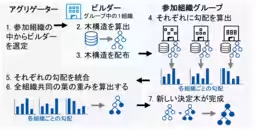
Conducting this real-world experiment was no small feat. NICT used DeepProtect, a deep learning-based approach, while Kobe University employed eFL-Boost, based on gradient-boosted decision trees. The banks did not share direct data with one another. Instead, they collaboratively built AI models through federated learning, preserving privacy while maximizing the utility of shared insights.
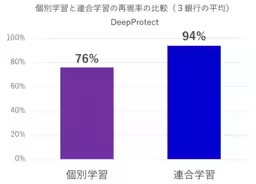
The experiment was meticulously designed to accommodate continuous learning; as fraudulent techniques improve, data inputs can be adjusted, allowing the models to learn from fresh data. The collaboration proved fruitful, resulting in an 18-point improvement in recall rate when comparing the federated learning models against those developed by each bank independently.
Results and Analysis
In evaluating the efficacy of the models, the joint AI systems achieved an impressive recall rate of over 89% across all three banks in detecting fraudulent activities. To further bolster these findings, researchers generated synthetic transaction data from frozen accounts and analyzed the model’s performance against this data, leading to improvements in accuracy.
Following the successful conclusion of this proof-of-concept experiment, a subsequent phase is set to initiate with Terra Axon, a startup stemming from Kobe University. This phase will involve domestic experimental validation in collaboration with one of the participating banks to further assess the AI fraud detection system in a real banking environment.
Future Prospects
Looking ahead, the implications of this study extend beyond banking. The advancement of these federated learning techniques, honed through this experimentation process, presents a significant opportunity to apply them across industries where data privacy is paramount, such as healthcare, retail, and logistics. The aim is to harness these powerful AI tools to address broader societal challenges requiring strict data protection.
Collaboration continues to be a key component of success, as the institutions involved share findings to tailor these technologies to emerging user needs and refine their functionalities. Further basic research is anticipated to adapt to the evolving landscape of fraud detection and data privacy in various sectors.
Topics Financial Services & Investing)

【About Using Articles】
You can freely use the title and article content by linking to the page where the article is posted.
※ Images cannot be used.
【About Links】
Links are free to use.