



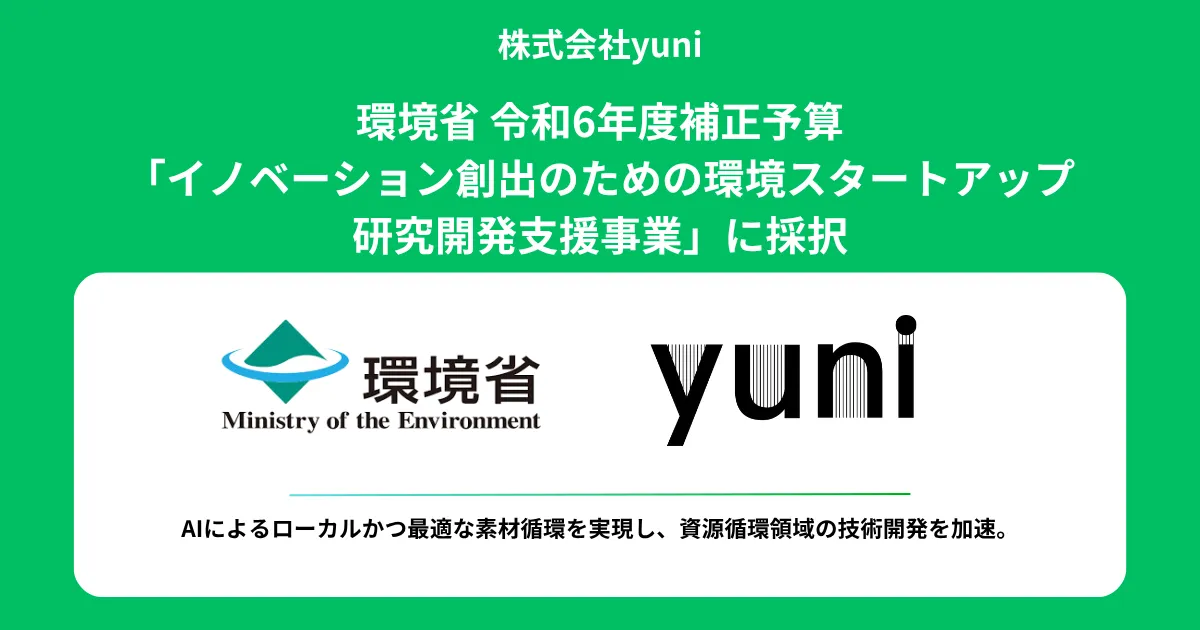
Transforming Waste into Resources: yuni's Innovative AI Matching System Gets Government Support
yuni Secures Funding for Sustainable Innovation
In an exciting development for environmental sustainability, yuni, a startup based in Tokyo’s Shibuya district, has been selected for the Environmental Ministry's fiscal year 2024 supplementary budget program. This initiative, dubbed “Innovation Creation for Environmental Startups,” aims to enhance sustainable practices and significantly improve resource recycling in Japan.
Objectives of the Project
The core of yuni’s project is focused on the development of an AI matching system designed to create local yet optimal material recycling systems. The goal is to transform waste into recyclable materials, thereby advancing the local production and consumption model that yuni has pioneered since its founding in 2019.
Key elements include:
- - Developing an AI agent that can efficiently match waste producers to recycling facilities and material users.
- - Seeking to improve the recycling rates and reduce transportation costs through waste processing innovations.
- - Aiming for a nationwide optimal resource recycling system.
Current Challenges in Resource Recycling in Japan
Japan faces considerable challenges when it comes to waste management, generating approximately 40 million tons of general waste and 370 million tons of industrial waste annually. Notably, about 100 million bedding items are discarded each year, with a recycling rate as low as 2%—a significant environmental issue.
The existing recycling system has inherent difficulties, including:
1. Ineffective Matching: Current matching systems between waste producers, recycling businesses, and material end-users are inefficient. These systems do not cater to the local variances in waste types and amounts, nor do they access the diversity of recycling technologies.
2. Challenges in Local Recycling: Transportation costs and CO2 emissions complicate the economics of recycling, making it tough to assess local supply-demand balance accurately.
3. Scalability Limitations: The process is overly dependent on personal outreach and lacks efficient data-driven methods to optimize nationwide operations.
yuni's Approach
With a vision to transition Japan from a wasteful society to one that values resources, yuni has established several recycling factories across three locations (Nishiwaki City in Hyogo Prefecture, Tsuru City in Yamanashi Prefecture, and Izumisano City in Osaka Prefecture). Collaboration with municipalities in regions like Tokyo and Yamagata has been instrumental in this process.
In 2025, yuni is set to further its commitment by participating in another initiative aimed at promoting local consumption of recycled materials.
Research and Development Focus
In this funded project, yuni aims to develop several key functionalities:
- - Optimizing Matching for Waste and Recyclables: The system will analyze various waste characteristics and offer the best recycling methods, thereby streamlining demand forecasting and supply planning.
- - Assessing Local Economic Viability: Evaluating transportation costs and CO2 emissions will help compare local versus interstate recycling strategies.
- - Supporting Development of Recycled Material Uses: Investigation into new materials created from combining various waste will be undertaken, aligning with market needs.
- - Data-Driven Business Expansion: Collecting and analyzing waste data per region will guide future factory location decisions and enhance collaborations.
By shifting to an AI-driven approach, yuni is committed to improving the overall efficiency and effectiveness of resource recycling in Japan.
Expected Outcomes
The potential outcomes of this initiative are far-reaching:
- - Environmental Benefits: Significant CO2 emissions reduction from minimized transportation distances and an increase in resource recycling rates.
- - Economic Gains: Improved profitability in resource recycling businesses, lowering logistics costs and enhancing efficiency.
- - Social Impact: Stimulating regional economies through local recycling initiatives, fostering job creation, and increasing environmental awareness among communities.
The SBIR Program
This endeavor is a part of the Small Business Innovation Research (SBIR) program initiated by the Environmental Ministry, which aims to support startups engaging in environmentally beneficial research and development. Under this program, yuni has been granted funding in the Phase 2 open innovation segment, marking a significant milestone in their sustainability efforts.
Future Plans and Collaborations
With aspirations for a scalable AI matching system set for completion by the end of 2025, yuni plans to implement projects in collaboration with other factories and municipalities across Japan. The company's vision includes expansions into other regions, including central and southern Japan, as well as contributing to global resource recycling efforts.
Moreover, yuni is actively seeking partnerships with municipalities and companies interested in engaging in effective waste management and sustainable practices. They invite potential collaborators in the fields of recycling and AI development to join their initiative.
About yuni
Founded in October 2019, yuni aims to transition Japan from being a waste-intensive nation to a resource-centric society. With a keen focus on beddings, yuni’s susteb service rescues bedding from incineration and facilitates its transformation into recycled materials. Guided by a mission to eliminate waste incineration, yuni continues to innovate and expand its operations in the resource recycling sector.
Topics Environment)
【About Using Articles】
You can freely use the title and article content by linking to the page where the article is posted.
※ Images cannot be used.
【About Links】
Links are free to use.