



Exploring Japan's Economic Future Through AI and Automation in Waseda's Podcast
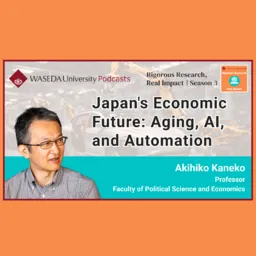
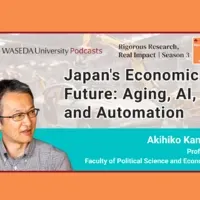
Waseda University has recently released the second episode of its English-language podcast series "Rigorous Research, Real Impact" for the third season. Titled "Japan’s Economic Future: Aging, AI, and Automation," this episode addresses the critical issue of how automation and AI, coupled with demographic changes, will impact Japan's long-term economic growth.
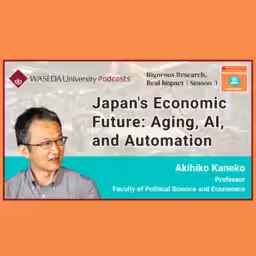
Hosted by Waseda student Kanon, this episode features an insightful discussion with Professor Akihiko Kaneko from the School of Political Science and Economics. Together, they delve into pressing questions about the relationship between technological innovation, inheritance, and intergenerational asset transfer. They explore how different motivations for leaving inheritances can influence economic growth, and how Japan's challenges of an aging population and decreasing labor force raise questions about the role of automation in enhancing productivity.
One key point highlighted during their discussion is the importance of education and purposeful reskilling in addressing disparities between workers, emphasizing that technology cannot be the sole solution to these issues. They engage in an exploration of how automation can support productivity increases in a uniquely Japanese context, identifying the challenges that arise from an ageing population, which may further emphasize the need for enhanced workforce training and adaptation.
In addition to these discussions about Japan’s socioeconomic landscape, Professor Kaneko also sheds light on Waseda University’s English degree programs. These programs give students the chance to learn alongside peers from diverse linguistic and cultural backgrounds, fostering a deep understanding of global economic issues while building valuable international networks. This unique educational approach aligns perfectly with the podcast's aims of connecting academia to real-world challenges, making it a fitting resource for students and professionals alike.
The podcast is available on various platforms including Spotify, Apple Podcasts, Amazon Music, and YouTube, making it accessible to a broad audience seeking to understand the implications of research on societal challenges. Each episode runs for about 15 minutes, featuring eight Waseda researchers, along with three student hosts, who present their findings in an engaging and comprehensible manner. The goal is to clarify how contemporary research intersects with pressing news and issues, making complex subjects accessible to all listeners.
The series will explore a range of topics throughout its third season, such as Japan’s labor and immigration issues, business practices, and cultural insights, all while emphasizing Waseda’s commitment to research and education. Future episodes will cover pressing subjects that influence not only Japan but the world at large, thus appealing to audiences interested in Japanese society and global challenges.
The upcoming episodes include discussions on labor shortages due to migration on October 14, presented by Lecturer Parvin Shahida, followed by Professor Nobuki Hasegawa's exploration of sustainable business realities on November 4, and concluding with Professor Naoko Nemoto regarding the intersection of social good and business practices on November 25.
As Waseda University continues to enhance its global profile, ranking 61st in "Arts & Humanities" and 78th in "Social Sciences & Management" in the QS World University Rankings by Subject for 2026, it becomes evident that the university is not only a hub for academic excellence but also a beacon for international cooperation in education, particularly for international students. Waseda proudly welcomes the largest number of international students in Japan, further underlining its pivotal role in higher education.
This podcast series is a fantastic opportunity for anyone interested in studying abroad at Waseda, as well as those keen on understanding more about Japan and its relationship to overarching global issues. Each episode enhances listeners’ perspectives while connecting them with ongoing research at the university, ultimately contributing to a deeper awareness of economic dynamics in an increasingly complex world.

Hosted by Waseda student Kanon, this episode features an insightful discussion with Professor Akihiko Kaneko from the School of Political Science and Economics. Together, they delve into pressing questions about the relationship between technological innovation, inheritance, and intergenerational asset transfer. They explore how different motivations for leaving inheritances can influence economic growth, and how Japan's challenges of an aging population and decreasing labor force raise questions about the role of automation in enhancing productivity.
One key point highlighted during their discussion is the importance of education and purposeful reskilling in addressing disparities between workers, emphasizing that technology cannot be the sole solution to these issues. They engage in an exploration of how automation can support productivity increases in a uniquely Japanese context, identifying the challenges that arise from an ageing population, which may further emphasize the need for enhanced workforce training and adaptation.
In addition to these discussions about Japan’s socioeconomic landscape, Professor Kaneko also sheds light on Waseda University’s English degree programs. These programs give students the chance to learn alongside peers from diverse linguistic and cultural backgrounds, fostering a deep understanding of global economic issues while building valuable international networks. This unique educational approach aligns perfectly with the podcast's aims of connecting academia to real-world challenges, making it a fitting resource for students and professionals alike.
The podcast is available on various platforms including Spotify, Apple Podcasts, Amazon Music, and YouTube, making it accessible to a broad audience seeking to understand the implications of research on societal challenges. Each episode runs for about 15 minutes, featuring eight Waseda researchers, along with three student hosts, who present their findings in an engaging and comprehensible manner. The goal is to clarify how contemporary research intersects with pressing news and issues, making complex subjects accessible to all listeners.
The series will explore a range of topics throughout its third season, such as Japan’s labor and immigration issues, business practices, and cultural insights, all while emphasizing Waseda’s commitment to research and education. Future episodes will cover pressing subjects that influence not only Japan but the world at large, thus appealing to audiences interested in Japanese society and global challenges.
The upcoming episodes include discussions on labor shortages due to migration on October 14, presented by Lecturer Parvin Shahida, followed by Professor Nobuki Hasegawa's exploration of sustainable business realities on November 4, and concluding with Professor Naoko Nemoto regarding the intersection of social good and business practices on November 25.
As Waseda University continues to enhance its global profile, ranking 61st in "Arts & Humanities" and 78th in "Social Sciences & Management" in the QS World University Rankings by Subject for 2026, it becomes evident that the university is not only a hub for academic excellence but also a beacon for international cooperation in education, particularly for international students. Waseda proudly welcomes the largest number of international students in Japan, further underlining its pivotal role in higher education.
This podcast series is a fantastic opportunity for anyone interested in studying abroad at Waseda, as well as those keen on understanding more about Japan and its relationship to overarching global issues. Each episode enhances listeners’ perspectives while connecting them with ongoing research at the university, ultimately contributing to a deeper awareness of economic dynamics in an increasingly complex world.
Topics Other)


【About Using Articles】
You can freely use the title and article content by linking to the page where the article is posted.
※ Images cannot be used.
【About Links】
Links are free to use.