



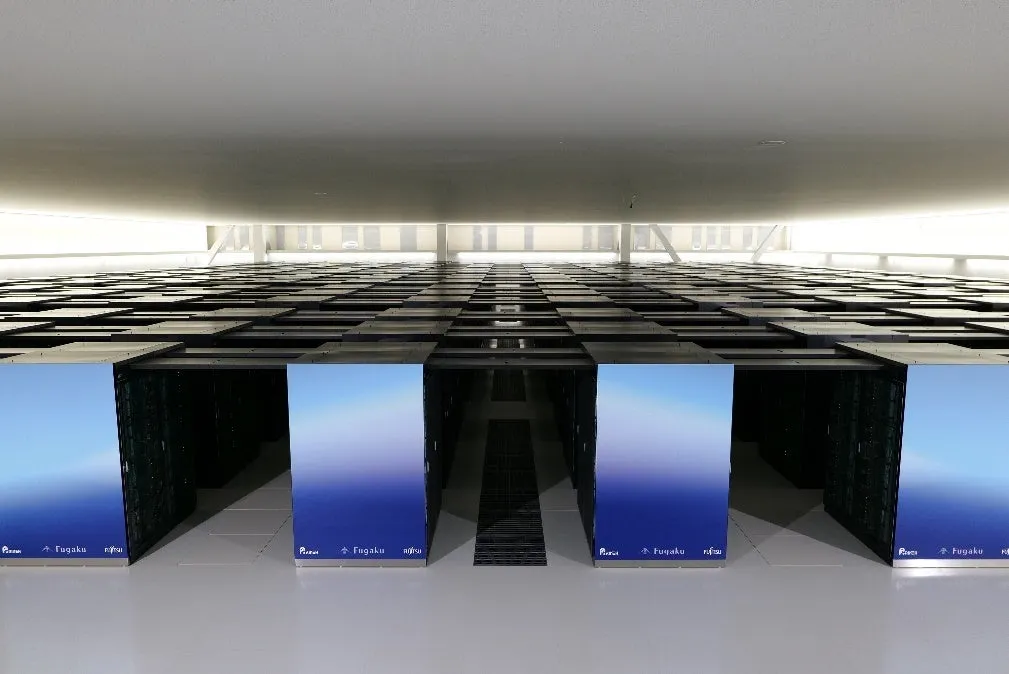
Fugaku Supercomputer Achieves Top Rank on Graph500 for 11th Consecutive Time
Fugaku's Impressive Achievement in Supercomputing
The Fugaku supercomputer, a collaboration among RIKEN, Tokyo Institute of Technology, Fixstars Corp., NTT Corporation, and Fujitsu Limited, has once again secured the top spot in the global Graph500 rankings. This high-performance computing benchmark assesses computational capabilities in large-scale graph analytics, specifically in the Breadth-First Search (BFS) category. The recent score achieved by Fugaku stands at an astonishing 204 TeraTEPS, marking its 11th consecutive win in this esteemed evaluation.
Understanding Graph500
Graph500 was established in 2010 to focus on the performance of supercomputers, particularly in handling large graph data efficiently. As societies become increasingly data-driven, the necessity for advanced graph analytics grows. The BFS benchmark not only serves as a testament to a supercomputer's capability in handling massive datasets, but it also paves the way for innovations in various industries such as social networking, logistics, and artificial intelligence. In a world where connections and relationships between data points dictate operational success, the results from this benchmark are critical.
Fugaku's Performance Metrics
In the latest assessment, the research team utilized 152,064 nodes of Fugaku, representing an impressive 95.7% of the supercomputer's total capacity, to tackle a hyper-large graph comprising approximately 8.8 trillion vertices and 140.7 trillion edges. Remarkably, this BFS problem was solved within an average time of 0.69 seconds. The successful handling of such an extensive dataset showcases the unique memory-efficiency techniques developed by the research group, enabling them to achieve a phenomenal score previously unheard of in the Graph500 ranks.
Optimization Techniques
One key aspect that led to this success was the application of optimized algorithms that address redundancy in graph exploration, efficient data partitioning across multiple nodes, and enhanced communication performance for large network architectures. Moreover, the team implemented a mechanism for the automatic exploration of seed values to mitigate performance fluctuations due to randomization, demonstrating an innovative approach to achieving consistent results.
The Role of Fugaku in Society 5.0
Fugaku is not just a supercomputer; it represents Japan's commitment to advancing societal goals through technology, particularly in pursuit of Society 5.0. This concept embodies an integrated society where advancements in AI, IoT, and big data foster both economic growth and social solutions. As such, Fugaku is positioned as a pivotal infrastructure in realizing these ambitions, with a focus on sustainable development.
Future Directions
The collaborative team behind Fugaku continues to push the boundaries of what's possible in high-performance computing. Upcoming projects will delve into reducing computational load through pre-processing methods and enhancing data compression techniques further. With continued innovation and a keen focus on real-world overlaps with sophisticated data theory, the future looks promising for applications stemming from this groundbreaking work.
Through its remarkable achievements, Fugaku not only solidifies its standing at the forefront of computational science but also exemplifies how such prowess can be harnessed to address pressing global challenges. As technological advancements continue to evolve, the implications of Fugaku’s success extend far beyond the realm of supercomputing, heralding a future where data can unlock new solutions to complex problems.
For further details on the rankings, please visit the Graph500 Official Website.
References
- - RIKEN Center for Computational Science website
- - GitHub repository for Fugaku's developed programs link

Topics Consumer Technology)

【About Using Articles】
You can freely use the title and article content by linking to the page where the article is posted.
※ Images cannot be used.
【About Links】
Links are free to use.