




A Collaborative Ten-Year Roadmap for Artificial Cell Construction by Over 100 Asian Researchers
A Vision for Artificial Cells: The Road Ahead
In an unprecedented move, over 100 researchers from six Asian countries have joined forces to outline a collaborative ten-year roadmap aimed at the construction of artificial cells. Their ambitious strategy, which progresses from the conceptual ProtoCell to the functional AutoCell, reflects a growing international commitment to the frontiers of synthetic biology and artificial cell research.
Key Highlights of the Roadmap
This newly released roadmap sheds light on several critical objectives intended to advance artificial cell technology:
1. Defining the Functionalities: By integrating biomolecules such as proteins and nucleic acids, the researchers aim to recreate essential cellular functions within artificial systems. The proposal outlines a two-tier strategy that starts with the development of ProtoCells, eventually leading to sophisticated AutoCells.
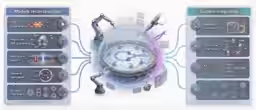
2. Utilizing AI-Driven Central Biofoundries: The roadmap advocates the use of AI-powered biofoundries to facilitate research standardization and automation, thereby spawning a new collaborative research model that promises to transform artificial cell construction immensely.
3. Strengthening Asia's Presence in Global Research: The initiative aims to bolster international visibility and collaborative efforts among Asian researchers involved in artificial cell research, consistently seeking to highlight the contributions and expertise native to this region.
The Researchers Behind the Initiative
The team spearheading this endeavor includes prominent figures from various esteemed institutions. Professor Daisuke Kiga from Waseda University, Professor Norikazu Ichihashi from the University of Tokyo, and Dr. Yoshihiro Shimizu from RIKEN, among others, collectively push forward an agenda aimed at redefining our understanding of life through synthetic biology.
Inspired by successful collaborative efforts in Europe and the United States, the SynCell Asia Initiative was formally established in 2023. Following a series of workshops, participating researchers engaged in extensive dialogue to craft a shared vision rooted in scientific frameworks that emphasize Asia’s regional strengths and perspectives.
Current Research Landscape
Research into artificial cells, especially those synthesized from biological polymers such as lipids, DNA, and proteins, poses one of the most formidable challenges in synthetic biology. Achieving this goal is pivotal, not only for expanding academic understanding of what constitutes life but also for fostering innovations in biotechnology fields, including programmed cells and biomanufacturing.
Despite significant advancements over the past 20 years, both North America and Europe have seen the emergence of distinct communities dedicated to artificial cell research. Yet, integrating these individual functionalities into a cohesive, operational artificial cell remains unresolved globally.
Core Challenges Identified
This roadmap does not shy away from identifying complex challenges that have hindered progress in artificial cell research:
- - Metabolic Continuity: Many current synthetic systems depend heavily on preloaded energy sources, significantly limiting their autonomous functionality over time.
- - Ribosome Autonomy: Current methods do not adequately replicate the complex assembly of ribosomes, a critical component for self-sustaining protein production.
- - Lack of Design Rules: There is still a pressing need for systematic guidelines based on physical principles for designing controllable modules that replicate cellular functions effectively.
- - Complex Spatiotemporal Coordination: Temporally and spatially orchestrating DNA replication, chromosome distribution, and cell division presents a significant systems-level challenge.
A Comprehensive Research Paradigm
To address these challenges, the roadmap introduces a new research paradigm based on four pivotal axes:
1. Centralized AI-Driven Biofoundries: Replace traditional decentralized approaches with AI-integrated central biofoundries that streamline the supply of standardized artificial cell components to distributed research stations.
2. Single Artificial Cell Omics: Use automated platforms to gather multi-omics data at a single-cell level, necessary for refining machine learning models.
3. Hybrid Modeling Approaches: Utilize both theoretical and data-driven models to comprehend design constraints and critical control parameters for artificial cell systems.
4. Artificial Cell Evolution: Prepare for unexpected interactions by proposing artificial evolutionary cycles even before establishing a stable cell proliferation phase, enabling exploration of emergent functions across complex layers of cellular design.
Milestones of the Research Agenda
The roadmap outlines a phased approach for the next decade:
- - Phase One: ProtoCell (Years 1-5): This phase aims to develop a stable ProtoCell based on lipid vesicles, incorporating a basic genome and synthesizing over 90% of protein types via a cell-free system.
- - Phase Two: AutoCell (Years 6-10): Transition towards an AutoCell that autonomously regenerates ribosomes from its genome, facilitating sustained growth and division cycles.
Broader Implications
The proposal put forth by the SynCell Asia Initiative embodies a remarkable convergence of capabilities across Asia, advocating for transnational collaboration and shared infrastructural efforts. This initiative challenges the existing fragmented pursuit of artificial cells, urging stakeholders to adopt a systematic and standardized approach to build coherent and operational systems.
With a specific focus on artificial cells, the outcomes from this initiative are expected to significantly impact various fields, ranging from quantitative biology to AI and biomanufacturing, propelling forth their common advancement.
Future Outlook
Successful construction of artificial cells necessitates the collective efforts of various research teams, and though challenges persist, the roadmap’s vision demonstrates a clear pathway toward meaningful advancements. By embracing AI-driven advancements and fostering international standards, the global scientific community can expect progressive strides toward the realization of autonomously functioning artificial cells.
Researchers' Reflections
The ongoing discourse initiated in the Asia region resonates with previous discussions that began in the early 2000s, leading to the formation of dedicated research communities in the U.S. and Europe. The establishment of this roadmap marks a significant milestone, further highlighting artificial cell research as a core focus in the field of synthetic biology in Asia.
For more detailed insights on this groundbreaking initiative, refer to the published work in Nature Biotechnology set to appear on May 26, 2026.

Topics Health)

【About Using Articles】
You can freely use the title and article content by linking to the page where the article is posted.
※ Images cannot be used.
【About Links】
Links are free to use.