




Successful Experiment on Long-term Preservation of Goldfish Scales for Space Research
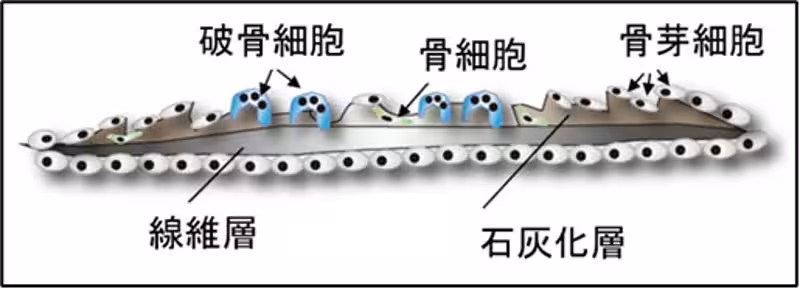
A significant breakthrough in space research has been achieved by a collaborative team from Kanazawa University, Okayama University, Rikkyo University, and Bunkyo University. Under the leadership of Professor Nobuo Suzuki from Kanazawa University’s Center for Environmental Research in the Noto Peninsula, the team successfully demonstrated that the scales of goldfish (Carassius auratus) can be sterilized using a 0.1% hypochlorous acid solution and stored at a low temperature of 4°C for over a week without changing the culture medium. Remarkably, throughout this period, the osteoblasts and osteoclasts present in the scales maintained their activity and responsiveness to gravitational forces.
Preliminary experiments have also confirmed that the cellular activity of goldfish scales can be preserved for more than three weeks under similar conditions without the need for medium replacement. This advancement offers a game-changing solution for space experiments as it eliminates the need to raise fish and pack the scales at the rocket launch site. Instead, scales can be preserved and transported from Japan to NASA launch sites in a low-temperature environment, enabling greater flexibility in case of unexpected launch delays. This success is anticipated to significantly contribute to technological advancements in space experimental research.
Commencing in 2024, this project has received funding from JAXA's Space Science Institute for its research on utilizing space environments. Furthermore, it has been selected for the 2025 Front-Loading Research Program, aiming to leverage these findings for proposed space experiments aboard the International Space Station (ISS). The impressive results from this study were published online on April 7, 2025, in the American international academic journal "Life Sciences in Space Research."
The academic credibility of this research is bolstered by a robust team of authors, including Suzuki, Kuroda, Ikegame, Takino, Tsunoda, and several more contributors from well-respected institutions. The study has been financially supported by various research grants, including the JSPS Grants-in-Aid for Scientific Research, ensuring a solid backing for future investigations into preventing and treating space-induced diseases.
This pioneering research not only advances our understanding of how biological materials can be preserved for space exploration but also represents a significant step forward for interdisciplinary collaboration among Japanese universities. Future studies will focus on further applications and the practical implications of these findings in space missions. Exciting times await, with this research paving the way for innovative experiments in extreme environments, ultimately enhancing our capacity for long-duration space travel and exploration.



Preliminary experiments have also confirmed that the cellular activity of goldfish scales can be preserved for more than three weeks under similar conditions without the need for medium replacement. This advancement offers a game-changing solution for space experiments as it eliminates the need to raise fish and pack the scales at the rocket launch site. Instead, scales can be preserved and transported from Japan to NASA launch sites in a low-temperature environment, enabling greater flexibility in case of unexpected launch delays. This success is anticipated to significantly contribute to technological advancements in space experimental research.
Commencing in 2024, this project has received funding from JAXA's Space Science Institute for its research on utilizing space environments. Furthermore, it has been selected for the 2025 Front-Loading Research Program, aiming to leverage these findings for proposed space experiments aboard the International Space Station (ISS). The impressive results from this study were published online on April 7, 2025, in the American international academic journal "Life Sciences in Space Research."
The academic credibility of this research is bolstered by a robust team of authors, including Suzuki, Kuroda, Ikegame, Takino, Tsunoda, and several more contributors from well-respected institutions. The study has been financially supported by various research grants, including the JSPS Grants-in-Aid for Scientific Research, ensuring a solid backing for future investigations into preventing and treating space-induced diseases.
This pioneering research not only advances our understanding of how biological materials can be preserved for space exploration but also represents a significant step forward for interdisciplinary collaboration among Japanese universities. Future studies will focus on further applications and the practical implications of these findings in space missions. Exciting times await, with this research paving the way for innovative experiments in extreme environments, ultimately enhancing our capacity for long-duration space travel and exploration.
Topics Entertainment & Media)
【About Using Articles】
You can freely use the title and article content by linking to the page where the article is posted.
※ Images cannot be used.
【About Links】
Links are free to use.