




Exploring the Interaction of Optical and Magnetic Skyrmions for Future Technologies
The Interaction Between Light and Magnetic Skyrmions
The existence of skyrmions, topological structures that can be found in both light and magnetic materials, has opened exciting new avenues for research in advanced information technologies. A research team from Waseda University, led by Professor Masahito Mochizuki, has made significant strides in understanding the interaction between optical skyrmions and magnetic skyrmions through computational simulations.
Understanding the Basics: What is a Skyrmion?
Initially proposed in the 1960s as a way to describe elementary particles, skyrmions have evolved to represent unique topological characteristics in various physical systems, including magnetic materials, liquid crystals, and even light itself. The magnetic skyrmion, characterized by a vortex-like arrangement of atomic magnetization, has been actively researched since its experimental confirmation in 2009, due to its potential as a carrier of information in future memory and computing technologies.
On the other hand, the optical skyrmion is formed through the spatial structuring of light's polarization and phase. Recent advancements in topological photonics, a field focused on harnessing the properties of light, have revealed a new dimension of skyrmion research that is ripe for exploration.
Research Breakthroughs in Optical Skyrmion Interaction
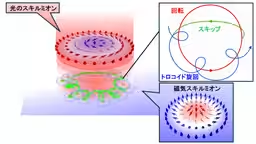
The research team employed advanced computer simulations to investigate what happens when optical skyrmions are directed toward magnetic skyrmions. They discovered that this interaction prompts three notable movements in magnetic skyrmions: rotation, skipping, and trochoidal spiraling. During the rotation, the magnetic skyrmion revolves around the center of the incoming optical skyrmion. The skipping phenomenon occurs when the magnetic skyrmion unexpectedly alters its path at certain locations. Furthermore, under specific conditions, the trochoidal movement emerges, which involves repeating a small loop while progressing along its trajectory.
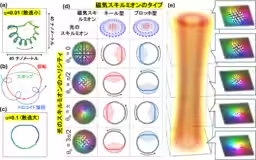
One of the key findings was that modifying the helicity—the internal structure of the optical skyrmion—allowed for selective control over the position and motion trajectory of the magnetic skyrmion. This not only demonstrates the ability to manipulate magnetic skyrmions through optical means but also suggests a promising direction for incorporating light into future information technologies.
Applications in Next-Generation Technologies
The implications of these findings stretch far beyond theoretical understanding; they point toward revolutionary applications in next-generation information technologies that fuse light and magnetism. The prospect of using light to non-contact capture and control magnetic skyrmions via

Topics Consumer Technology)




【About Using Articles】
You can freely use the title and article content by linking to the page where the article is posted.
※ Images cannot be used.
【About Links】
Links are free to use.