



New Optical Process for Targeting Orientation of Carbon Nanotubes Holds Promise for Next-Generation Semiconductor Devices
Introduction
In the world of nanotechnology, carbon nanotubes (CNTs) are highly sought after for their remarkable electrical, optical, and mechanical properties. They represent a potential breakthrough in material science, particularly for the next generation of electronic devices. However, for practical applications, precise control over the orientation of these nanotubes is crucial. A recent collaborative research effort led by Associate Professor Daichi Nishihara from Tokyo University of Science and Senior Researcher Daichi Suzuki from the National Institute of Advanced Industrial Science and Technology unveiled a new optical post-processing technique that targets only specific areas of a CNT film, allowing for the formation of localized and well-aligned structures.
The New Process
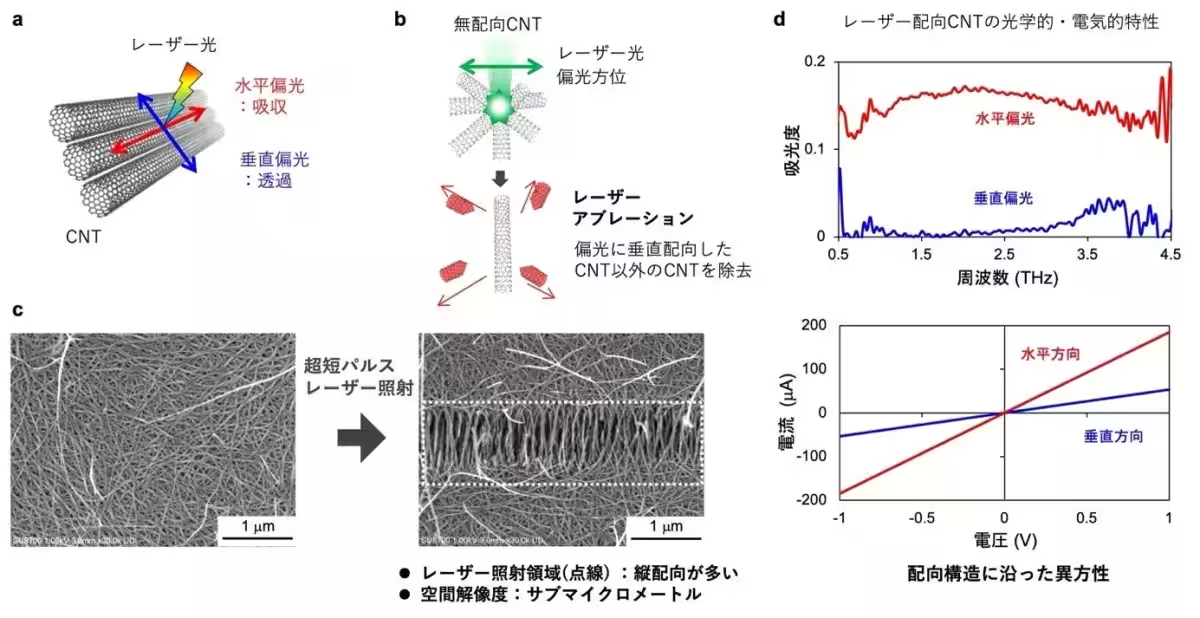
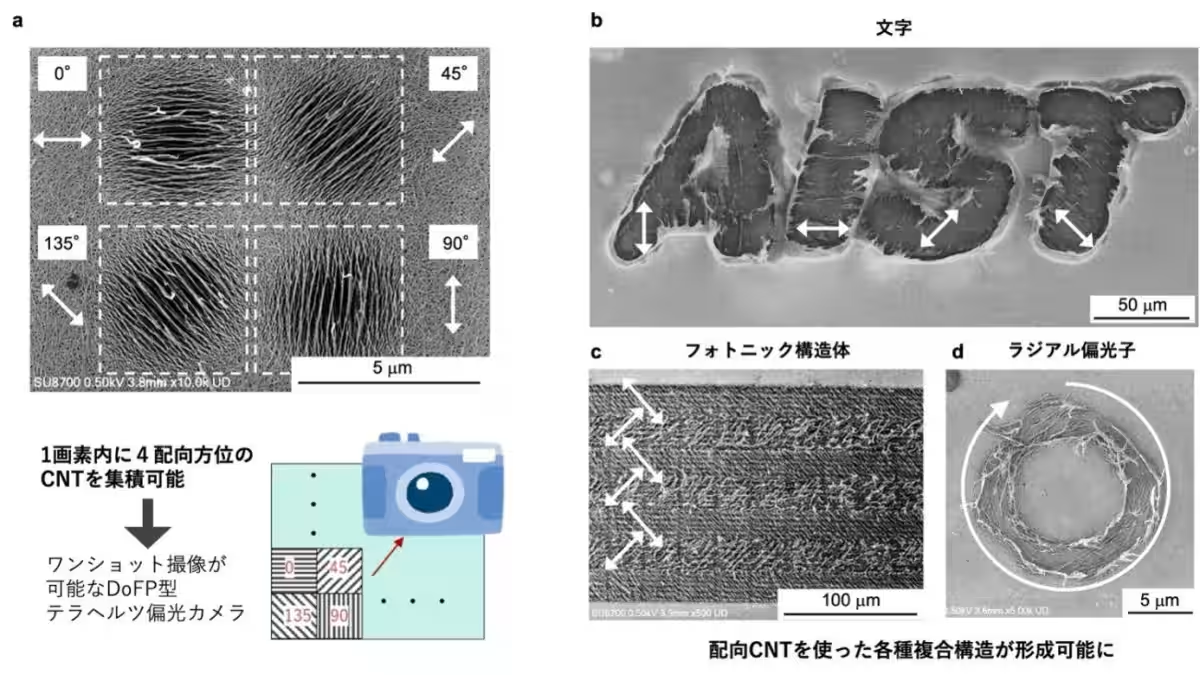
The innovative technique employs polarized ultrashort pulse lasers to manipulate the arrangement of unaligned CNT films. The researchers achieved a remarkably high quality of orientation at a sub-microscale spatial resolution, which significantly outperforms previous methodologies. By irradiating the CNTs with the laser in a controlled manner, they could induce a specific orientation only in the desired locations, enabling high-density integration of CNTs with different orientations on the same chip. This could pave the way for applications such as terahertz polarization image sensors and next-generation high-speed, low-power logic devices.
Mechanism Behind the Technique
The success of this technique lies in the use of ultrashort pulse lasers, which emit light for an extremely brief duration (on the order of tens of picoseconds). This minimizes heat diffusion into the surrounding material, allowing for a non-thermal structuring of the CNTs. As a result, only the CNTs that do not align with the plane of the polarized light are selectively ablated, maintaining the integrity of the surrounding structures. The researchers noted that the oriented CNTs showcased exceptional electrical and optical anisotropy, confirming the effectiveness of this method.
Implications for Device Development
With this newfound ability to control the orientation of CNTs at such a fine scale, the researchers aim to apply these techniques to develop advanced terahertz polarization image sensors. Furthermore, the unique abilities of CNTs could lead to groundbreaking advancements in logic devices that operate at higher speeds while consuming less power.
Future Prospects
The potential applications of this technique extend beyond imaging sensors and logic devices; it opens up new avenues in photonic structures as well. By creating complex composite structures directly on the film's surface, the researchers can now arrange CNTs in various orientations, such as words, stripes, and circles. This could revolutionize how materials are designed and utilized in electronic applications. The result of this research is set to be published in the renowned journal, Nature Communications, on August 1, 2026.
Conclusion
The development of this localized polarization-guided alignment process for CNTs may well be a crucial step towards realizing the full potential of nanotechnology in electronics. The remarkable attributes of carbon nanotubes, combined with this innovative technique, promise to usher in a new era of advanced semiconductor devices, paving the way for enhanced performance and efficiency in various applications.
Topics Consumer Technology)


【About Using Articles】
You can freely use the title and article content by linking to the page where the article is posted.
※ Images cannot be used.
【About Links】
Links are free to use.