



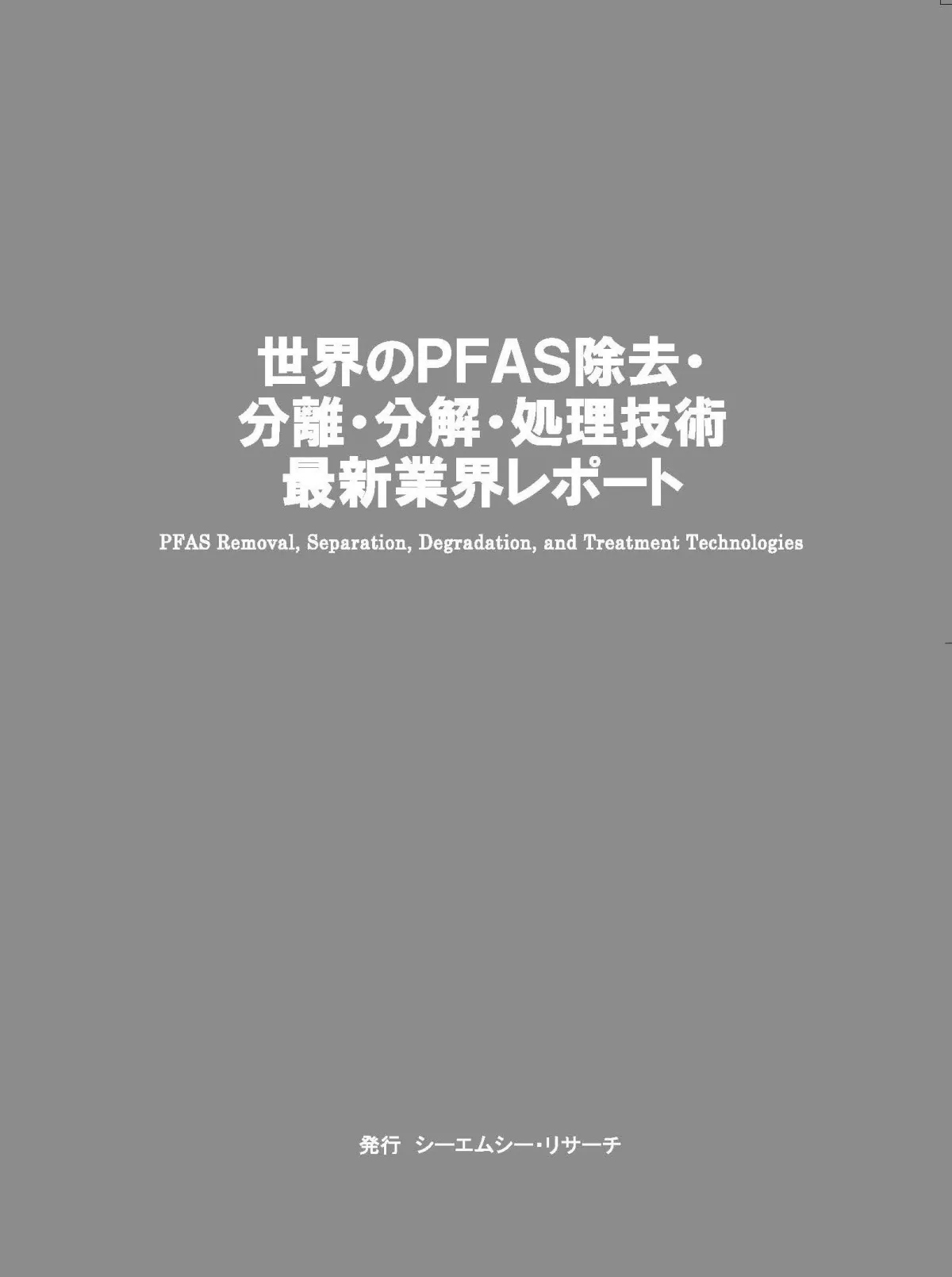
Comprehensive Report on Global Technologies for PFAS Removal, Separation, Degradation, and Treatment
New Release Overview
Title: Global Report on PFAS Removal, Separation, Degradation, and Treatment Technologies
Publication Date: November 21, 2025
Format: A4, paperback, 619 pages
Price: ¥330,000 (tax included)
Set Price (book + PDF version CD): ¥440,000 (tax included)
ISBN: 978-4-910581-72-9
Publisher: CMC Research Inc.
- ---
Special Features of the Report
- - PFAS Crisis! Overview of Accelerating Regulations and Supply Chain Restructuring: Gain insights into critical removal, separation, and degradation technologies of PFAS.
- - Detailed Analysis of Regional Schedules and Industry Impact: Predict market opportunities and risks quantitatively until 2030.
- - In-Depth Analysis of PFAS Removal Techniques: Focus on separation, adsorption, aggregation, and membrane treatment technologies, including major companies utilizing these methods.
- - Next-Generation Decomposition Technologies Explained: Detailed discussions on electrochemical oxidation, plasma treatment, supercritical water processes, and photocatalysis.
- - Investigation of Startup, Academic, and International Consortium Technologies: Comprehensive tracking of exit strategies and innovative solutions.
- - Visualizing the Technology Race from 'Separation and Concentration' to 'Complete Degradation': Thorough analysis of application fields and companies implementing these advancements.
- - Industry Analysis of Cooling Equipment: Examination of chiller, cooling tower, heat exchanger, and CDU features.
- - Case Studies of PFAS Contamination Remediation Projects: Review of techniques employed by participating companies.|
Context of Publication
PFAS (Per- and polyfluoroalkyl substances), known for their outstanding properties like water and chemical resistance, have supported a multitude of industries, including semiconductors, aerospace, energy, medical, food packaging, and textile processing. However, their chemical stability also leads to extreme persistence in the environment, bioaccumulation, and potential toxicity, rendering them subjects of global regulation, often referred to as “forever chemicals.” Significant regulatory proposals spearheaded by the European Chemicals Agency (ECHA), stringent water quality standards set by the US Environmental Protection Agency (EPA), and proactive policies in various Asian countries expand these challenges into geopolitical concerns rather than merely regional issues.
Companies are now faced with a heightened responsibility. The imperative has shifted from merely reducing usage to ensuring the recovery and safe degradation of PFAS already released into the environment. While traditional technologies like activated carbon adsorption and ion exchange resins have reached maturity, the burden of handling concentrated sludge is rapidly increasing. Risks associated with incineration by-products, escalating landfill regulations, and rising disposal costs highlight the limitations of existing treatment models.
In response, innovative technologies are emerging, including electrochemical oxidation, plasma decomposition, supercritical water oxidation, and photocatalytic reactions. However, uncertainty remains regarding their implementability, economic feasibility, and scalability, making technology selection an integral decision for maintaining competitive advantage.
The crisis has surpassed mere symptoms. Stricter regulations are being implemented exponentially, with


Topics Environment)
【About Using Articles】
You can freely use the title and article content by linking to the page where the article is posted.
※ Images cannot be used.
【About Links】
Links are free to use.