



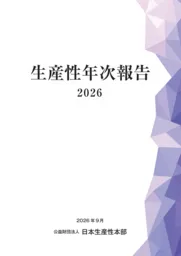
The 2026 Annual Report on Productivity Released by Japan Productivity Center: Insights on AI's Impact on Employment
The 2026 Annual Report on Productivity Released by Japan Productivity Center
On September 30, the Japan Productivity Center (JPC), a public foundation dedicated to enhancing productivity, announced its latest findings through the "2026 Annual Report on Productivity." This marks the fourth release since the inception of this biannual report aimed at offering insights into fostering an environment conducive to innovation, crucial for improving Japan's productivity.
The current report encapsulates the activities of the "Innovation Conference," spearheaded by Hiroko Ota, vice chairperson of JPC and president of the National Graduate Institute for Policy Studies. Focusing on the theme of "Impacts of AI on Productivity and Employment," the conference has been evaluating the implications of AI on various sectors since 2025. Initially concentrating on the effects AI has on employment, the conference undertook surveys and interviews with companies, labor unions, and experts, which are now documented in this interim report.
Findings from the Corporate Survey on AI's Impact on Employment
The annual report features a comprehensive survey addressing how AI proliferation may affect employment, hiring practices, human resource evaluations, and work styles among participating companies. The significant findings from this survey, conducted with over 70% of the sampled companies already implementing AI solutions for 1 to 3 years primarily to enhance operational efficiency, are as follows:
- - About 45.5% of respondents aim to transition towards AI-driven business models as the primary goal behind their AI adoption.
- - More than half predict a decline in overall employee counts over the next 5 to 10 years, despite over 90% reporting no immediate impacts on current staffing levels.
Insights from Hearing Studies on AI's Role in Employment
Additionally, hearing sessions were conducted with two companies actively employing AI and two industry labor unions. Key insights raised during these discussions include:
- - While the recruitment of employees in generic administrative roles is expected to taper off, there have been no immediate cutbacks in hiring. The rapid evolution of AI creating an environment of uncertainty regarding future hiring impacts.
- - Although current employment levels remain stable, the desired quality of candidates is shifting. There is a growing emphasis on skills beyond merely addressing challenges – including creative problem definition and the ability to innovate existing processes.
- - Concerns have been voiced regarding widening disparities between those proficient in utilizing AI and those who are not, with implications for future evaluations particularly critical if generative AI becomes more prominent in workplaces.
Expert Insights on AI's Societal and Business Impact
The report also conducted expert interviews discussing various themes such as the relationship between AI, productivity, employment, and the societal ramifications of these changes. Notable remarks include:
- - The enhancement of productivity through AI is contingent on numerous factors, including the nature of tasks, methods of implementation, verification frameworks, and organizational culture.
- - Jobs that are repetitive and standardized are more susceptible to replacement by AI, which may contribute to the inadequacy in experiential learning among younger employees and potential contraction of employment opportunities.
- - The performance boost from generative AI hinges on the user's domain-specific expertise, which raises concerns about Japan's comparatively lower qualifications in specialized knowledge.
- - Effective AI utilization necessitates a focus on reskilling, the capacity to define and verify questions, and a solid understanding of associated risks.
- - Decisions on what is socially acceptable to delegate to AI must be carefully considered to prevent ambiguity regarding the stakeholders' interests.
- - Governance, aimed at not just restricting AI use but also facilitating its secure and beneficial expansion, remains a foundational concern.
Overview of the 2026 Annual Report
The report is structured into several sections,
- - Part 1 focuses on AI's impact on employment and productivity, compiling findings from corporate surveys and expert analysis.
- - Part 2 provides various studies and reports concerning productivity, including a mental health survey and an exploration of workforce awareness toward productivity challenges.
- - Part 3 includes essential data on labor productivity trends and international comparisons.
For those interested in delving deeper, the full text of the "2026 Annual Report on Productivity" is available on the research and proposal activity site of the Japan Productivity Center. By evaluating the implications of AI, businesses can strategize to leverage these technological advancements and drive productivity improvements effectively.
Topics Business Technology)


【About Using Articles】
You can freely use the title and article content by linking to the page where the article is posted.
※ Images cannot be used.
【About Links】
Links are free to use.