



ORLIB Corporation's Next-Gen Battery Technology Patent Pioneers New Horizons in Lithium-ion Performance
Revolutionizing Energy Storage: ORLIB Corporation's Patented Technology
Introduction
In a significant advancement for battery technology, ORLIB Corporation, headquartered in Bunkyo-ku, Tokyo, has announced that its patent for a new generation of batteries employing prelithiated silicon anodes has now been disclosed in both the United States and Europe, following its earlier approval in Japan. This groundbreaking technology aims to enhance the energy density of lithium iron phosphate (LFP) batteries without the use of rare metals, making it a game-changer in the energy storage sector.
Key Technological Insights
The core of ORLIB's innovation lies in its unique prelithiation technology, which utilizes a proprietary pressurized electrochemical process to eliminate irreversible capacity in conventional anodes completely. By applying this process to high-capacity silicon anodes, the following enhancements can be achieved:
- - Increased Energy Density: The energy density of the batteries can be improved by over 1.5 times compared to existing technologies.
- - Improved A/C Ratio: It becomes feasible to maintain an anode/cathode (A/C) capacity ratio considerably higher than one without depleting the cathode lithium.
- - Enhanced Performance: Output and cycle life see significant improvements, making the battery more suitable for various applications.
- - Cost Efficiency: The elimination of rare metals enables a reduction in production costs, making this technology more accessible.
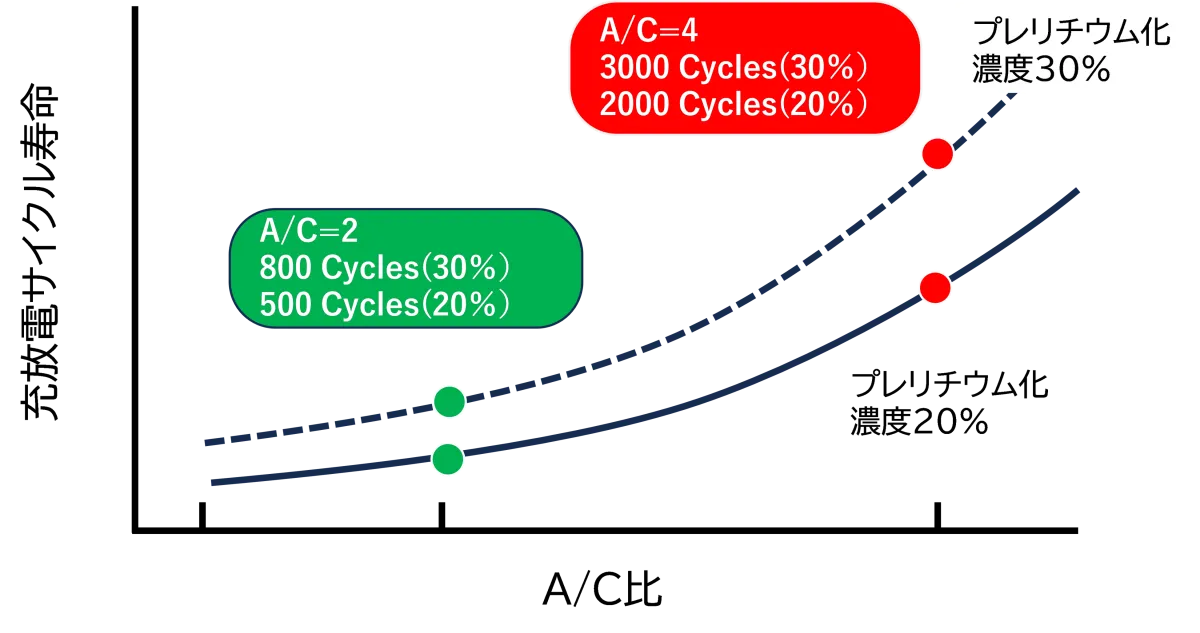
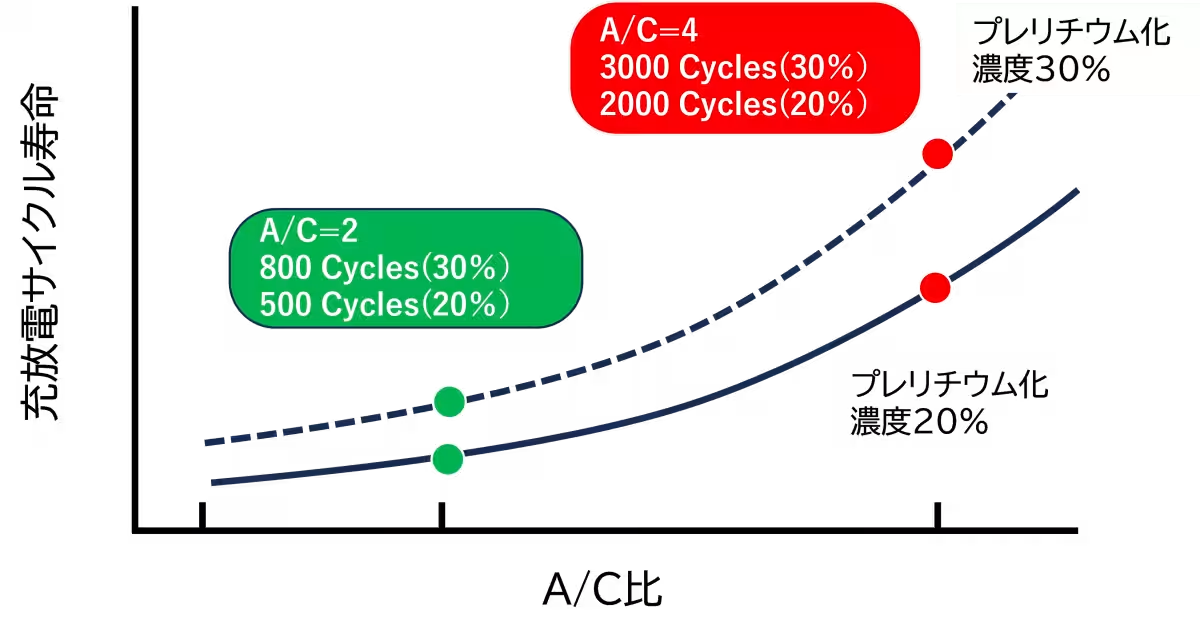
Typically, conventional anodes force the A/C ratio to be around one due to irreversible capacity issues. However, with irreversible capacity eliminated, ORLIB's technology allows for A/C ratios to be expanded between 2 and 4 while maintaining effectively available cathode capacity.
Patent Details: High-Energy LFP Batteries
The recently disclosed patents specifically focus on the practical configuration of:
- - Cathode: Lithium iron phosphate (LFP)
- - Anode: Prelithiated silicon-based active material
- - A/C Ratio: 1.5 or higher
This unique combination is poised to enhance the energy density of LFP batteries significantly, promising high performance and safety at lower costs, marking a substantial advancement for applications in electric vehicles (EVs) and energy storage systems.
Cycle Life Improvements
The integration of prelithiated silicon technology substantially boosts the charging/discharging cycle life. The following performance outcomes can be anticipated:
- - A/C Ratio of 2: 500 to 800 cycles
- - A/C Ratio of 4: 2000 to 3000 cycles (until discharge capacity declines to 80% of its initial state)
Societal Implications: Performance, Cost-Effectiveness, and Safety
Silicon offers a lower material cost alternative to graphite. The LFP/prelithiated silicon batteries achieve a remarkable energy density comparable to cobalt-based batteries while being more cost-effective. This innovation promises to contribute to:
- - The widespread adoption of electric vehicles
- - The expansion of renewable energy integration
- - Alleviating global resource challenges
With patent applications submitted in major markets worldwide, including an anticipated release in China, ORLIB's technology is set to redefine energy storage solutions.
Patent Information
- - Japan: Patent No. 7792739
- - United States: US 2026/0171409 A1
- - Europe: EP 4734295 A1
Company Overview
ORLIB Corporation
Founded: May 15, 2020
Headquarters: 5-24-1 Hongo, Bunkyo-ku, Tokyo
CEO: Masaharu Sato
Business focus: Development and commercialization of high-energy secondary batteries to support a sustainable and abundant society.
Website: ORLIB Corporation
(1) Next-Generation Secondary Batteries: Refers to emerging battery technologies aiming to replace conventional lithium-ion batteries, including solid-state batteries and enhanced lithium-ion batteries.
(2) Prelithiation Technology: A technique where battery electrodes react with lithium prior to assembly, offering benefits in cycle life and internal resistance, albeit with challenges in control and time efficiency. ORLIB's technology stands out for its efficiency and ability to eliminate irreversible capacity uniformly in reduced timeframes.

Topics Consumer Technology)
【About Using Articles】
You can freely use the title and article content by linking to the page where the article is posted.
※ Images cannot be used.
【About Links】
Links are free to use.