



ABEJA and Murata Manufacturing Collaborate to Advance Physical AI for Automated Laboratory Operations
ABEJA and Murata Manufacturing Enhance Automation with Physical AI
In a significant step towards automating laboratory research activities, ABEJA, based in Minato-ku, Tokyo, has partnered with Murata Manufacturing from Nagaokakyo, Kyoto, to perform vital technology validations using Physical AI. The ultimate goal of this endeavor is to enable automation in research and experimental activities using advanced AI systems.
Integrating Human and AI
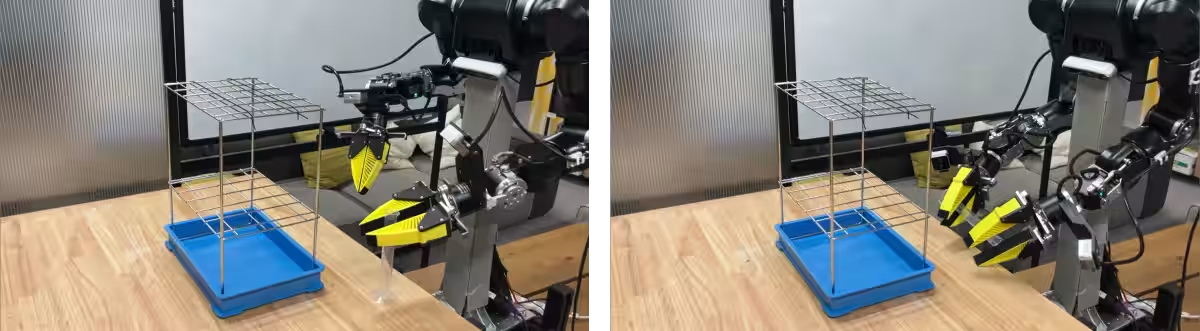
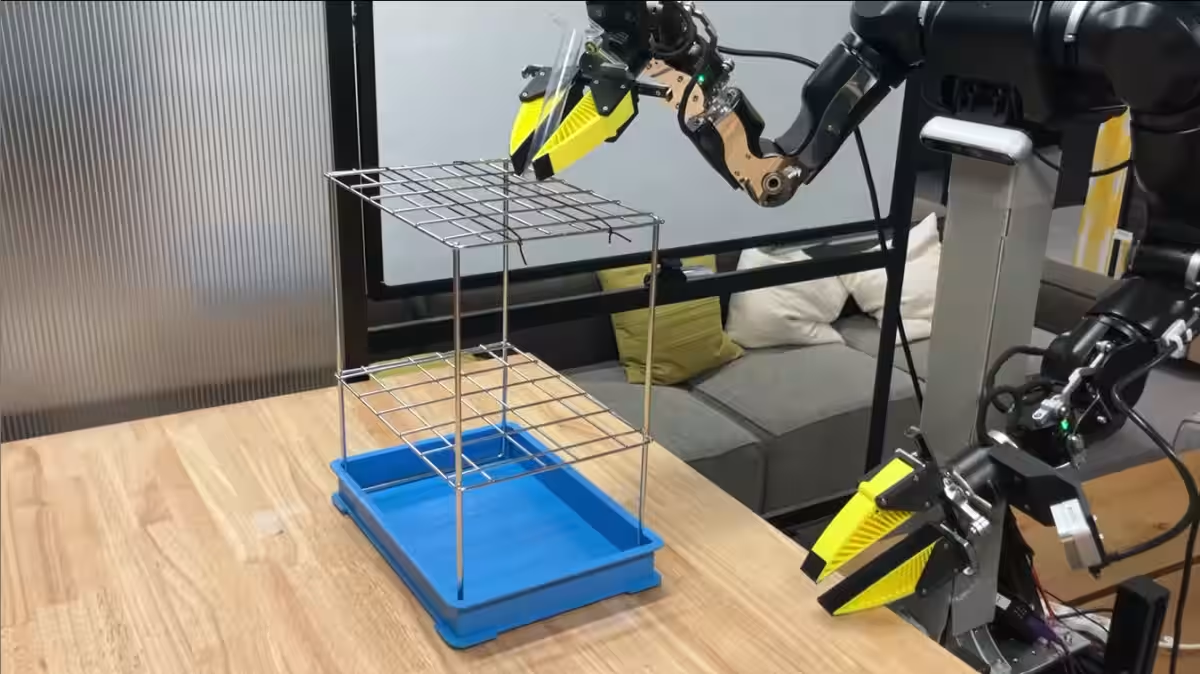
The collaboration emphasizes the importance of human-AI synergy, aligning with ABEJA's vision of "implementing a rich world." By focusing on technology that integrates vision, language, and actionable data (termed the VLA Model - Vision-Language-Action Model), the partners have successfully executed a series of complex actions involving dual-arm robots. This included the challenging operation of "part swapping" which has historically posed difficulty in robotics due to precision requirements.
In an age where labor shortages are a pressing issue across industries, the incorporation of high-autonomy robots represents a promising solution. Physical AI, which merges robotics and AI capabilities, is rapidly evolving globally, especially for its practical applications in manufacturing and logistics.
Practical Application of Physical AI Technology
The process commenced with ABEJA simulating the handling of experimental instruments, initially testing with a single robotic arm. Progressing through iterative cycles of data collection, learning, and inference, a dual-arm robot was eventually tested for more intricate tasks.
Dual-arm operations necessitate an exceptional degree of accuracy since even minor discrepancies between both arms can lead to significant operational errors. The robot had to perfectly synchronize the position, orientation, and timing of the item being transferred. High-level control technology was essential for executing these challenging maneuvers.
During the evaluations, the AI guiding the dual-arm robot received input from cameras mounted on the robot itself, allowing it to autonomously make inferences such as "grabbing the object with the left arm" and "transferring it to the right arm" before accurately adjusting the object for placement in a specified rack.
Overcoming Traditional Limitations of Industrial Robots
Typically, traditional industrial robots struggle with adaptability when the conditions for object position, orientation, and timing shift unexpectedly. In contrast, ABEJA's approach involved a dual-arm robot being remotely operated by a human, allowing it to learn from hundreds of demonstration data points. This training enables the robot to discern object states from camera feeds and perform learned actions fluidly.
The foundational model applied in this testing was NVIDIA's "GR00T N1.7," which not only supports commercial use but also excels at complex tasks such as small parts assembly and multi-stage inference capabilities. This allows for more human-like maneuvers within robotics, elevating the potential for real-world application.
Future Prospects
The tests carried out represent a crucial step in pushing the envelope for Physical AI applications in sophisticated dual-arm robotic interactions. Looking ahead, ABEJA remains committed to utilizing the ABEJA Platform to facilitate AI applications in mission-critical operations, driving transformation within the industrial landscape.
About ABEJA
Founded in 2012, ABEJA is dedicated to realizing the potential of AI in practical applications while ensuring continuous advancements in enterprise platforms. Their core offering, the ABEJA Platform, integrates human oversight and AI decision-making into operational frameworks, promoting effective data management and operational excellence in real-world settings. The company's headquarters is located in Bizflex Azabu-Juban, Minato-ku, Tokyo.
For more information, visit ABEJA's official website.
Topics Consumer Technology)
【About Using Articles】
You can freely use the title and article content by linking to the page where the article is posted.
※ Images cannot be used.
【About Links】
Links are free to use.