



Uchida Yoko Unveils Next-Gen CBT Platform 'TAO' Globally
Introduction
Uchida Yoko, a leading name in educational technology, has launched its next-generation Computer-Based Testing (CBT) platform, 'TAO', in collaboration with Open Assessment Technologies S.A. (OAT), based in Luxembourg. This full lineup was unveiled in Japan before its global release. The initiative comes at a time when educational methodologies powered by data are increasingly sought after, facilitating a smooth transition from traditional paper assessments to digital formats.
Background and Development
In recent times, there has been a rapid shift towards CBT within educational assessments, necessitating a robust cloud platform capable of accommodating a diverse range of participants and simultaneous access from numerous devices. Hence, the collaboration between Uchida Yoko and OAT has focused on developing a state-of-the-art CBT infrastructure.
'TAO' is rooted in open-standard technology and has been progressive since its inception in 2002. With ongoing research and implementation, it achieved significant adoption in major countries, handling assessments for around 30 million users annually. The platform's global standardization as a CBT solution has been affirmed via its deployment in critical educational surveys in countries like France, Italy, the UK, and the USA.
In Japan, Uchida Yoko has partnered with OAT since 2016, working on enhancing the CBT environment. In 2020, 'TAO' was integrated into the Ministry of Education's CBT system, MEXCBT, further solidifying its role in the educational landscape.
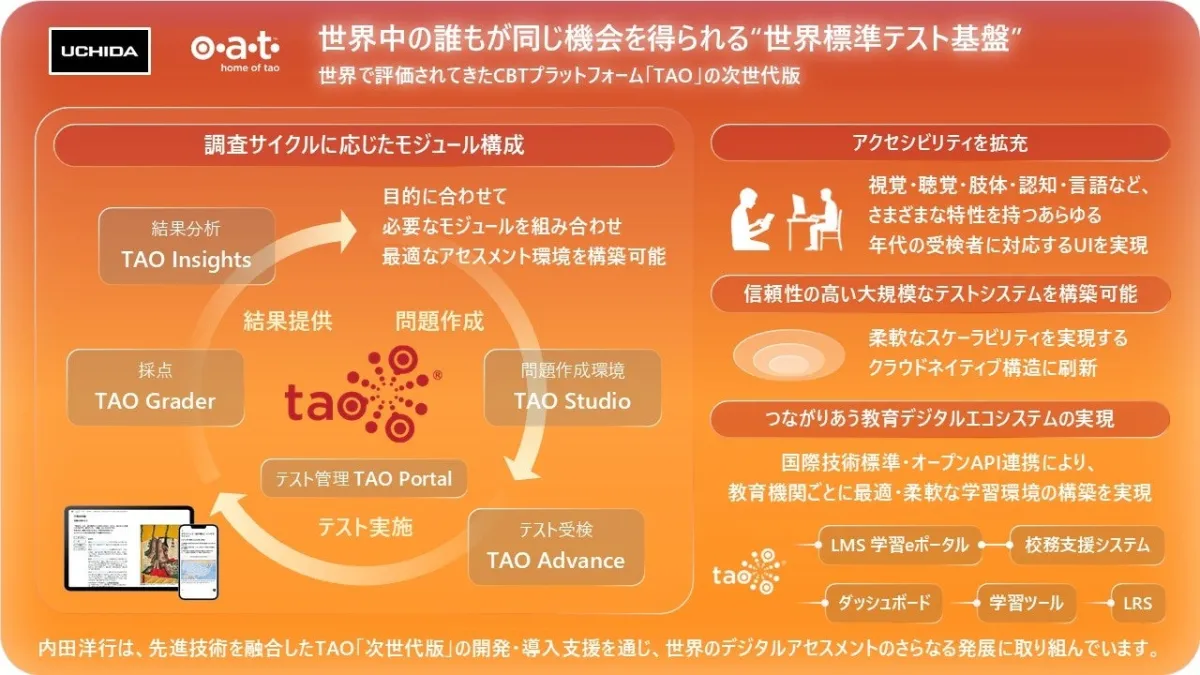
Features of the Next-Gen TAO
This next-generation 'TAO' maintains the original ethos and reliability while developing a platform that allows learners from various backgrounds to be evaluated on equal footing, regardless of location, language, or circumstance. With growing demands for more robust features due to technological advancements, Uchida Yoko and OAT are prepared to face challenges posed by larger-scale assessments, enhanced accessibility, and a more integrated digital education ecosystem. Notably, OAT is now part of Uchida Yoko's group as of 2023 to streamline the development process.
The OECD's Programme for International Student Assessment (PISA) utilized the next-gen 'TAO' platform during its 2025 testing, demonstrating its efficacy across 106 countries. The continuous global propagation of 'TAO' aims to ensure all learners have fair access to examination opportunities.
Evolution and Adoption
The TAO platform's evolution began with the Luxembourg Institute of Science and Technology and the University of Luxembourg in 2002 when it was conceptualized as a common CBT foundation funded by governmental initiatives. It has garnered widespread attention among researchers and educational institutions leading to its adoption in the OECD PISA survey in 2009. Eventually, the founding of OAT in 2013 represented a pivotal step not only for the platform but also for large-scale academic assessments in various countries.
In Japan, Uchida Yoko recognized the potential of 'TAO' since 2016, and since then, it has been incorporated into multiple educational assessments, including the significant nationwide learning situation surveys. By 2025, the infrastructure is anticipated to be utilized by over one million students within Japan's educational framework.
Key Attributes of Next-Gen TAO
The next-gen 'TAO' is fundamentally designed to adapt to diverse educational settings. Its accessibility features ensure equitable testing experiences for all students with enhancements systematically integrated into the overall architecture. It operates on a modular platform, enabling customization based on individual needs.
1. Accessibility: The platform complies with international web accessibility standards, catering to students with varying needs including visual, auditory, and physical disabilities. It assures equal opportunities for participation through a multilingual interface designed for users around the globe.
2. Cloud-Native Structure: A cloud-native infrastructure now allows for automatic resource scaling during high-traffic periods, ensuring stable performance even during mass assessments.
3. Integration Flexibility: TAO adheres to international standards, facilitating secure and adaptable integration with Learning Management Systems (LMS) and other educational tools, ensuring organizations can easily incorporate TAO into their existing systems.
4. User-Friendly Authoring Tools: The next-gen TAO allows educators to create diverse assessments featuring audio and video components, enabling a multifaceted evaluation of student capabilities.
5. Future Expansions: Planned enhancements for TAO include improved security features tailored for high-stakes exams and AI technologies for better question generation and assessment management.
Conclusion
Uchida Yoko's ongoing dedication to enhancing educational data use for improved learning outcomes, equity, and sustainable educational environments through the next-generation TAO platform is indicative of a significant shift in how assessments are conducted and standardized globally. The strategic alliance between Uchida Yoko and OAT is poised to redefine educational evaluation frameworks across the globe.

Topics Consumer Products & Retail)
【About Using Articles】
You can freely use the title and article content by linking to the page where the article is posted.
※ Images cannot be used.
【About Links】
Links are free to use.