



Spot Work Market Insights: Job Demand and Wages Surge in 2026
Spot Work Market Insights: Job Demand and Wages Surge in 2026
The Tuna Group Holdings, a consulting and recruitment outsourcing firm based in Chuo, Tokyo, has published its latest findings on the "spot work" sector through its research institution, Tuna Work Style Institute. This organization, which focuses on diverse working styles, has reported the latest data from the Spot Work Market Data Report for March 2026. Here’s what the research reveals about the evolving landscape of spot work opportunities in Japan:
1. Job Vacancy Rates Reached 4.33
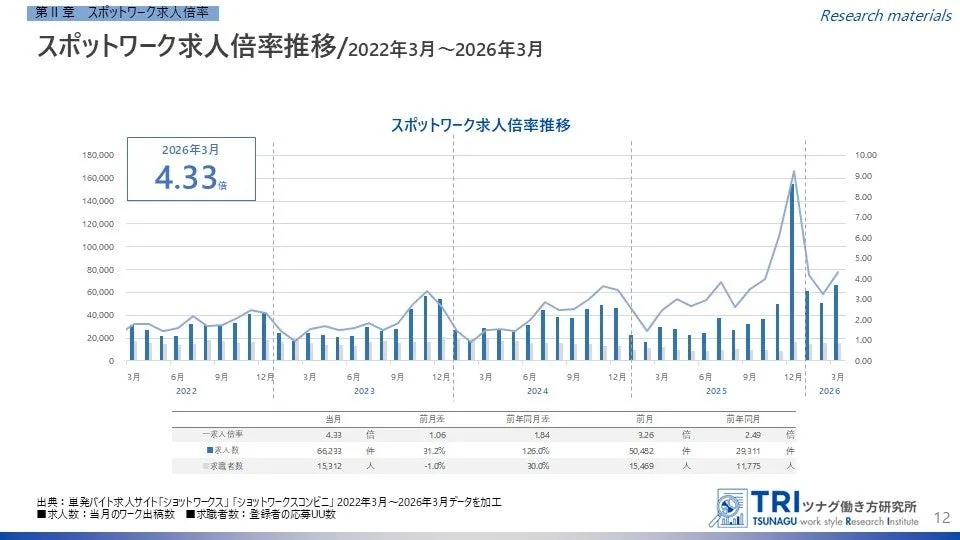
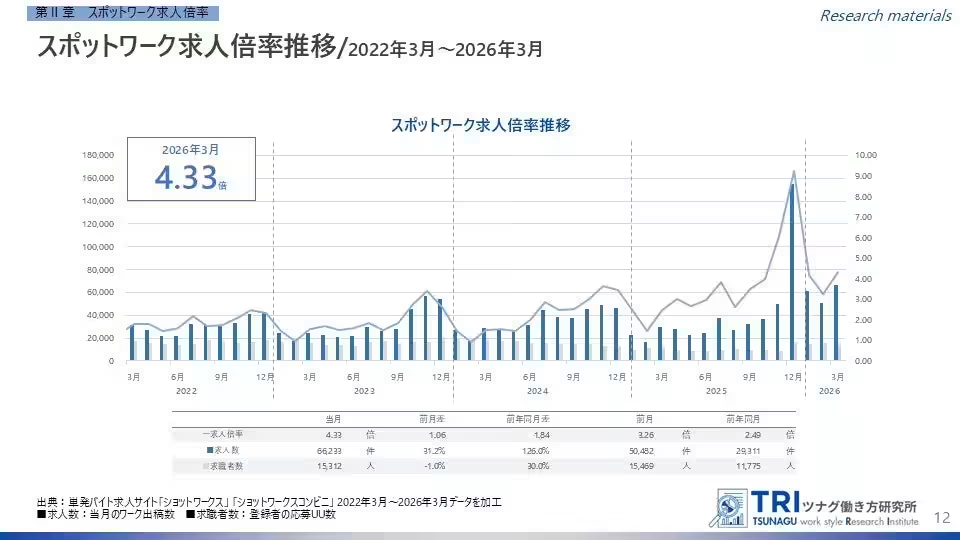
The job vacancy ratio for spot work positions stood at an impressive 4.33 in March 2026, reflecting a significant increase of 1.06 points from February and a rise of 1.84 points compared to the same month last year. This represents 22 consecutive months of growth in job vacancies within this sector, indicating a robust demand for short-term, flexible work arrangements.
2. Growth Rate of Work Opportunities
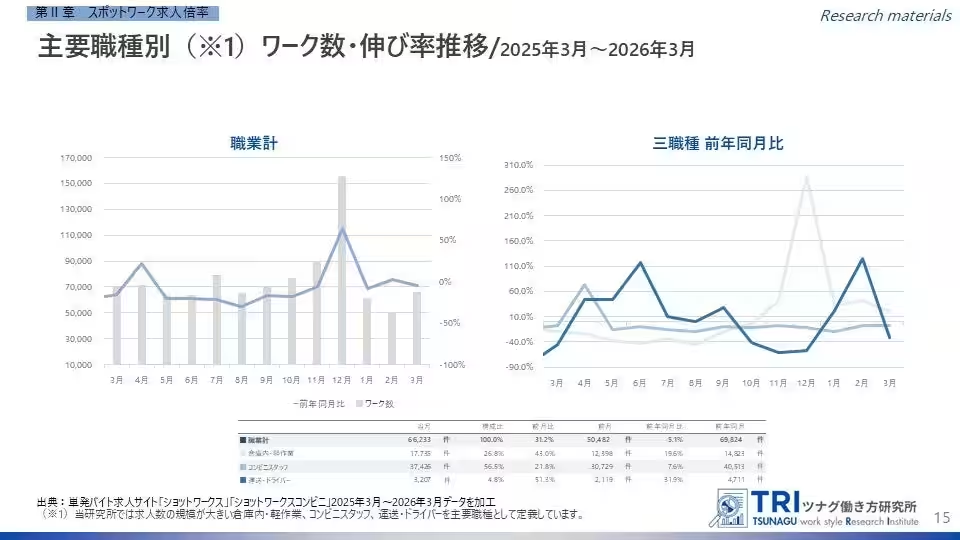
While the number of work opportunities saw a month-on-month increase of 31.2% in March, it fell by 5.1% compared to the same month in the previous year. Analysis of specific job categories reveals that the "warehouse and light work" sector experienced a staggering 43.0% increase month-on-month, while convenience store staff positions rose by 21.8% and transportation driver roles surged by 51.3%. However, in year-on-year terms, the convenience store staff roles dropped by 7.6%, and transportation driver roles experienced a notable decline of 31.9%.
3. Average Hourly Wage Trends
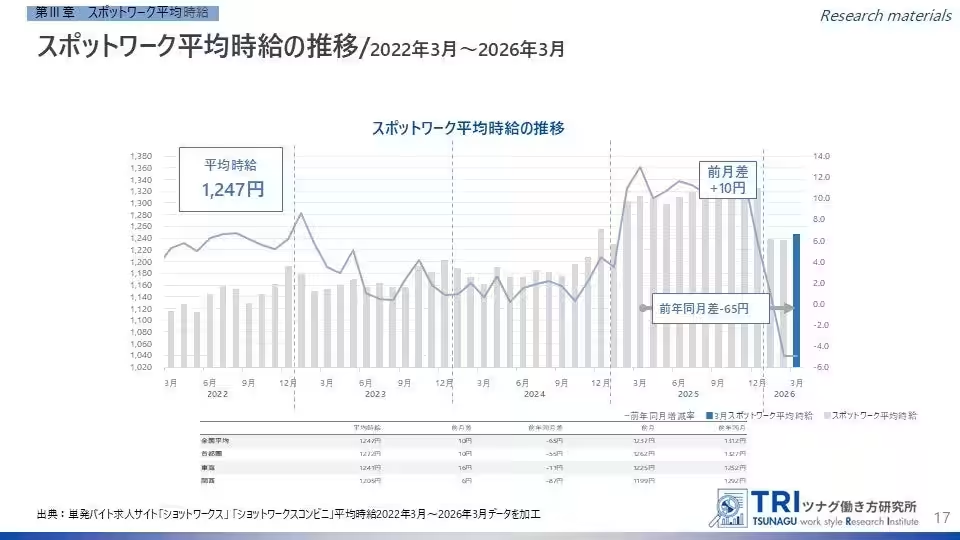
The average hourly wage for spot work in March was reported at 1,247 yen, reflecting a small increase of 10 yen from the previous month. Nonetheless, it signifies a decrease of 65 yen when compared to the same month last year, suggesting a cooling off from the high wage levels seen in 2025. Regionally speaking, the Kansai area experienced a larger drop in wages, while the Tokai region exhibited a more stable wage trend.
Implications of the Spot Work Market Report
Definition of Spot Work
Spot work encompasses short-term, isolated labor that does not establish ongoing employment relationships. It can be further categorized into gig work, which does not involve formal employment contracts, and short-term temporary jobs that do. Noteworthy examples of gig work include services such as Uber Eats delivery.
Current Market Dynamics
The surge in spot workers can be attributed to several factors:
Individual Factors: Reforms in work styles driven by overtime regulations and reductions in working hours due to COVID-19 have amplified the desire for additional employment among workers.
Corporate Factors: From a productivity standpoint, companies aim to optimize workforce management by employing the necessary number of people only when needed.
* Technological Factors: The entrance of job providers that offer timely and on-demand matches for spot work.
Importance of Ongoing Monitoring
The ongoing survey of the spot work market carries significant social implications. The Ministry of Internal Affairs and Communications' labor force statistics have integrated ILO standard indicators of "unused labor" since 2018. Individuals expressing a desire to work in addition to their current jobs may be considered broadly unemployed. By facilitating additional work opportunities, the spot work trend contributes to income stability and potentially lowers broad unemployment rates, thus enhancing national productivity.
About Tuna Work Style Institute
Established in 2015, Tuna Work Style Institute is dedicated to researching diverse work styles under the auspices of Tuna Group Holdings. Led by Director Hiroshi Ohno, the institute collaborates with experts in corporate human resources and labor law to interpret emerging labor regulations and offer recommendations for the future of employment.
In conclusion, the spot work market is on a powerful upward trajectory, revealing trends in job demand and wage fluctuations. As more individuals seek flexibility in their work, keen observations and further analysis will be necessary to navigate the evolving landscape of employment opportunities in Japan.

Topics General Business)
【About Using Articles】
You can freely use the title and article content by linking to the page where the article is posted.
※ Images cannot be used.
【About Links】
Links are free to use.