



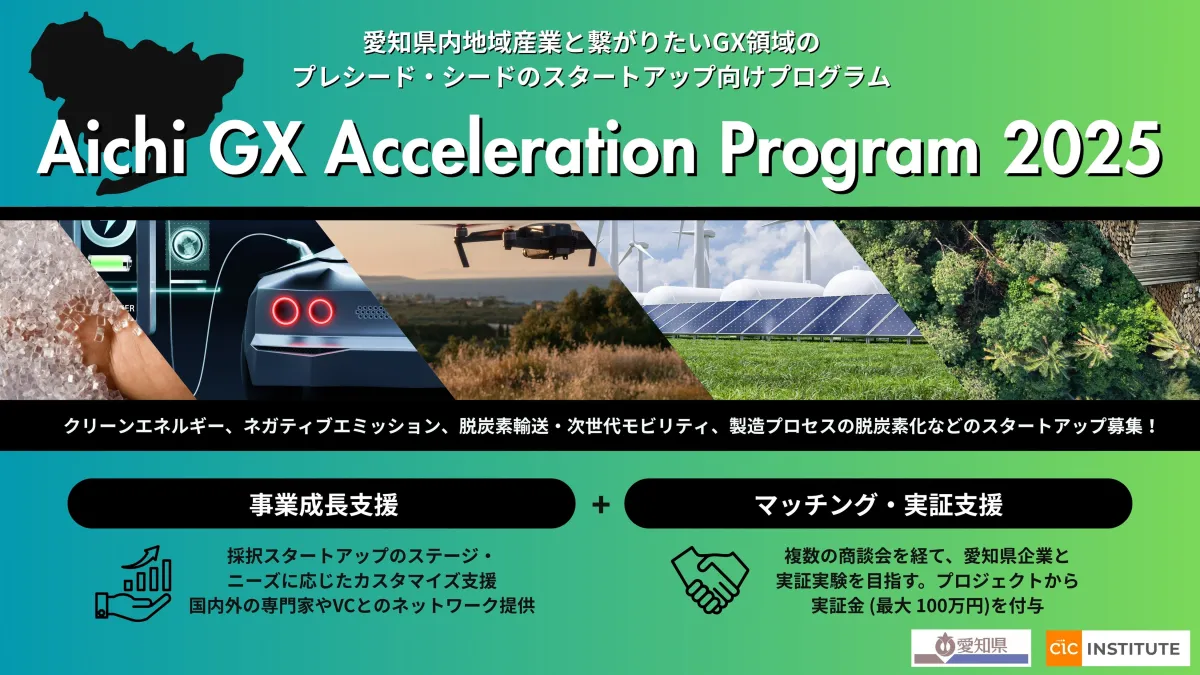
Five Startups Selected for the Aichi GX Acceleration Program 2025
Five Startups Selected for the Aichi GX Acceleration Program 2025
The Aichi GX Acceleration Program 2025, hosted by the Aichi Prefecture and operated by CIC Institute, has officially selected five startups for its upcoming program. This initiative focuses on fostering startups that integrate advanced manufacturing and green technologies, supporting their growth through expert mentorship and partnerships with local businesses in Aichi.
The Selected Startups
The chosen startups, with a focus on sustainable innovation, are as follows:
1. ESREE Energy, Inc.
This company is developing a Pumped Thermal Energy Storage (PTES) system utilizing natural refrigerants (CO₂). PTES technology makes it possible to generate and store heat and cooling efficiently by using surplus electricity to operate heat pumps. It allows for energy generation during peak demand periods by leveraging the temperature differences. Moreover, these thermal outputs can be used for industrial heating and climate control.
2. Komham Inc.
Utilizing their specially developed microbial strain known as “Komham,” this startup offers a rapid decomposition and resource recovery technology for organic waste, including food scraps. This bio-technology significantly reduces the traditional composting process from weeks to just one day, achieving decomposition rates of up to 98%. Their flagship product, the Smart Compost®, combines IoT and solar energy to create an independent waste processing solution, aiming to replace traditional incineration with a more sustainable composting option.
3. Comvey Inc.
Comvey introduces an innovative reusable packaging system called “Share Bag®,” specifically designed for e-commerce businesses. This solution allows consumers to choose between cardboard and Share Bags when shopping online, which can be conveniently returned via mail post. After cleaning, these bags are reused, resulting in reduced packaging waste and CO₂ emissions. This system not only alleviates packaging stress for users but also boosts loyalty and sales for e-commerce operators.
4. Three Lab Inc.
This startup applies laser processing technology developed by Nagoya Institute of Technology to revolutionize the re-sharpening process for cutting tools. Their approach aims to significantly reduce tool costs while enhancing environmental sustainability by increasing the rate of recycled tools. This innovative business model is set to transform Japan’s cutting tool market, fostering both economic and environmental advancements projected at an annual value creation of ¥200 billion.
5. Ripper Inc.
Ripper focuses on creating eco-friendly natural color tires that can replace traditional petroleum-derived carbon black. Their aim is to reduce CO₂ emissions during both the manufacturing and disposal phases while also limiting microplastic pollution from tire wear. This next-generation tire not only emphasizes design individuality but also embodies environmental stewardship.
Upcoming Events
The kickoff event for the program is scheduled for August 20, 2024, from 1:00 PM to 4:30 PM at STATIONAi in Nagoya. This event will feature pitches from the selected startups and matching sessions with local businesses, fostering essential partnerships for innovation.
About the Aichi GX Acceleration Program
The Aichi GX Acceleration Program aims to create an ecosystem for manufacturing-integrated startups by promoting open innovation and generating new industries through the synergy of top-level regional management resources and participating startups. As part of this initiative, the grand opening of STATION Ai, Japan’s largest startup support hub, will take place in October 2024. This facility will offer focused support for green and manufacturing sectors, aiming to nurture globally competitive startups and establish a thriving community for innovation.
About CIC Institute
CIC Institute collaborates with governments, local authorities, universities, and other stakeholders to build an innovation ecosystem that supports startups, especially those in deep tech. By executing numerous projects in conjunction with administrative and educational institutions, the institute contributes to economic growth through ecosystem development and innovation. They plan to continue expanding their initiatives in response to increasing demand from municipalities and private enterprises, facilitating innovation creation across the CIC network.






Topics Business Technology)
【About Using Articles】
You can freely use the title and article content by linking to the page where the article is posted.
※ Images cannot be used.
【About Links】
Links are free to use.